
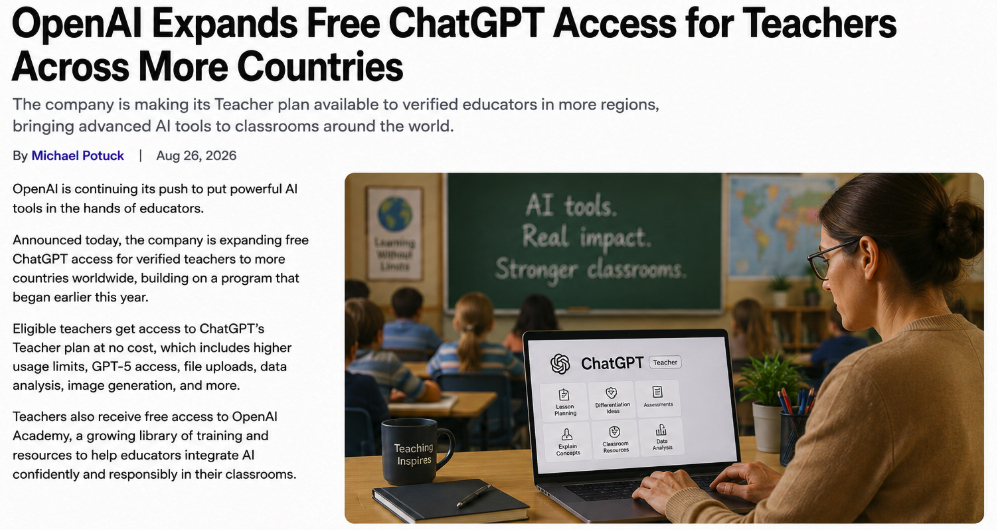
OpenAI is significantly expanding its push into U.S. education, bringing its free ChatGPT for Teachers program to dozens of additional school systems and putting generative AI tools in the hands of hundreds of thousands of educators and staff.
The latest expansion adds 55 school systems across 20 states and reaches more than 100,000 additional educators and staff. With the new cohort, OpenAI says it is now working with more than 100 K–12 organizations across 30 states, providing free ChatGPT access and training to more than 300,000 educators and staff.
The scale of the rollout illustrates how quickly artificial intelligence is moving from experimental classroom technology into institutional education infrastructure. The next phase of that transition, however, will depend not only on access to powerful models but also on privacy, training and how schools decide AI should fit into teaching.
ChatGPT for Teachers Will Remain Free Through June 2028
OpenAI first launched ChatGPT for Teachers in 2025. The company now says the service will remain free for verified U.S. K–12 educators through June 2028, giving schools a multi-year window to experiment with the technology without requiring individual teachers to pay for access.
That timeline matters because meaningful adoption in education can take longer than consumer technology adoption. School systems need time to develop policies, train staff, evaluate privacy requirements and determine which classroom uses actually improve learning.
Free access lowers one of the most obvious barriers. Instead of limiting advanced AI tools to teachers or districts with dedicated technology budgets, OpenAI can expose a much broader group of educators to the platform.
A New Privacy Agreement Covers 16 States
The expansion is accompanied by a new data privacy agreement spanning 16 states. OpenAI describes it as a common framework designed to help districts evaluate ChatGPT for Teachers against student-data privacy requirements.
Privacy is particularly important in K–12 environments, where schools handle sensitive information about minors and must navigate both legal requirements and parental expectations. A fragmented set of district-by-district reviews can slow technology adoption substantially.
A shared framework could make those evaluations more consistent, although individual districts will still need to determine how AI tools fit their own policies and obligations.
OpenAI also emphasizes that ChatGPT for Teachers remains intended for administrators, faculty and educators rather than direct student access through this particular program. The company says its approach is based on the principle that AI should support learning rather than provide shortcuts, with educators retaining control over how the technology influences classroom experiences.
The Real Opportunity Is Teacher Productivity
Much of the debate about generative AI in education initially focused on students using chatbots to write essays or complete homework. Teacher-focused AI programs shift the discussion toward a different set of use cases.
Educators can use generative AI to brainstorm lesson plans, create examples at different difficulty levels, prepare quizzes, summarize material, adapt explanations for different learners and reduce repetitive administrative work.
The potential value is not simply producing content faster. If AI can reduce the amount of time teachers spend on routine preparation, it could give them more time for direct instruction, feedback and individual student support.
That promise will depend on teachers understanding both what the technology does well and where it can fail. AI-generated educational material still needs review for factual accuracy, appropriateness and alignment with curriculum requirements.
Training May Matter as Much as Free Access
OpenAI’s announcement is notable because it combines access with training. The company says the broader initiative includes helping educators learn how to use ChatGPT rather than simply distributing accounts.
That distinction could prove critical. Giving teachers an AI tool without guidance can produce inconsistent results: some educators may develop sophisticated workflows while others avoid the technology entirely or use it in ways that do not meaningfully improve teaching.
Professional development can help schools establish shared practices around verification, privacy, responsible prompting and the appropriate role of AI-generated material.
As AI becomes a standard workplace technology, educators may also need to teach students how to work with these systems critically. Teachers who understand AI themselves will be better positioned to explain its strengths, limitations and risks.
Competition for the Education Market Is Increasing
OpenAI is not alone in targeting educators. Anthropic launched its own Claude for Teachers initiative in July 2026, offering eligible U.S. K–12 educators a year of access to premium Claude features and education-focused tools.
The competition suggests that schools are becoming an important strategic market for AI companies. Teachers who become comfortable with a particular platform may influence how students, administrators and institutions perceive that technology over time.
Education also provides AI companies with an opportunity to demonstrate that generative models can be used for more than automation. The strongest classroom applications are likely to focus on supporting teachers, adapting learning materials and helping students develop understanding rather than simply generating final answers.
AI Is Becoming Part of School Infrastructure
Reaching more than 300,000 educators and staff does not mean every classroom will immediately transform. Adoption will vary widely among states, districts and individual teachers.
But the scale of OpenAI’s expansion shows that generative AI in education is moving beyond isolated pilots. School systems are increasingly being asked to develop policies and workflows for technology that is likely to remain part of the educational environment.
The most important question is therefore shifting. It is no longer simply whether teachers should use AI. It is how schools can integrate it while preserving privacy, academic standards and meaningful human instruction.
By keeping ChatGPT for Teachers free through June 2028 and expanding both institutional participation and privacy frameworks, OpenAI is betting that familiarity will drive adoption. If that strategy succeeds, AI assistants could become as routine in lesson preparation as search engines, presentation software and learning-management systems are today.
The technology may be moving quickly, but the success of AI in education will ultimately depend on something much more traditional: whether it helps teachers teach and students learn.