
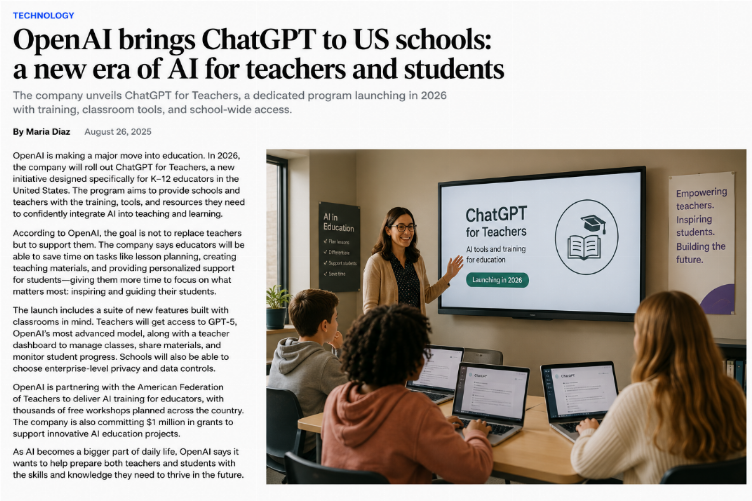
OpenAI is accelerating its push into American education, positioning ChatGPT not simply as a tool students might use outside the classroom but as an increasingly formal part of the infrastructure teachers and school districts use every day. The company’s education strategy is taking shape around ChatGPT for Teachers, a dedicated version of its AI assistant designed for verified U.S. K–12 educators and school staff.
The shift matters because the debate over artificial intelligence in schools has changed dramatically. Early conversations focused heavily on plagiarism, cheating and whether students should be allowed to use generative AI at all. Schools are now confronting a more complicated reality: AI is already part of students’ lives, and educators increasingly need practical ways to understand, manage and use the technology themselves.
ChatGPT moves from experiment to school infrastructure
ChatGPT for Teachers gives educators a dedicated workspace where they can use AI for lesson planning, adapting classroom materials, research, administrative work and collaboration. OpenAI says information shared in these workspaces is not used to train its models by default, an important distinction for schools handling student information and other sensitive educational material.
The product also gives school and district leaders administrative tools such as single sign-on, role-based access controls and domain management. Rather than leaving individual teachers to create unrelated personal accounts, districts can bring educators into a centrally managed environment designed around education-specific privacy and compliance requirements.
OpenAI currently offers ChatGPT for Teachers free to eligible verified U.S. K–12 educators for a limited period. The company has framed that access as a way to give teachers time to experiment with AI and develop their own understanding of how it can be useful before the technology becomes even more deeply embedded in education.
Teachers are becoming the center of the AI strategy
The teacher-first approach is significant. Instead of beginning with a product aimed directly at children, OpenAI is emphasizing educators as the people who should guide how AI enters the classroom. Teachers can use the system to create differentiated materials, brainstorm lesson structures, prepare presentations, analyze information and collaborate with colleagues.
That strategy also reflects a practical challenge for the education sector. Students have adopted generative AI rapidly, but teacher training has often struggled to keep pace. Giving educators access to the same class of tools their students encounter can help schools move beyond blanket bans and toward more informed policies about when AI is appropriate, when it is not and how its outputs should be evaluated.
OpenAI has been working with U.S. school districts to learn how the product performs at scale. Its initial district cohort represents a large number of teachers and staff and includes school systems in states such as California, Texas, Virginia, Georgia, Florida, New Jersey, Illinois and Iowa. The company has said feedback from these deployments is helping shape future improvements.
AI tools are becoming more capable
The education push is happening at the same time that ChatGPT itself is evolving beyond a conventional question-and-answer chatbot. In August 2026, OpenAI introduced new education-focused plugins for ChatGPT Work and Codex, including tools designed for K–12 teachers, college educators and college students.
These systems are intended to help users carry out more complex, multi-step workflows using course materials and institutional context. For teachers, that could mean AI becoming less of a standalone writing assistant and more of a workspace capable of supporting recurring tasks across lesson preparation, curriculum organization, research and administrative processes.
That evolution could make AI substantially more useful to schools, but it also raises the stakes. The more deeply AI systems are connected to classroom materials and institutional workflows, the more important privacy, accuracy, transparency and human oversight become.
Schools still face difficult questions
Giving teachers better AI tools does not resolve the broader debate about artificial intelligence in education. Generative models can produce inaccurate information, reinforce errors and encourage overreliance if their outputs are accepted without scrutiny. Educators must also decide which activities should remain deliberately human, particularly when the goal is to develop a student’s own reasoning, writing or problem-solving abilities.
There is also a fundamental difference between using AI to reduce repetitive administrative work and using it to replace intellectual effort. A teacher who uses ChatGPT to reorganize a lesson plan or generate several versions of an exercise is making a different educational choice from a student who asks an AI system to complete an assignment.
Schools will therefore need policies that are more sophisticated than simply allowing or banning ChatGPT. They will need to define appropriate use by age, subject and task, train teachers to recognize the limitations of model outputs and help students understand why verification and independent thinking still matter.
Preparing students for a world where AI is normal
OpenAI’s broader education strategy suggests the company sees AI literacy as an increasingly important part of preparing young people for work and higher education. In a recent partnership focused on AI education, OpenAI argued that students need not only access to AI tools but also the ability to critically evaluate their outputs, understand their limitations and use them responsibly.
That may ultimately be the most consequential part of the company’s school strategy. The question is no longer whether students will encounter generative AI. Many already do. The challenge is whether schools can teach them to use it without weakening the skills education is supposed to develop.
By placing teachers at the center of its U.S. K–12 expansion, OpenAI is betting that educators can become the bridge between rapid technological adoption and responsible classroom practice. If that approach works, ChatGPT could evolve from a controversial outside tool into a routine part of teachers’ professional environment. But its long-term value will depend less on how much work AI can automate than on how effectively schools preserve human judgment, curiosity and critical thinking while using it.