
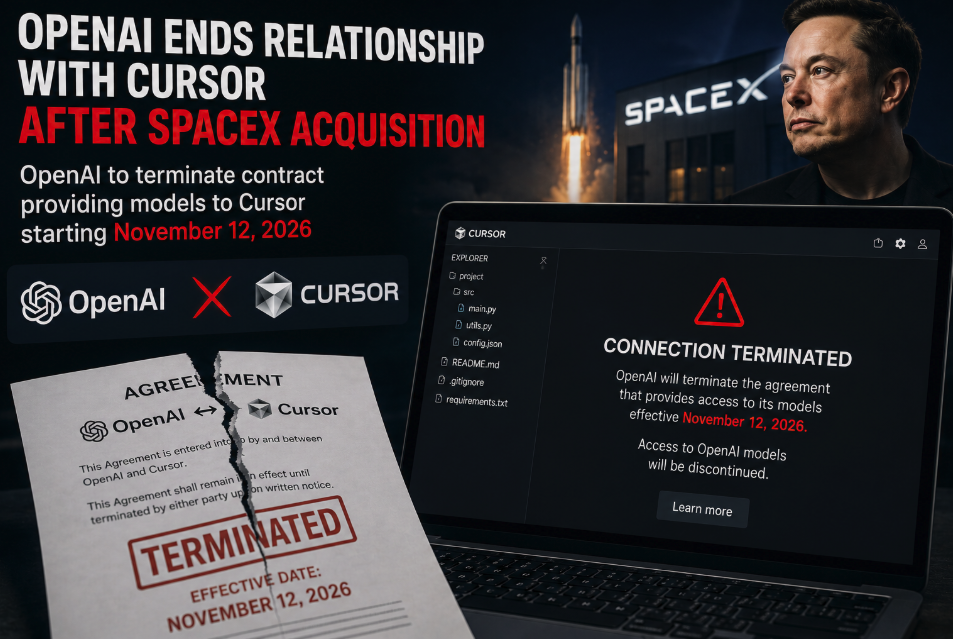
OpenAI’s decision to wind down its model-supply agreement with Cursor after the coding platform’s acquisition by SpaceX is becoming more than another chapter in the long-running conflict between OpenAI and Elon Musk. It is also a warning about the structure of the AI software market: applications that present themselves as neutral interfaces to many frontier models may remain neutral only as long as their ownership does not collide with the strategic interests, contracts and trust requirements of the companies supplying those models.
A Times of India report published August 29 highlights how explicitly OpenAI has tied the move to Musk. OpenAI notified SpaceX that it intends to wind down the contract providing OpenAI models to Cursor and has proposed November 12, 2026 as the shutoff date. The company says the acquisition activated a limited change-of-control cancellation window and that its past experience with Musk-controlled companies leaves it unable to trust that SpaceX will use OpenAI technology within its terms.
The commercial disagreement is significant on its own. The deeper story is what it says about the supposedly interchangeable model layer underneath modern AI products. Cursor became one of the defining AI coding tools partly by allowing developers to work across different models inside a single environment. SpaceX’s ownership now demonstrates that access to those models is not simply a technical feature. It is a relationship that can disappear when corporate control changes.
OpenAI is unusually explicit about why it is leaving
OpenAI did not frame the cancellation as a disagreement over pricing, performance or infrastructure. In its official August 28 statement, the company said it cannot be confident SpaceX will comply with its terms of service because of its experience with Musk’s other companies. OpenAI cited what it says was a contract violation by Twitter after Musk acquired the platform and sworn testimony concerning xAI’s violation of OpenAI terms.
Those are OpenAI’s allegations and rationale for invoking the contract provision; they should not be read as evidence that Cursor itself violated its previous agreement. OpenAI in fact praised Cursor’s team and said it had worked with the company for nearly four years. The trigger was the change in ownership and OpenAI’s assessment of the organization now controlling the application.
That distinction makes the episode more consequential for the wider developer ecosystem. A software company can apparently maintain a productive relationship with a model provider for years and still see that relationship reassessed almost immediately when ownership changes. Frontier-model access is therefore partly an asset of the company and partly a revocable dependency on the supplier’s willingness to continue the relationship.
November 12 remains a proposed date, not a final cutoff
Some coverage has presented November 12 as the date on which OpenAI models definitively disappear from Cursor, but OpenAI’s own documentation is more careful. Its updated Cursor support page says the company has proposed a transition period ending November 12, 2026. During that period, OpenAI would continue providing the models Cursor currently uses, although Cursor could choose to end access sooner.
OpenAI says the official termination date will be shared once it is confirmed between the companies. That makes November 12 the current target rather than an immutable deadline. OpenAI has nevertheless drawn a firmer boundary around future technology: it says it will not provide upcoming models to Cursor during the wind-down.
The company specifically mentioned its forthcoming Astra model when explaining the higher level of accountability it believes is required as capabilities advance. The implication is that access to the newest models will increasingly be governed not only by API compatibility and commercial demand but by provider-specific judgments about who controls the application, how the model is deployed and whether contractual safeguards are credible.
Cursor’s new owner is also building competing models
Cursor’s acquisition changes the competitive geometry because SpaceX is not a passive software conglomerate. Cursor announced on August 14 that it had officially become part of SpaceX, completing an acquisition process that began after the companies partnered on model training in April. Cursor said the combination would give it access to an enormous GPU fleet and allow it to build stronger models at lower operating cost.
The company pointed to Grok 4.6 as an early example of what the combined organization could produce. That means Cursor is no longer merely an application distributing models from competing laboratories. It sits inside an organization that has its own model-development ambitions and the compute infrastructure to pursue them aggressively.
From OpenAI’s perspective, the contractual trust issue is the stated reason for ending the agreement. From an industry perspective, however, the acquisition also illustrates a broader vertical-integration trend. The model provider, compute provider and application layer are increasingly being assembled into competing stacks. When that happens, a neutral application layer becomes much harder to sustain.
The immediate technical damage may be smaller than the strategic signal
The Times of India reports that Cursor co-founder Michael Truell said OpenAI models account for roughly 5% of Cursor user traffic. If that figure accurately reflects current usage, losing the direct OpenAI relationship would not remove the models responsible for most activity on the platform. Cursor has also been developing and promoting its own model capabilities alongside access to external systems.
Developers who specifically want OpenAI inside Cursor are not necessarily locked out either. OpenAI says users can bring their own OpenAI API key for supported local Chat and Agent features, run the Codex IDE extension inside Cursor or connect through a compatible AI gateway provider. The commercial integration can disappear while technical routes to OpenAI models remain available.
This is a useful distinction because it shows that model access has several layers. There is direct platform integration, individual API access, third-party gateways and provider-owned extensions. Losing one layer can make a product less seamless without making the underlying model completely inaccessible.
The real risk is dependency hidden behind a model picker
Multi-model AI applications often make model choice look almost trivial. A dropdown menu lets a user switch from one provider to another, creating the impression that foundation models are interchangeable utilities behind a stable interface. The OpenAI-Cursor dispute reveals how much contractual infrastructure sits behind that simple selector.
A model option can depend on negotiated pricing, capacity commitments, safety controls, usage restrictions, change-of-control clauses and the strategic relationship between two companies. None of those dependencies are visible when a developer selects a model inside an editor. Yet any one of them can determine whether that model remains available six months later.
For enterprise buyers, this should change how AI coding platforms are evaluated. Model breadth is valuable, but the durability of that breadth matters too. Organizations may increasingly need to ask whether an application has direct contractual access, whether users can bring their own API credentials, how quickly the platform can substitute another provider and what happens if ownership or competitive relationships change.
Anthropic’s response shows how quickly suppliers can reposition
The Times of India also reports that Anthropic moved quickly to emphasize its relationship with Cursor, with co-founder and chief compute officer Tom Brown saying the company would increase compute support for Claude models inside the editor. The timing illustrates another feature of the emerging AI market: one provider’s withdrawal can immediately become another provider’s distribution opportunity.
That dynamic may prevent any single supplier dispute from crippling a sufficiently diversified application. But it also makes the application layer a battleground among model companies. Providers are not simply selling intelligence as a commodity; they are competing for developer habits, usage volume and strategic placement inside the tools where software is increasingly written.
Cursor’s ability to replace OpenAI usage with Claude, Grok, its own models or other providers could make the short-term impact manageable. The long-term consequence may be greater pressure for AI applications to develop proprietary models or maintain redundant supplier relationships so that no external lab can become a single point of failure.
AI coding platforms are becoming strategic infrastructure
The Cursor episode matters because coding assistants are evolving from convenience tools into environments where developers delegate increasingly complex work to agents. As those agents become more capable, the model underneath them becomes part of a company’s software-production infrastructure. Sudden changes in model availability therefore matter more than they did when AI coding meant little more than autocomplete.
This creates incentives for vertical integration. SpaceX gains an AI-native coding interface and a direct route to developers while Cursor gains compute and model-development resources. OpenAI has Codex and its own developer ecosystem. Anthropic is strengthening Claude’s position in coding tools. The industry is moving toward stacks in which the companies building frontier models also want stronger control over the interfaces and workflows through which those models are consumed.
OpenAI’s breakup with Cursor is therefore not only a Musk-versus-OpenAI story, even though OpenAI has made Musk’s contract history central to its explanation. It is an early example of what happens when an ostensibly neutral AI application becomes part of a rival vertically integrated ecosystem. The model picker may still show several choices, but behind each choice is a commercial and strategic relationship that can change overnight.
For developers and companies building on AI coding platforms, the lesson is increasingly clear: model portability is not just a feature. It is risk management. November 12 may still move as OpenAI and Cursor finalize the transition, but the larger shift has already happened. Access to frontier intelligence is becoming inseparable from the ownership, contracts and competitive alliances surrounding the software that delivers it.