
The dominant advice in AI visibility has often sounded simple: get mentioned on Reddit, build a YouTube presence and make sure independent communities are talking about your brand. A new B2B citation study suggests that advice may be badly calibrated for one specific part of the buying journey.
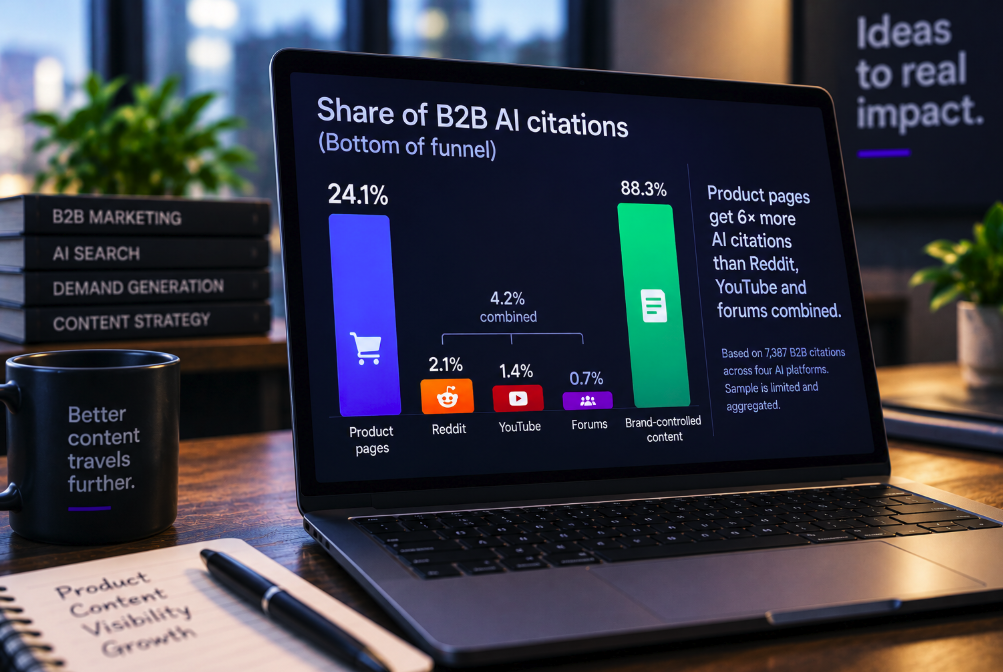
In Ten Speed's analysis of 7,387 AI citation appearances from evaluation-stage prompts, product pages captured 24.1% of citations. Community-driven sources — including Reddit, YouTube, forums and discussion threads — accounted for 4.2% combined. On the surface, that makes product pages almost six times as prominent as the community category when B2B buyers are comparing vendors, features and use cases.
The finding was examined in detail by Greg Jarboe in a September 4 Search Engine Journal analysis, which is particularly useful because Jarboe challenged Ten Speed on its methodology before repeating the headline. Several qualifications emerged from that process, and they are essential to interpreting the result correctly.
The study is not evidence that product pages universally beat Reddit across AI search. It is a directional snapshot of bottom-of-funnel B2B citation behavior across a limited client dataset, aggregated across four AI platforms that may behave very differently. Within that boundary, however, the result is significant enough to challenge the idea that third-party community content is always the primary route to AI visibility.
The dataset was built around buyers who were already evaluating products
Ten Speed's original study deliberately excluded broad informational questions. Instead of prompts such as “what is a CRM,” the researchers wrote queries that resemble a buyer further down the funnel: direct product comparisons, alternatives, feature questions, integration requirements, use cases and buying-intent prompts.
The final analysis covered 170 prompts and 7,387 citation appearances collected through Peec AI, which monitors linked sources surfaced by ChatGPT, Perplexity, Claude and Gemini. Ten Speed's sample came from its B2B SaaS and professional-services client base across sectors including fintech, physical security, hospitality and IT automation, with look-alike competitors added so the results would not contain only client-owned pages.
The word “appearances” matters. The 7,387 figure does not represent 7,387 unique URLs or independent brands. A source cited repeatedly across different responses contributes multiple times to the total. The study therefore measures citation volume within this prompt set, not the size of the underlying web corpus.
Product pages were the largest single citation category
Product pages led the dataset at 24.1% of all citation appearances. Articles, a category combining blog posts, news and PR, followed at 17.4%. Comparison pages accounted for 13.3%, listicles 13.2%, how-to guides 8.9% and homepages 7.8%.
Third-party profiles on services such as G2 and Capterra contributed another 7.2%. Ten Speed argues that these profiles are partly controllable because companies can often manage their descriptions, categories, feature information and integrations even though they do not own the platform itself.
The community side was much smaller in this particular dataset. Discussion pages represented 3.7% and video 0.5%. Ten Speed's broader grouping of Reddit, YouTube, forums and similar discussion sources reached 4.2% of citation volume.
That contrast produces the headline: product pages at 24.1% versus community-driven sources at 4.2%. Numerically, product pages appeared about 5.7 times as often, which is reasonably summarized as roughly six to one.
The 88.3% figure is even more striking — and needs careful definition
Ten Speed classifies product pages, articles, comparisons, listicles, how-to guides and homepages as brand-controllable content. Together, those formats represented 88.3% of citation volume in its evaluation-stage sample.
That does not mean 88.3% of all AI citations on the web come from brand-owned websites. It means that within this particular B2B, mid- to bottom-of-funnel dataset, most cited material belonged to page types that marketing teams can create or substantially control.
The distinction matters because citation behavior is strongly related to the question being asked. When a buyer asks how a named product handles a specific integration or compares with a competitor, a first-party product or comparison page may be one of the most direct sources available. When someone asks a broad awareness question or seeks personal experience, community sources may become more useful.
Ten Speed explicitly says its study was designed around the former situation, not the latter.
This does not invalidate Reddit or YouTube
The study is best read as a funnel-stage finding rather than a verdict on community marketing. Reddit may be valuable because it contains firsthand experience, criticism, troubleshooting and language that differs from corporate copy. YouTube can demonstrate products in ways a text page cannot. Those characteristics may matter much more for some prompt types than they did in Ten Speed's evaluation set.
There is an additional nuance inside Ten Speed's own data. Although Reddit contributed a modest share of total citation volume, the Reddit threads that did appear were cited relatively aggressively on a per-URL basis. In other words, Reddit was not broadly present, but individual threads could become influential once an AI system selected them.
That is a different pattern from saying Reddit is irrelevant. It suggests that community content may have lower coverage in this dataset but high value in particular questions.
The same caution applies to YouTube. A roughly 1% presence reported in the study does not establish that video is generally unimportant to AI systems. It establishes that video was uncommon in this set of B2B evaluation citations at this point in time.
Search Engine Journal found important methodological limits
Jarboe's fact-check surfaced several issues that make the study more useful when acknowledged rather than less useful. One published chart initially listed 220 prompts even though the rest of the analysis used 170. Ten Speed confirmed to Search Engine Journal that 170 was the correct figure and said the visual would be corrected.
The number of distinct client brands behind the dataset is also undisclosed. Ten Speed said releasing even a range alongside the named verticals could risk identifying clients in a relatively small confidential base. That is understandable commercially, but it prevents outside researchers from assessing how concentrated the sample is.
Most importantly, the dataset does not contain a clean platform-level breakdown. Citations from ChatGPT, Perplexity, Claude and Gemini were aggregated together. That is a substantial limitation because the four systems have different retrieval architectures, source preferences, product designs and citation behaviors.
A 24.1% product-page average could conceal a much higher share on one platform and a much lower share on another. The same is true for Reddit, YouTube and every other source type.
The headline split was descriptive, not a universal statistical result
Search Engine Journal also asked whether the 24% versus 4% contrast had been statistically tested. Ten Speed said that specific headline split was descriptive. The study used nonparametric statistical tests for other comparisons across page types, but not to establish the product-page-versus-community ratio as a universal effect.
This is an important difference between observing a pattern and proving that the pattern generalizes beyond the sample. The data clearly contains more product-page citation appearances than community citation appearances. What it cannot establish is that another set of companies, prompts, industries or AI platforms would reproduce the same ratio.
Ten Speed itself frames the research as practitioner intelligence rather than a definitive industry benchmark. The study is not peer reviewed, the client base is not a random sample of B2B companies, and the results come from a single point-in-time export.
Those limitations should travel with the percentages whenever they are repeated.
Other citation research already produces different source mixes
The need for caution becomes clearer when this dataset is compared with other AI citation studies. A separate 2026 B2B SaaS benchmark from LoudFace analyzed 160,240 citations across five brands and reported that company websites collectively captured about half of citations while Reddit emerged as the single most-cited individual domain, driven heavily by ChatGPT.
Another study reported by Search Engine Land in March analyzed more than one million citations across 75,000 AI answers and found listicles leading overall at 21.9%, articles at 16.7% and product pages at 13.7%. That study covered a different prompt mix and platform set.
These findings do not necessarily contradict Ten Speed. They demonstrate why citation percentages cannot be detached from methodology. Change the buyer intent, brands, verticals, models, time period or classification system and the source distribution can change substantially.
The right question is therefore not “which study is correct?” but “which study most closely resembles the decisions we are trying to understand?”
Bottom-of-funnel prompts naturally reward factual product information
Ten Speed's result is plausible because evaluation prompts often require details that first-party pages are designed to contain. A buyer asking whether a product supports a particular integration, how a feature works, what a service is designed for or how two vendors differ needs specific factual information.
A clear product page can answer those questions directly. It can define the product, list capabilities, describe target users and explain integrations in language that an AI retrieval system can extract.
This also helps explain why homepages appeared in 7.8% of citations. Ten Speed interprets the homepage as an entity-definition surface: when an AI system needs a baseline explanation of what a company is and what it sells, the company's primary page is often an obvious source.
For marketers, the implication is not that product pages need to become long AI-optimized encyclopedias. It is that vague positioning can create an information deficit. If the page never plainly says what the product does, who it serves and how it works, an AI system may need to reconstruct those facts elsewhere.
Comparison content appears unusually productive
Another useful finding is the performance of comparison queries. Comparison-format prompts represented 20% of the 170-prompt set — 34 prompts — but generated 1,970 of the 7,387 citations, or 26.7% of total citation volume.
Ten Speed describes that as a 1.33-times return relative to the format's share of prompts. This does not mean a comparison page is guaranteed to earn 33% more citations. It means comparison prompts in this sample generated a disproportionately large number of cited sources.
That makes sense structurally. Asking an AI assistant to compare two products can require evidence about features, pricing, integrations, positioning and use cases from several sources. The response may therefore contain more citations than a narrower question.
For B2B content teams, the strategic takeaway is stronger than “publish more X-versus-Y pages.” Comparison information should be accurate, specific and maintained because AI systems may use it when buyers are explicitly assembling shortlists.
Directory profiles deserve to be treated as structured content
The 7.2% share for third-party profiles is another reminder that owned versus earned is not always a clean distinction. Companies do not own G2, Capterra or similar directories, but they can often influence the factual layer of their profiles.
Categories, descriptions, integration lists and feature tags can provide highly structured information about a product. If those fields are stale or inaccurate, an AI system retrieving the directory page may reproduce an outdated representation of the company.
That makes directory maintenance part of AI visibility even when review scores are not the immediate concern. A profile can function simultaneously as third-party validation and as a structured description of the product.
Citation share is not traffic, pipeline or revenue
The most commercially important limitation may be the simplest: being cited is not the same as being clicked. It is certainly not the same as generating a demo request, opportunity or closed deal.
Ten Speed says it does not yet have data connecting these citation appearances to pipeline. That prevents the study from answering whether a product-page citation is more economically valuable than a Reddit citation, or whether either one changes purchase behavior.
An AI system could cite a product page while satisfying the user's question entirely inside the answer. A Reddit thread could be cited less frequently but exert more influence because it provides an independent customer perspective. Citation count alone cannot resolve those differences.
Marketers should therefore resist translating 24.1% citation share into 24.1% of AI-driven commercial value. The study measures source selection, not business outcomes.
The most actionable lesson is control, not a six-to-one formula
The strongest strategic implication is that B2B companies may have more influence over bottom-of-funnel AI citations than the current conversation sometimes implies. If 88.3% of citation appearances in this sample came from controllable content formats, improving first-party information is not merely a traditional SEO exercise.
Product pages can be made clearer. Comparison pages can be made more complete. Homepages can define the company explicitly. How-to content can answer product-specific questions. Directory profiles can be corrected. These are surfaces a marketing team can change without manufacturing community conversations or attempting to manipulate independent forums.
That does not mean every brand should redirect its community budget into product copy. It means the appropriate content investment depends on the prompt stage the company wants to influence.
For awareness questions, independent discussion may remain crucial. For evaluation questions, Ten Speed's data suggests that factual, controllable product information deserves more attention than it often receives in AEO and GEO strategies.
The next study needs platform-level data
Ten Speed identifies the missing platform breakdown as its biggest open question. That should be the next priority. An aggregate across ChatGPT, Perplexity, Claude and Gemini is useful for identifying a broad pattern, but marketers do not optimize for an abstract average AI engine.
If ChatGPT strongly favors community discussions while another platform heavily favors first-party product pages, the combined 24.1% and 4.2% figures could hide the most actionable finding. Platform-specific behavior would tell marketers whether a content strategy transfers across systems or needs to be adapted.
Repeated measurements over time would also matter. AI retrieval and citation behavior changes rapidly as models, search integrations and ranking systems are updated. A single snapshot cannot establish whether product pages are gaining or losing citation share.
The study is therefore most valuable as a hypothesis generator. It says that, in one B2B evaluation-stage dataset, the sources closest to the vendor were cited far more often than community sources. The next question is whether that pattern survives across platforms, industries and time.
Product pages won this sample, not the entire AI web
The headline is striking because it pushes against a popular narrative. Product pages captured 24.1% of citation appearances, while Reddit, YouTube, forums and related discussion sources combined for 4.2%. In this dataset, product pages beat the community category by nearly six to one.
But the denominator is as important as the percentage. The study covers 7,387 citation appearances from 170 hand-written, mid- to bottom-of-funnel prompts across a limited B2B SaaS and professional-services client base. It aggregates four AI platforms, does not disclose the number of client brands, and does not connect citations to clicks or revenue.
Those constraints do not erase the result. They tell us what the result actually means.
For B2B marketers, the practical message is not to abandon Reddit or YouTube. It is to stop assuming that AI visibility must be won somewhere outside the company's own site. When a buyer is asking concrete questions about a product, the clearest source may still be the page the company controls — provided that page contains clear, specific and retrievable information worth citing.