
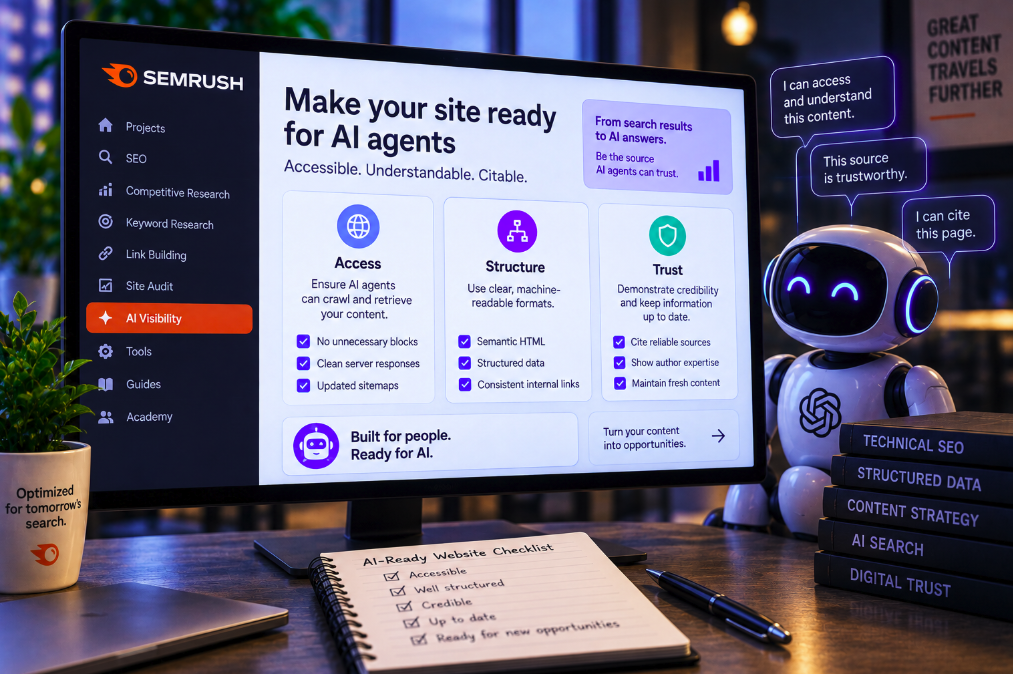
SEO for AI agents begins before an AI system evaluates whether a page deserves to be cited. The agent first has to reach the page, retrieve the important information without fighting the site’s rendering stack, understand what each section says and find enough independent evidence to trust the claims it may repeat to a user.
That is the practical framework behind Semrush’s September 2 guide to preparing websites for AI agents. Written by Carlos Silva, the guide argues that the emerging agentic web does not require businesses to discard technical SEO and start again. Instead, familiar foundations now have another audience: systems such as ChatGPT, Claude, Perplexity and Google’s AI experiences that can retrieve information, compare options and increasingly take actions on a user’s behalf.
AI visibility starts with knowing which bot is visiting
One of the most useful distinctions in Semrush’s guide is that “AI crawler” is too broad a label for making access decisions. Different bots can visit a website for different reasons. Some collect material for model training, others build retrieval indexes used to generate cited answers, and user-triggered fetchers may access a specific page because someone explicitly asked an assistant to read it.
Those purposes matter when configuring robots.txt. A publisher that wants to opt out of model training may decide to block a training crawler such as GPTBot while continuing to allow retrieval-oriented crawlers and user-triggered agents. Blocking everything associated with an AI company can have a very different consequence: the site may reduce the chance that its content can be discovered, retrieved or cited in that company’s live answers.
The correct policy therefore depends on the publisher’s objective. Training rights, search visibility and user-requested retrieval are separate decisions, even when the bots belong to the same AI provider. Treating them as one category can unintentionally trade away visibility when the original goal was only to limit training use.
If the content is inaccessible, every optimization after that is irrelevant
Semrush’s first principle is almost aggressively basic: an AI agent cannot cite information it cannot retrieve. That makes crawlability, server reliability and rendering architecture part of AI-search strategy rather than background technical maintenance.
The guide recommends putting essential content in the initial HTML instead of making it dependent on client-side JavaScript. AI systems do not all render pages with the same capabilities as a modern browser, and a page that appears complete to a human visitor can expose far less information to a lightweight crawler or retrieval system.
This is consistent with Semrush’s broader technical SEO guidance for search engines and AI search, which emphasizes semantic HTML, crawlable site architecture and accessible page structure. The old technical-SEO question was whether Googlebot could find and understand a page. The new question is whether multiple classes of machine visitors can do so reliably.
Fast and reliable delivery becomes part of citation eligibility
Performance also matters differently when the visitor is an automated system operating under time and resource constraints. A human may wait through a slow page if the information appears valuable enough. A crawler or live retrieval process can simply time out and move to another source.
Semrush cites analysis indicating that pages that frequently fail to load in time are cited far less often than reliably accessible pages. The exact citation multiplier should not be treated as a universal law across every AI platform, but the engineering logic is straightforward: unreliable retrieval reduces the number of opportunities a system has to evaluate and use the content.
For AI readiness, technical performance is therefore not only a user-experience metric. It can become a source-selection constraint. A page that is theoretically authoritative but frequently unavailable may lose to a slightly less impressive source that the agent can actually retrieve when the answer is being assembled.
Site architecture helps machines see expertise as a body of work
Once agents can reach the content, structure becomes the next problem. Semrush recommends familiar pillar-and-cluster architecture, descriptive internal links, current XML sitemaps and eliminating orphan pages. None of these tactics is new, but their value extends naturally into retrieval systems.
A coherent internal structure gives machines evidence about relationships between pages. A broad guide connected to focused supporting pages looks like a deliberate body of expertise rather than a collection of isolated URLs. Descriptive anchor text helps explain what lies at the other end of a link, while a current sitemap supplies a clean inventory of canonical content.
This does not mean an internal-linking template can manufacture topical authority. Architecture organizes evidence; it does not create expertise that is absent from the content. But when strong material already exists, good structure makes that expertise easier for both search engines and AI systems to discover and interpret.
AI-friendly writing is really extraction-friendly writing
Semrush’s content recommendations center on a simple retrieval reality: AI systems often need a specific passage, not an entire article. A page can be excellent as a complete reading experience while making its most useful facts difficult to isolate if every answer depends on several preceding paragraphs.
The guide recommends opening sections with complete, self-contained answers that directly address the heading. If a sentence were removed from the page, it should still identify the subject and make sense without forcing the system to reconstruct what “this,” “it” or “they” refers to.
This is close to the bottom-line-up-front approach long used in journalism, technical documentation and featured-snippet optimization. The benefit is not limited to machines. Readers scanning a long page can identify the answer quickly and continue into the explanation when they need more detail.
Chunking gives each passage one clear job
The same logic applies at section level. Semrush advises keeping headings focused on one question and avoiding paragraphs that mix several unrelated ideas. Retrieval systems can rank passages independently, so the strongest insight on a page is easier to reuse when it exists in a clearly bounded section.
That does not require reducing articles to a sequence of one-sentence blocks. Good editorial writing can still use substantial multi-sentence paragraphs and nuanced argument. The objective is conceptual clarity: one section should have a recognizable purpose, and its opening should make that purpose explicit.
Consistent terminology also helps. If a page describes the same product feature with three different labels, a retrieval system has to infer that they refer to the same concept. Human readers may enjoy stylistic variation; machine extraction often benefits from precision and stable naming.
Commercial pages need facts an agent can compare
Agentic search becomes particularly important when the system is not merely answering a factual question but helping a user make a decision. An agent comparing software vendors, products, hotels or professional services needs concrete attributes it can place side by side.
Semrush recommends making pricing, features, limitations, intended audience and availability explicit. “Industry-leading performance” is difficult to verify. A documented throughput figure, starting price, plan limitation or availability status gives the agent something specific to compare and gives the user something specific to evaluate.
This creates an uncomfortable implication for some marketing pages: ambiguity that once helped funnel prospects toward a sales conversation can become a competitive disadvantage when an AI agent is filtering vendors before the user visits any website. If one supplier publishes clear pricing and constraints while another requires interpretation or a sales call for basic facts, the first is easier for the agent to represent accurately.
Comparison pages need symmetry, not just persuasive copy
The same principle changes how comparison and alternative pages should be built. A useful “X versus Y” page should evaluate both options against consistent criteria rather than selecting a different set of attributes for each side. Alternatives pages should name competitors directly and support trade-off claims with verifiable facts.
For AI systems, this reduces inference. The more an agent has to deduce from vague marketing language, the greater the risk that it produces an incomplete or incorrect comparison. Clear tables, named features and explicit limitations make the decision surface more machine-readable without necessarily making it less useful to humans.
The best optimization here is accuracy rather than aggression. A page designed to manipulate an agent into selecting the brand while obscuring important limitations is vulnerable to contradiction from third-party sources. In an environment where systems can cross-check several websites, consistency becomes a competitive asset.
Trust increasingly depends on evidence outside your website
Semrush’s third foundation is trust. A company can make any claim on its own domain; an AI system deciding whether to repeat that claim has stronger evidence when independent sources agree with it. That makes off-site consistency, reputable mentions, reviews and links relevant to AI visibility as well as conventional SEO.
Basic business facts should match across the company’s website, directories, review platforms and social profiles. Conflicting addresses, pricing, opening hours or product details introduce uncertainty. An agent attempting to verify an answer may choose a different source when the evidence surrounding one brand is inconsistent.
Authority signals also include editorial mentions and backlinks from credible third parties. The goal is not simply accumulating link volume. It is creating an external information footprint that corroborates what the company says about itself.
Named authors and primary sources make claims easier to verify
Source transparency is another familiar editorial practice acquiring new importance. Semrush recommends real bylines, current author biographies and direct links to primary research or official documentation behind important claims. An unattributed statistic on an anonymous page gives a retrieval system less to verify than a claim connected to an identifiable author and original source.
Freshness matters for the same reason. A visible update date can help indicate whether a fast-changing page is current, but only if the content has genuinely been reviewed. Automatically changing a date without updating the underlying facts does not make stale information trustworthy.
For businesses, this suggests that editorial governance is becoming part of AI optimization. Maintaining pricing, specifications, author information and cited evidence is not merely housekeeping. It affects whether machines can confidently repeat what the page says.
Structured data is useful, but Semrush does not present it as an AI citation switch
The guide takes a notably cautious position on schema markup. Semrush recommends standard Schema.org types such as Article, Organization, BreadcrumbList and Product, preferably implemented in JSON-LD where appropriate. Those formats already have established uses in traditional search and can clarify structured facts about a page.
At the same time, Semrush notes that Google says no special structured data is required for AI Overviews or AI Mode, while evidence about whether ChatGPT, Claude or Perplexity directly use schema when deciding what to cite remains inconclusive. That is an important boundary for marketers tempted by claims that a new markup vocabulary can guarantee LLM visibility.
Structured data should accurately represent visible page content and support established search features. It may also make information easier for some systems to interpret, but current evidence does not justify treating JSON-LD as a universal ranking factor for AI citations.
AI readiness has to be measured differently from organic rankings
Preparing a site for agents also changes measurement. Traditional SEO can observe impressions, rankings, clicks and conversions. AI systems may influence a customer before the person ever visits the source website, which makes referral traffic an incomplete measure of visibility.
Semrush recommends monitoring crawler activity, brand mentions, citations and the pages appearing in AI answers. Log files can confirm whether retrieval bots are visiting. Citation-tracking tools can show whether specific URLs are being selected. Prompt monitoring can reveal whether visibility improves for commercially important questions after changes are made.
The useful sequence is diagnostic. If agents are not visiting, investigate access. If they visit but never cite, examine content structure, relevance and trust. If the brand is cited but the wrong pages or outdated facts appear, investigate information architecture and freshness. Measurement becomes a way to identify which layer of the access-structure-trust chain is failing.
AI-agent SEO is less exotic than the terminology suggests
The strongest takeaway from Semrush’s guide is how little of the underlying work depends on speculative new tactics. Clean HTML, reliable servers, intentional robots rules, logical internal linking, explicit product facts, primary-source citations and consistent business information were sensible practices before AI agents became a marketing concern.
What has changed is the consequence of getting them wrong. A poorly structured site once risked losing rankings or frustrating visitors. Now it may also become invisible to an automated system that chooses which companies a user hears about, which products are compared and which source is cited in the final answer.
That is why SEO for AI agents starts with access, structure and trust. Access determines whether the machine can see the information. Structure determines whether it can extract and compare it. Trust determines whether the system has enough evidence to repeat it. Before brands search for an AI-ranking trick, those three foundations need to work.