
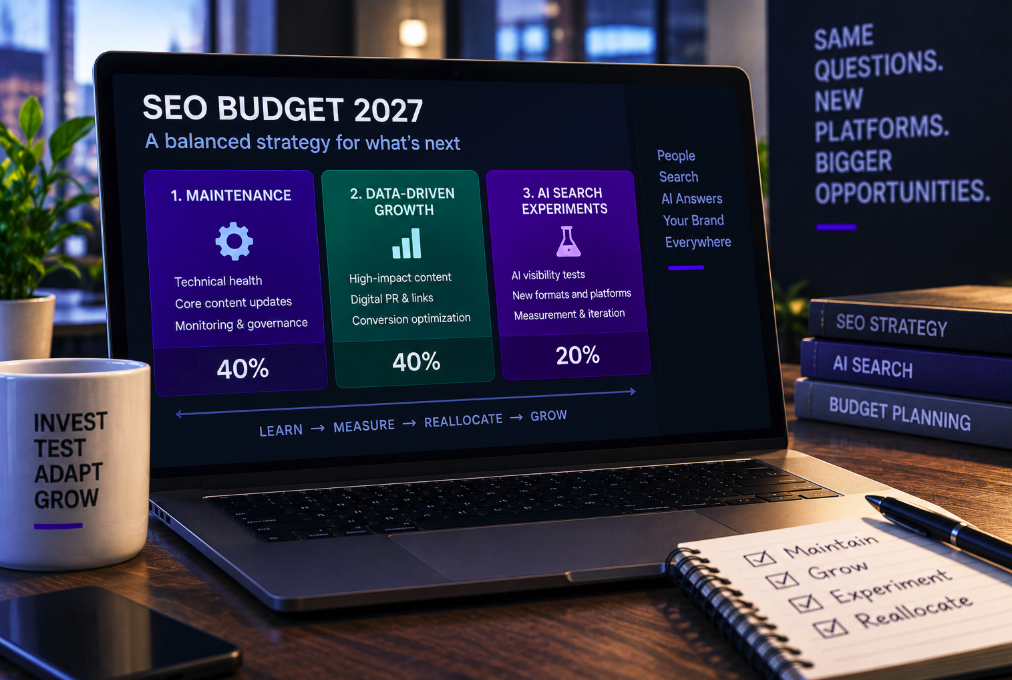
The 2027 SEO budget has to fund two realities at the same time. Traditional organic search still requires technical maintenance, content improvement, authority building and conversion work, while AI-generated answers are creating a second discovery layer whose commercial value is important but still difficult to measure.
That makes an all-in bet on AI search premature, but treating AI visibility as an unfunded side project is increasingly hard to defend. A more resilient budget separates the program into three distinct layers: maintenance that protects existing performance, data-backed growth initiatives with a credible return case, and a dedicated experiment fund for AI search visibility.
The framework, proposed in a Search Engine Land analysis on building a defensible 2027 SEO budget, changes the annual planning question from “how much should SEO get?” to “what kind of uncertainty is each dollar funding?” It also adds something many SEO budgets lack: predefined rules for moving money when the evidence changes.
The result is not a single universal percentage split. A mature publisher, an ecommerce site rebuilding its technical platform and a B2B company with strong rankings but weak AI visibility should not have identical budgets. The useful idea is the architecture: maintain, grow, experiment and reallocate.
Maintenance protects the organic asset you already own
The first budget layer is the least glamorous and usually the easiest to underestimate. Existing organic visibility does not maintain itself.
Websites accumulate technical debt. Internal links break, redirects multiply, templates change, structured data becomes stale, important pages lose freshness and new product decisions introduce crawling or indexing problems. Competitors improve pages that once ranked comfortably. Search interfaces change around results that have not moved.
A maintenance budget funds the recurring work required to keep the current organic asset functioning: technical monitoring, crawling and indexing diagnostics, content refreshes, internal-link governance, schema maintenance, analytics quality, migrations, redirects and routine performance investigation.
This is defensive investment, but defensive does not mean low value. If organic search already produces meaningful revenue, protecting that revenue can have a clearer business case than chasing an uncertain new growth initiative.
Maintenance should be sized by exposure, not ambition
The amount required for maintenance depends on what the business stands to lose. A site generating a small share of revenue from organic search may tolerate more technical risk than a publisher or marketplace whose economics depend heavily on search discovery.
Complexity matters too. A static 500-page B2B site and a marketplace generating millions of dynamic URLs do not have the same baseline engineering requirement. Neither do a company making two releases per year and a product team shipping template changes every week.
A defensible maintenance budget therefore starts with exposure: current organic revenue, traffic concentration, technical complexity, publishing velocity and known infrastructure risks.
Executives may prefer to fund visible growth projects, but the maintenance layer is what prevents the growth budget from being spent recovering traffic that should never have been lost.
The second layer should fund growth with evidence behind it
Once the existing asset is protected, the next pool of money should go toward opportunities where data supports an investment thesis.
That can include expanding into commercial topics already validated by PPC, improving pages sitting within striking distance of high-value rankings, building content around proven customer demand, strengthening authority in strategically important categories or resolving conversion problems on pages that already attract qualified organic traffic.
The important word is “proven.” Growth projects should not enter the core budget merely because a keyword tool reports attractive volume. They should have evidence connecting the search opportunity with a business outcome.
That evidence can come from Search Console, analytics, CRM data, paid-search conversions, sales calls, competitor gaps or existing page performance. The exact source matters less than the discipline of requiring a measurable hypothesis.
Growth budgets need opportunity models, not content quotas
Many SEO plans still translate money into output: a certain number of articles, landing pages or links per month. Output is easy to budget, but it is not the same thing as value.
A stronger model attaches resources to opportunities. A high-converting category with weak organic coverage may deserve several coordinated assets, technical work and digital PR. A high-volume informational topic with no clear path to revenue may deserve much less, even if producing the content is easy.
This becomes especially important as AI systems answer more generic informational questions directly. Content whose only business case was “this keyword has volume” faces greater uncertainty than content connected to a product, service, subscription, proprietary dataset or differentiated expertise.
The 2027 growth budget should therefore be built around expected outcomes and confidence levels rather than an annual publishing quota.
AI search deserves its own experimental capital
The third layer is the newest: a ring-fenced fund for AI visibility experiments.
Organizations are already asking SEO teams how they appear in ChatGPT, Gemini, Google AI Mode, Perplexity, Claude and other answer systems. Yet the measurement environment is immature. Citation frequency changes by model and prompt, referral traffic can be small, attribution is incomplete and the relationship between an AI mention and later conversion is difficult to observe.
That combination makes AI search a poor candidate for either extreme. It is too important to ignore, but too uncertain to absorb a large share of the core SEO budget without evidence.
An experiment fund solves that governance problem. It gives the team permission to test while limiting the amount of capital committed before the business understands the return.
The experiment fund should buy learning, not AI theater
A dedicated budget can quickly become a justification for buying every new “GEO” platform or producing content solely because an AI visibility dashboard assigns it a score. That is not the objective.
The fund should finance experiments with explicit hypotheses. A team might test whether adding clearer entity information improves brand recognition across answer engines, whether original data earns more citations than generic summaries, whether comparison pages are surfaced more often for commercial prompts or whether stronger third-party corroboration changes how models describe the company.
It can also fund measurement infrastructure: prompt panels, citation tracking, log analysis, referral attribution and manual validation of automated visibility reports.
The output of the experiment fund is therefore not only traffic. It is evidence about which interventions change machine visibility and whether those changes connect to outcomes the business values.
Do not invent AI-specific technical work Google does not require
The rise of AI search has also created a market for speculative optimization tactics. Budget owners should distinguish experiments from unsupported claims about hidden ranking requirements.
Google's current guidance for AI features in Search says there are no additional technical requirements or special optimizations necessary to appear in AI Overviews or AI Mode. Pages need to be indexed and eligible to appear in Search, while familiar fundamentals such as useful content, crawlability, internal links, page experience and accessible text remain relevant.
That does not mean AI visibility cannot be improved. It means a budget should not automatically fund a new technical checklist simply because it has been relabeled for AI.
The experiment pool is precisely where uncertain hypotheses belong: small enough to test, instrumented enough to measure and easy enough to stop when the evidence is weak.
AI visibility is broader than Google
Google can report traffic from AI Overviews and AI Mode inside Search Console's Web performance data, but the wider AI discovery ecosystem is fragmented across platforms.
ChatGPT, Claude, Perplexity and other assistants have different retrieval systems, source preferences and referral behaviors. Some can cite a site directly; others may mention a brand without generating a click. A user may later search the brand on Google, making the original AI exposure invisible in last-click analytics.
That is why an AI experiment budget needs multiple measures. Direct referral traffic is useful, but so are citation presence, brand accuracy, share of relevant prompts, downstream branded search and assisted conversions where they can be observed.
None of those proxies should automatically be treated as revenue. Their purpose is to build enough evidence to decide whether the experimental budget deserves to grow.
Scenario planning is better than pretending the 2027 environment is predictable
Annual budgets often create false precision. Teams choose a number in the fourth quarter and then behave as though the search environment will remain stable for the next 12 months.
That assumption is particularly weak heading into 2027. Google can change the prevalence and layout of AI answers. AI assistants can expand shopping, advertising or browser integrations. Referral behavior can shift. Measurement platforms can improve. A channel that appears marginal in January may become strategically important by September.
A defensible plan therefore includes scenarios. In a conservative scenario, AI referrals and measurable commercial influence remain small, so the experiment fund stays limited while maintenance and proven growth receive most resources. In an acceleration scenario, AI visibility begins influencing meaningful revenue or brand demand, justifying larger investment.
A disruption scenario might involve a sharp decline in traditional informational search traffic, forcing resources toward direct audience, commercial-intent content and AI visibility faster than originally planned.
Write the reallocation rules before the results arrive
The most useful part of a three-layer budget is that money can move between layers. The difficult part is deciding when.
Those rules should be agreed before teams become emotionally attached to their projects. An AI visibility initiative that produces no measurable movement after several controlled tests should lose funding. A new content cluster generating qualified pipeline faster than forecast should be allowed to absorb more of the growth pool.
Likewise, an unexpected technical problem may temporarily require money to move back into maintenance because protecting existing revenue has become the highest-return action.
Predefined thresholds make reallocation a governance process rather than an internal political contest.
Use confidence levels to decide how much capital a project deserves
Not every SEO initiative should face the same proof standard. Maintenance work can have high confidence because the downside of not doing it is known. A content expansion into an adjacent category may have medium confidence because demand and conversion evidence exist but ranking outcomes remain uncertain. A new AI visibility tactic may have low confidence because both the mechanism and commercial value are still being tested.
Budget size should reflect that confidence. High-confidence work can receive sustained funding. Medium-confidence growth can receive staged investment tied to milestones. Low-confidence experiments should begin with capped capital and explicit learning objectives.
This is essentially portfolio management applied to organic discovery.
The advantage is that SEO stops asking leadership to believe every initiative will work. Instead, the team acknowledges uncertainty and shows how financial exposure changes with the strength of the evidence.
A dedicated fund also prevents AI from cannibalizing core SEO by accident
Without a separate experiment budget, AI initiatives often enter through the side door. A leadership request triggers a new tracking tool, a consultant, extra content production and hours of manual prompt testing, all funded from the same resources responsible for technical health and proven organic growth.
The organization then claims it has not increased SEO spending even though core work has quietly been displaced.
Ring-fencing experimental capital makes that tradeoff visible. If leadership wants meaningful AI-search learning, it can fund the work explicitly rather than asking the existing program to absorb it invisibly.
This also protects AI experimentation from the opposite problem: being permanently deprioritized because every maintenance ticket appears more urgent.
The right percentage will vary by company
There is no credible universal rule saying every company should devote a fixed percentage of its SEO budget to maintenance, growth and AI search. The correct mix depends on technical risk, current organic maturity, competitive pressure, available data and how much AI-mediated discovery matters in the category.
A technically unstable site may need maintenance to dominate the budget. A mature site with strong infrastructure and obvious content gaps can weight toward growth. A brand already seeing meaningful AI referrals or customer journeys beginning in assistants may justify a larger experiment pool.
The split should therefore be an output of the planning process, not a benchmark copied from another company's slide.
What should remain consistent is the separation of purposes. Teams need to know which dollars protect existing value, which pursue evidence-backed growth and which are explicitly buying information about an uncertain future.
AI experiments should graduate when they stop being experiments
A successful test should not live forever in an innovation budget. Once an AI visibility tactic demonstrates repeatable value, it should move into the core growth program.
Suppose a company finds that original research pages consistently earn citations across several answer engines and that those citations correlate with branded demand and qualified visits. The next year's budget should not continue treating original research as speculative AI work. It has become a proven growth activity.
The reverse is equally important. Experiments that repeatedly fail should end rather than becoming permanent line items protected by novelty.
This graduation mechanism keeps the portfolio healthy: experiments generate evidence, evidence changes confidence, and confidence changes where capital sits.
The SEO budget is becoming a discovery budget
By 2027, the boundaries around “SEO” are likely to look increasingly artificial. Users discover brands through traditional results, AI answers, videos, forums, social platforms and conversational assistants, often moving between several surfaces before taking action.
That does not make traditional SEO obsolete. Technical accessibility, useful content, authority and clear entity information remain foundations that influence multiple discovery systems.
It does mean budget planning should account for a broader objective than ranking blue links. The business is investing in being discoverable, understandable and credible wherever people and machines look for answers.
A three-layer budget is a practical way to manage that transition without abandoning financial discipline.
2027 requires a budget that can learn
The strongest SEO budget for 2027 will not be the one with the most confident forecast. It will be the one designed to change when reality contradicts the forecast.
Maintenance protects the organic performance the business already owns. Data-backed growth concentrates resources where evidence suggests additional investment can produce returns. A dedicated AI search experiment fund creates room to learn about a fast-changing discovery channel without gambling the core program on unproven assumptions.
Scenario planning then acknowledges that the search environment can move, while explicit reallocation rules make it possible for the budget to move with it.
That is the real purpose of an AI experiment fund. It is not a declaration that AI search has already replaced SEO. It is a disciplined way to make sure the company is not forced to choose between ignoring the change and betting the entire budget on it.