
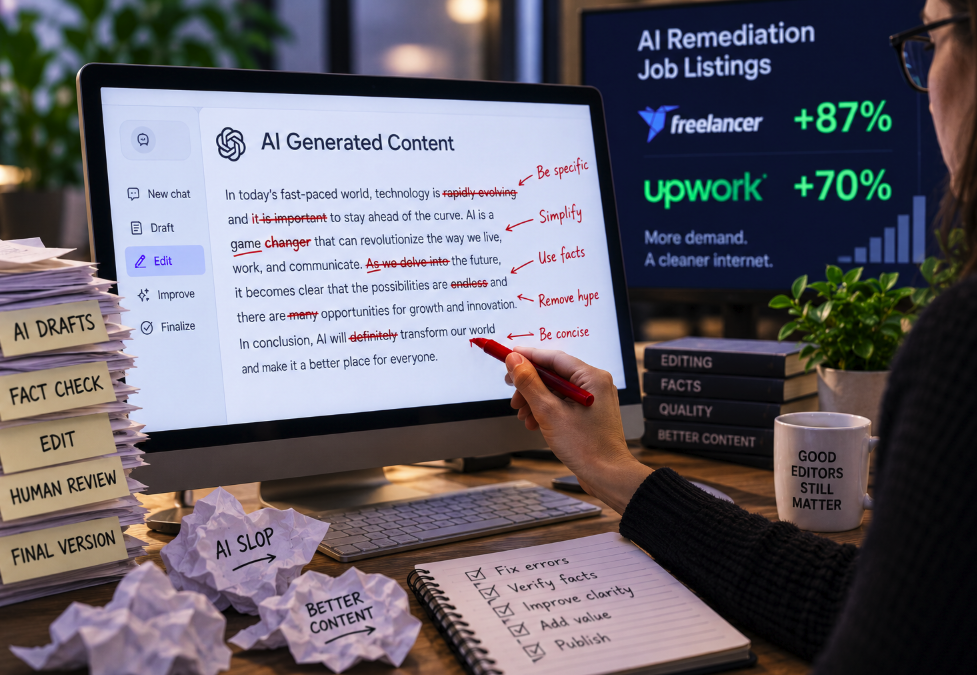
Generative AI was supposed to remove expensive creative work from the production process. Instead, a new category of paid work is emerging around repairing what the machines produce. Writers are rewriting generic copy, illustrators are correcting malformed images, video editors are cleaning synthetic footage and specialists are being hired to verify outputs that looked finished until someone examined them closely. The result is an unexpected labor market: the AI cleanup economy.
Search Engine Journal reported that listings for correcting AI-generated work on Freelancer.com rose 87% between August 2025 and June 2026, reaching 10,760 posts globally, based on platform data originally reported by The Guardian. Upwork separately reported a 70% year-over-year increase in AI remediation gigs, while Fiverr said searches for “AI cleanup” services grew more than twentyfold between 2023 and 2026. The measures are different and should not be compared as though they represent the same dataset, but together they point toward a clear commercial pattern: businesses are increasingly paying humans to repair AI output after generation.
AI did not eliminate the work; it moved it downstream
The economics behind this trend are easy to understand. A small company can generate a first draft of an article, illustration, presentation, video or marketing asset in minutes. That makes the initial production stage feel almost free compared with commissioning original professional work. The problem arrives when the output has to become commercially usable.
AI-generated material can contain factual errors, awkward prose, inconsistent design, distorted anatomy, broken visual details, invented information and generic language that does not fit a brand. Some of these problems are immediately obvious. Others become visible only when a professional starts reviewing the work against a real brief, style guide, factual standard or production requirement.
Matt Barrie, CEO of Freelancer.com, told The Guardian that many cleanup jobs originate with small businesses and entrepreneurs who use AI to create a first pass and then encounter problems they cannot resolve themselves. The apparent savings from generation can then be consumed by the time required to turn that draft into something usable.
Cleanup can be as difficult as creating from scratch
The assumption that remediation should be cheap is creating friction between clients and freelancers. If AI has already produced most of an image or document, a buyer may reasonably assume that a professional only needs to make a few corrections. But repairing a flawed artifact is not always equivalent to polishing a nearly finished one. Sometimes the professional has to diagnose what is wrong, preserve the parts that work and reconstruct everything else within the constraints of the existing output.
The examples collected by The Guardian make that mismatch concrete. Illustrator Todd Van Linda described declining a project that offered roughly $500 to repair 13 to 15 AI-generated illustrations for a children’s book under an expectation that each image would take around 15 minutes. Multimedia editor Nathan McConnell said he spent two to three hours in Photoshop on individual images from an approximately 100-card AI-generated tarot deck, fixing defects such as extra fingers and incorrect feet.
These are anecdotes rather than a universal measure of remediation time, but they expose an important flaw in the “AI first, human second” cost model. If the initial generation introduces errors throughout the asset, the editor is not merely finishing the machine’s work. The editor may be reverse-engineering it.
The new demand spans more than writing
Much of the public discussion around AI slop focuses on text because large language models made automated writing ubiquitous. Freelancer.com’s data suggests the cleanup market is broader. According to the reporting, graphic design represented the largest category among listings tagged with terms such as “correct AI,” “AI hallucination” and “AI error,” followed by video editing, proofreading and content writing.
That distribution matters because visual AI errors can be particularly expensive to fix. A paragraph can sometimes be rewritten quickly if the underlying information is available. A generated illustration with inconsistent lighting, malformed hands, impossible geometry or the wrong visual style may require detailed manual reconstruction. Video adds another layer because defects can persist across frames and must remain visually coherent over time.
As generative tools spread through marketing, publishing, ecommerce and creative production, remediation is therefore becoming a multidisciplinary skill. The valuable professional is not necessarily the person who refuses to use AI or the person who generates the most AI assets. It may be the person who can recognize where automated output fails and knows how to bring it up to professional standards efficiently.
Quantity has improved faster than reliability
The growth of cleanup work highlights a central contradiction in the generative AI boom. AI has radically reduced the marginal cost of producing another draft, image or variation. It has not reduced the cost of judgment by the same amount. A model can produce 100 alternatives almost instantly, but someone still has to determine which one is accurate, useful, original enough, legally appropriate, on-brand and technically ready for publication.
This creates what might be called a quality debt. Organizations generate content faster than their review systems can absorb it, then discover that the accumulated errors require specialized labor downstream. The faster generation becomes, the easier it is to create more material than a human team can responsibly verify.
The problem is especially visible in content marketing. A business can generate dozens of SEO articles with minimal effort, but publication at scale introduces risks around factual accuracy, repetition, weak sourcing, brand dilution and generic coverage. Human editing becomes a bottleneck not because AI failed to produce words, but because producing words was never the hardest part of professional publishing.
The hidden economics of the cheap first draft
Companies evaluating AI productivity often measure the time saved at the point of generation. If a draft that previously took three hours now appears in three minutes, the efficiency gain looks enormous. That calculation is incomplete if the organization does not include review, correction, fact-checking, compliance, design refinement and approval.
The cleanup data suggests businesses are increasingly discovering those downstream costs in the freelance market. The correct comparison is not human creation time versus AI generation time. It is the total cost of a publishable human workflow versus the total cost of an AI-assisted workflow, including every remediation step needed before the asset can safely reach customers.
For some tasks, AI will still win that calculation decisively. A strong first draft can accelerate brainstorming, transcription, routine variations and other constrained work. For tasks where mistakes are subtle or expensive, however, the review burden can erase much of the headline productivity gain. In the worst cases, starting again with a professional may be faster than repairing a deeply flawed generated artifact.
AI remediation may become a profession of its own
The platform numbers also suggest a labor-market transition rather than simple job destruction. Research cited by Search Engine Journal has found declines in freelance writing, coding and image-creation opportunities that were highly exposed to generative AI. At the same time, demand is emerging for people who can supervise, correct and improve machine output.
That does not mean the two effects cancel each other out. Cleanup work may pay differently, require different skills and offer less creative ownership than the jobs AI displaced. Several freelancers interviewed by The Guardian described remediation as tedious or frustrating, and some turn down projects they consider too difficult or underpriced.
There is also no guarantee that the niche will keep expanding indefinitely. Better models could reduce obvious defects and automate portions of remediation itself. Some freelancers expect the market to shrink as systems improve. Yet model improvement does not automatically eliminate quality control. As AI becomes capable of producing more sophisticated material, organizations may simply raise the standard of what they ask it to create, moving human review toward harder problems.
For marketers, the lesson is workflow design
The wrong takeaway is that businesses should stop using generative AI. The more useful lesson is that AI needs to be placed inside a production system that accounts for verification from the beginning. A company that generates thousands of assets before deciding how they will be reviewed is not necessarily creating productivity; it may be manufacturing a remediation backlog.
Strong workflows define which tasks AI can perform, what evidence or source material it should use, which errors require escalation and who owns final approval. Content teams can reduce cleanup costs by supplying better inputs, narrowing prompts, grounding factual claims, using templates carefully and involving domain experts before low-quality output multiplies across a project.
Quality assurance should also be priced into the business case. If human review is mandatory—and for many customer-facing, factual or brand-sensitive applications it should be—then those hours belong in the AI ROI calculation rather than being treated as an unexpected expense after generation.
The real scarcity is trustworthy human judgment
The surge in cleanup work exposes something generative AI has not made abundant: confidence that an output is actually ready. Models have made drafts extraordinarily cheap, but professional judgment remains comparatively scarce. Someone still has to know whether the copy makes sense, whether the facts are correct, whether an image looks physically plausible and whether the final product meets the standard a customer was promised.
If Freelancer.com, Upwork and Fiverr continue seeing rising demand for AI remediation, the irony will become harder to ignore. Businesses adopted AI to reduce the cost of creative production, only to create a market for specialists who clean up the results. The long-term winners may not be companies that generate the most content with AI. They may be the ones that design workflows where the machine produces less slop in the first place—and where human expertise is used before quality problems become expensive enough to require a rescue operation.