
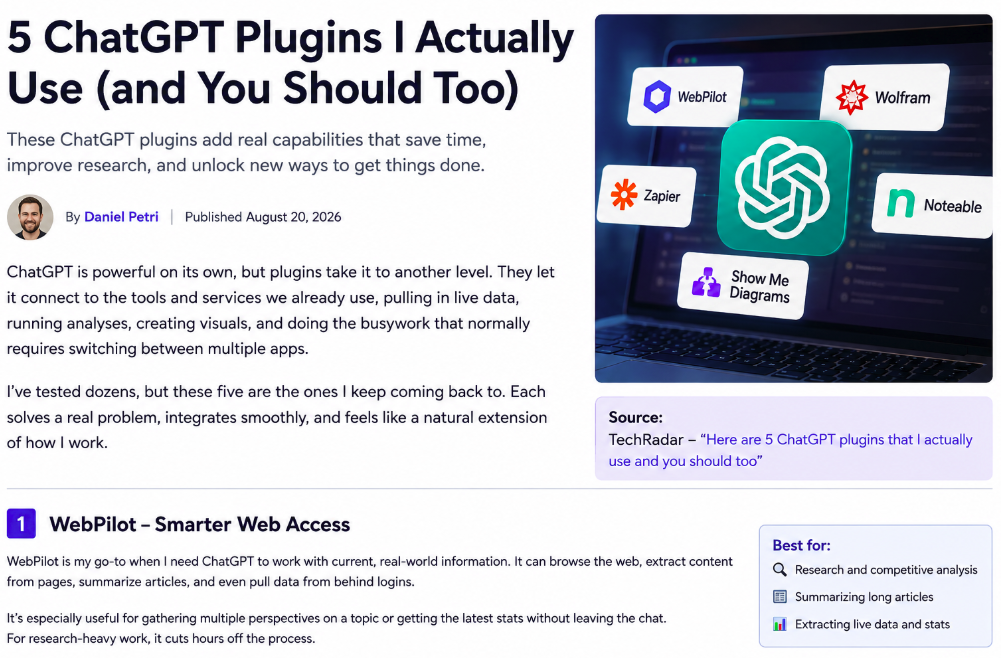
ChatGPT becomes considerably more interesting when the conversation stops being the final product. A useful answer is one thing; an assistant that can turn the answer into a playlist, a hiking shortlist, a structured task list or a workout plan starts to look like a different category of software.
That is the practical theme running through a new TechRadar feature by Eric Hal Schwartz, published on August 27, which identifies five ChatGPT plugins that have survived the novelty phase and become part of the author’s actual routine. The selections—Spotify, AllTrails, Todoist, FitAI Pro and Podcast App—are not especially interesting because they make ChatGPT smarter in the abstract. They are interesting because each gives the conversational interface access to a specialized service that already knows how to perform a particular job.
That distinction may ultimately matter more than the plugin directory itself. The future of AI assistants is unlikely to be defined only by which model produces the best paragraph. It will increasingly be defined by what happens after the paragraph.
Plugins solve the last-mile problem of conversational AI
A general-purpose model is exceptionally good at turning vague intentions into structured instructions. A user can say that they want music for a 75-minute workout, a hiking route that is not too steep, a realistic plan for Saturday errands or a podcast episode explaining a difficult subject at an introductory level. ChatGPT can understand all of those requests.
Without an integration, however, understanding is often where the useful part ends. The model can suggest a playlist, but it does not necessarily create that playlist in the service where the user listens. It can organize errands, but the plan still has to become tasks and reminders. It can recommend a trail, but specialized route data and recent trail information live elsewhere.
Plugins close that gap by connecting conversational intent with specialized applications. TechRadar’s examples are particularly effective because they demonstrate this across very different categories rather than concentrating on another collection of generic productivity tools.
Spotify shows why natural language can be a better interface
TechRadar’s first example is Spotify. The integration can use listening history, favorite artists and habits to help generate recommendations and playlists through conversation. Instead of choosing a predefined genre or mood, the user can describe a much more specific situation: duration, energy progression, musical styles, recently overplayed songs and even the kind of ending the playlist should have.
The important innovation is not AI music recommendation by itself. Spotify has been recommending music algorithmically for years. The improvement is the interface between the user’s intent and the recommendation engine.
Traditional software requires users to express what they want through the controls the product designer anticipated. Conversational interfaces allow users to describe the desired outcome in their own terms. A request such as “give me upbeat music” can become “start quietly while I work, increase the energy after 20 minutes and avoid the artists I listened to constantly last month.” The user can then refine the result without reconstructing the query from scratch.
That iterative conversation is where plugins can feel substantially different from simply putting an AI chatbot next to an existing app.
AllTrails demonstrates the value of combining constraints
TechRadar also highlights the AllTrails integration for finding hikes. Trail discovery is a good example of a problem that becomes cumbersome when the user has several constraints at once. Distance from home, driving time, trail length, elevation gain, parking, accessibility, dogs, children and weather can all matter simultaneously.
A conventional search interface can expose filters for some of those variables, but conversation allows the user to describe the entire situation naturally. ChatGPT can then use AllTrails as the specialized data source behind the request.
There is an important limitation here that TechRadar sensibly acknowledges: dynamic real-world conditions still need verification. Trail closures, weather and recent conditions can change. An AI-generated recommendation should not replace checking current official information before leaving.
That caveat points toward a broader rule for useful AI integrations. The assistant can dramatically reduce the work involved in finding and comparing options, while the authoritative source remains essential for facts that can change or carry real-world consequences.
Todoist turns planning into execution
The Todoist example is perhaps the clearest illustration of why integrations matter. ChatGPT has always been able to create a to-do list. The difference is whether that list remains text in a chat window or becomes part of the system a person actually uses to manage work.
According to TechRadar, the Todoist plugin can take a loosely described schedule or set of errands and turn it into structured tasks, including recurring reminders. That reduces one of the quiet sources of friction in productivity software: translating the plan in your head into the fields, dates and categories required by the application.
This is also where permissions and preview steps become important. When an AI can change an external system, users should distinguish between asking for a proposed plan and authorizing execution. TechRadar’s author describes asking for a preview before allowing ChatGPT to populate an overloaded schedule. That is a small habit with a much larger implication for agentic software: autonomy is useful, but review is valuable when actions have consequences.
FitAI Pro narrows the model around a specific domain
FitAI Pro takes a different approach. Rather than simply connecting ChatGPT to an existing consumer account, it provides a specialized fitness workflow around workout planning and logging. TechRadar reports using experience level, available equipment, training frequency and time limits to generate more practical gym sessions, with the ability to substitute exercises when necessary.
This is an example of specialization making a general model more useful. ChatGPT can already discuss exercise, but a purpose-built integration can structure that conversation around the data and actions relevant to the domain.
Users should still treat health- and fitness-related AI advice with appropriate caution, particularly when injuries, medical conditions or unusual symptoms are involved. But for routine organizational work—turning preferences and available equipment into a structured session—the value proposition is straightforward. The plugin handles the planning overhead that often sits between an intention and actually starting the workout.
Podcast App tackles discovery at the episode level
The fifth TechRadar recommendation, Podcast App, addresses another problem that conventional recommendation systems often handle poorly: finding one useful episode rather than subscribing to an entire show.
Podcast catalogs are enormous, and search metadata does not always capture why a particular episode is relevant. A conversational query can include the subject, preferred depth, maximum duration and the user’s existing knowledge. TechRadar’s author also asks the plugin to explain briefly why each recommended episode matches the request.
That last detail is especially useful because it makes the recommendation easier to evaluate. AI discovery works better when it does not merely output a list but exposes enough reasoning or context for the user to decide whether the recommendation fits.
The interesting trend is not the five plugins
The individual recommendations will change. New integrations will appear, existing ones will improve and some services that look essential today may eventually be absorbed into broader platform capabilities. The more durable observation is that the best integrations tend to share the same structure.
They start with a messy human intention. The language model interprets it. A specialized service supplies domain-specific data or functionality. The user can refine the result conversationally. Finally, the system produces something actionable rather than another block of text.
This is a much stronger model for AI assistants than the idea that every application should be replaced by one universal chatbot. Spotify remains better at managing music. AllTrails remains a specialized trail platform. Todoist remains a task system. The AI layer does not need to recreate those products. It can become the interface that coordinates them.
Plugin rankings are also becoming a quality problem
TechRadar notes another recent change: ChatGPT’s plugin recommendations now give more weight to integrations that users continue to use after installation. That is a sensible evolution for any growing directory.
Plugin ecosystems quickly encounter the same problem as app stores. Installation is a weak signal. A tool can have an excellent description, generate a burst of curiosity and then never be opened again. Continued use is much stronger evidence that the integration solves a recurring problem.
For developers, that changes the incentive. The goal is not merely to produce a clever demonstration of what ChatGPT can connect to. The integration has to earn a place in an existing workflow. That means reliability, predictable behavior and a clear reason to return matter more than novelty.
The next AI interface may be less about prompting
The early generative-AI era taught users to think about prompts. Better prompts produced better answers, and entire ecosystems emerged around prompt templates and techniques. Plugins suggest a different future in which the important skill is not writing increasingly elaborate instructions but giving an assistant enough context to coordinate useful tools.
Instead of learning how a music app structures filters, a user describes the atmosphere they want. Instead of manually translating a weekend plan into task-manager fields, they explain the weekend. Instead of searching several databases for an episode, trail or workout, they state the constraints that matter.
The interface becomes intent rather than configuration.
That does not remove the need for judgment. Users still need to verify dynamic information, review consequential actions and understand what data an integration can access. Connecting more services to an AI assistant also increases the importance of permissions and privacy. Convenience should not make those questions invisible.
The useful AI assistant is the one that leaves the chat
TechRadar’s five recommendations work as a practical list, but together they illustrate something larger about where ChatGPT is heading. A chatbot that can only answer questions competes primarily on the quality of its answers. A system that can interact with the applications people already use competes on whether it can reduce the distance between intention and action.
That is a much more consequential benchmark.
The best plugin is not necessarily the one that makes ChatGPT appear most intelligent. It is the one that quietly removes five steps from something the user already needed to do. Spotify, AllTrails, Todoist, FitAI Pro and Podcast App approach that problem from different directions, which is exactly why TechRadar’s selection is useful.
As AI assistants mature, the novelty of talking to software will fade. What will remain is a simpler question: after we tell the AI what we want, can it actually help us get there?
Source: Eric Hal Schwartz, TechRadar, “Here are 5 ChatGPT plugins that I actually use, and you should too,” published August 27, 2026.