
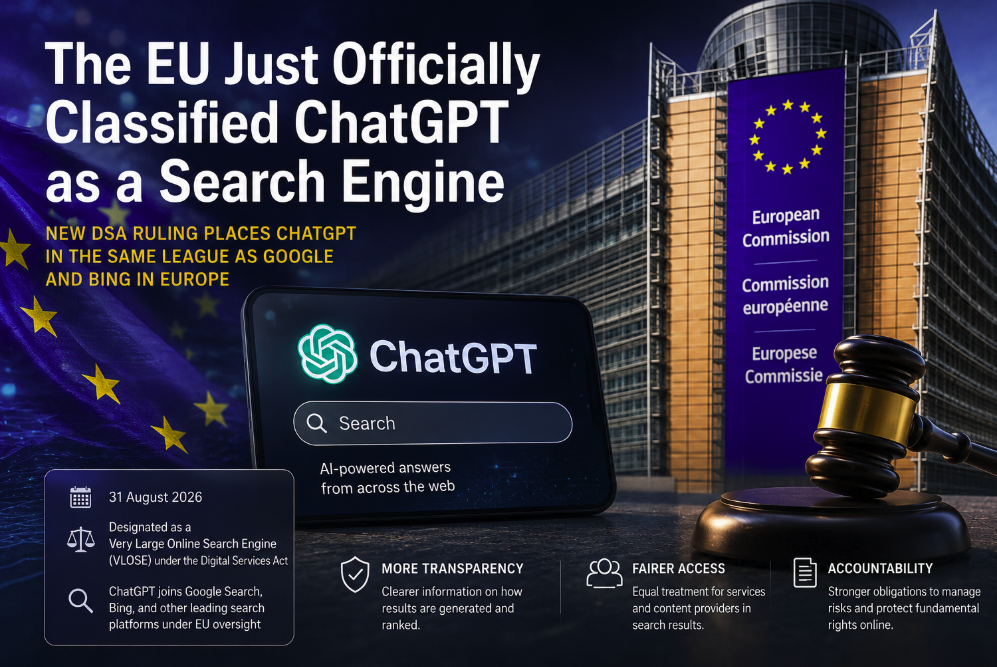
For the SEO industry, the debate over whether ChatGPT should really be considered a search engine just became much less theoretical. On 31 August 2026, the European Commission officially designated ChatGPT as a Very Large Online Search Engine (VLOSE) under the Digital Services Act. The designation does not mean that every ChatGPT interaction is legally equivalent to a traditional Google query, nor does it settle every technical debate about generative search. But within the EU's DSA framework, ChatGPT is now formally being regulated as an online search engine at very large scale.
That is a meaningful moment for generative engine optimization. GEO has often been described as a discipline adjacent to SEO: optimize for a chatbot, earn mentions from an LLM, or increase the probability that an AI assistant knows a brand. The Commission's decision gives us a sharper framing. When ChatGPT searches the web, selects sources, cites publishers and synthesizes answers for users, those activities are no longer merely search-like from an industry perspective. The service has crossed the EU threshold for formal VLOSE designation.
Why the EU designated ChatGPT a VLOSE
The immediate reason is scale. According to the Commission, ChatGPT, Reddit and Roblox each declared at least 45 million average monthly users in the European Union, meeting the threshold for designation under the DSA. Reddit and Roblox were designated Very Large Online Platforms, while ChatGPT was designated a Very Large Online Search Engine.
OpenAI's own DSA disclosure makes the scale of ChatGPT Search clearer. In its European Union Digital Services Act information, OpenAI says ChatGPT Search had approximately 159.1 million average monthly active recipients in the EU during the six-month period ending 31 March 2026. OpenAI notes that the figure was calculated specifically for DSA compliance and should not be relied on for other purposes, but it demonstrates why the service sits comfortably above the EU's 45-million-user threshold.
The designation also triggers additional responsibilities. The Commission says designated VLOPs and VLOSEs have four months after notification to comply with the DSA's additional obligations, including assessing and mitigating systemic risks arising from their services and algorithmic systems. The Commission's guidance for very large platforms and search engines describes these obligations as the DSA's most stringent rules, reflecting the scale and societal impact of services with more than 45 million EU users.
For GEO, the important word is “search”
The regulatory consequences are significant, but for search marketers the terminology itself deserves attention. ChatGPT is not being placed in a generic category of large AI applications. It has been designated a Very Large Online Search Engine. That classification aligns with what publishers increasingly observe in practice: ChatGPT can transform a user's question into web searches, retrieve current information, choose sources and return an answer containing links and citations.
OpenAI describes that process directly in its documentation for ChatGPT Search. The company explains that ChatGPT can search the web for current information and links to relevant sources, and that when search providers are involved the system may rewrite a user's request into one or more targeted queries before sending them to those providers. That retrieval layer is crucial for understanding why GEO increasingly overlaps with familiar search problems.
If a system generates queries, decides what to retrieve, chooses among domains, synthesizes evidence and presents selected sources to the user, then visibility inside that system is partly a search visibility problem. The interface is different from a ten-blue-links results page, but the underlying competition for discovery has not disappeared. It has moved into a more compressed and less transparent selection process.
AI visibility is not just “being known by the model”
This distinction matters because early discussions of LLM optimization often treated model knowledge as the central objective. The logic was straightforward: make a brand prominent enough across the web that the language model associates it with the right topics, products and categories. That remains useful, particularly for entity recognition and recommendation prompts. But web-connected AI search introduces another layer.
A publisher can be well represented in a model's latent knowledge and still fail to appear when the system searches for fresh evidence. Conversely, a domain that the model does not discuss frequently from memory can become highly visible if its pages are repeatedly retrieved and cited for current queries. In other words, AI visibility is produced by several mechanisms: model knowledge, query generation, source retrieval, source selection, citation and final-answer synthesis.
The VLOSE designation does not tell us how ChatGPT ranks sources, and it should not be misread as regulatory confirmation of any particular GEO theory. What it does is make the search layer impossible to dismiss as merely metaphorical. The EU is applying its large-search-engine framework to ChatGPT at the same moment marketers are trying to understand why some publishers are repeatedly retrieved and cited while others remain invisible.
Citations are becoming a new kind of search result
Traditional SEO gives users a visible list of competing results. Generative search can hide much more of the selection process. A user may receive one synthesized answer supported by a handful of citations, even though the system considered or searched substantially more information behind the scenes. That changes the economics of visibility.
A conventional ranking in position seven is still a visible ranking. In an AI-generated answer, the equivalent source may never appear to the user at all. The assistant can search multiple domains, use information to form its answer and expose only selected references. Citation visibility therefore becomes a scarce output rather than a simple extension of ranking position.
For publishers, this means measurement needs to move beyond “Does ChatGPT mention us?” We need to ask whether the system searches the publisher's domain, whether it retrieves the publisher's pages, whether those pages influence the generated answer, and whether the domain receives a visible citation. These are distinct stages, and optimizing one does not necessarily guarantee success at the next.
Source selection is now clearly inside the Search conversation
This is where the Commission's designation has the most interesting strategic implication for SEO. The industry has spent years developing methods to understand crawling, indexing, ranking and SERP visibility. Generative search introduces a different pipeline, but many of the core questions are recognizable. Which sources are eligible? Which domains does the system trust for a topic? How does freshness affect retrieval? When does the system search an official source directly? What makes one publisher more likely to be cited than another?
Those questions belong naturally inside Search, even when the final product is a conversational answer rather than a list of links. The emerging discipline may still be called GEO, AI SEO, LLM optimization or something else, but the naming matters less than the measurement model. If ChatGPT Search is a search engine under one of the world's most consequential digital regulatory regimes, marketers should be comfortable treating its source-selection behavior as a search visibility surface.
A useful experiment: measure the pipeline, not only the answer
The designation also suggests a practical direction for NetContentSEO's experiments. Instead of comparing only final citations across prompts, we can treat AI search as a pipeline and test each stage separately. For a controlled set of queries, we can record the brands or publishers recognized in the answer, the domains explicitly targeted during search where observable, the pages retrieved, the citations exposed and the final recommendation or conclusion.
That creates a more informative visibility model. A domain might have strong entity recognition but weak retrieval visibility. Another might be frequently retrieved but rarely cited. A third might earn citations yet almost never become the recommended entity. These differences are invisible when all outcomes are collapsed into a single “AI visibility score.”
Over time, this framework could also help separate traditional SEO strength from publisher-level recognition. If ChatGPT repeatedly chooses particular domains before it evaluates individual pages, then brand and publisher entities may influence search visibility earlier than conventional page-ranking analysis assumes. If, on the other hand, domain selection simply mirrors relevance and authority signals observable in standard search, the overlap between SEO and GEO may be larger than expected. Either result would be valuable because it is testable.
GEO is becoming part of Search, not an alternative to it
The European Commission's decision should not be exaggerated into a claim that ChatGPT and Google are technically identical products. They are not. Their interfaces, retrieval systems, answer generation, business models and user behaviors can differ substantially. Nor does a DSA designation establish how publishers should optimize for ChatGPT.
But the decision does remove one conceptual ambiguity. In Europe, ChatGPT has now been formally designated a Very Large Online Search Engine. For anyone working on GEO, that is more than a regulatory footnote. It reinforces the idea that AI visibility, citations and source selection should be studied as part of the evolving Search ecosystem rather than as a completely separate discipline built around chatbots.
The SEO question is therefore changing. It is no longer only, “Can this page rank?” It is increasingly, “Will the AI search system recognize this source, decide to retrieve it, trust it enough to use it and expose it to the user?” As ChatGPT enters the EU's VLOSE regime, that chain of decisions is becoming one of the most important new frontiers in Search.