
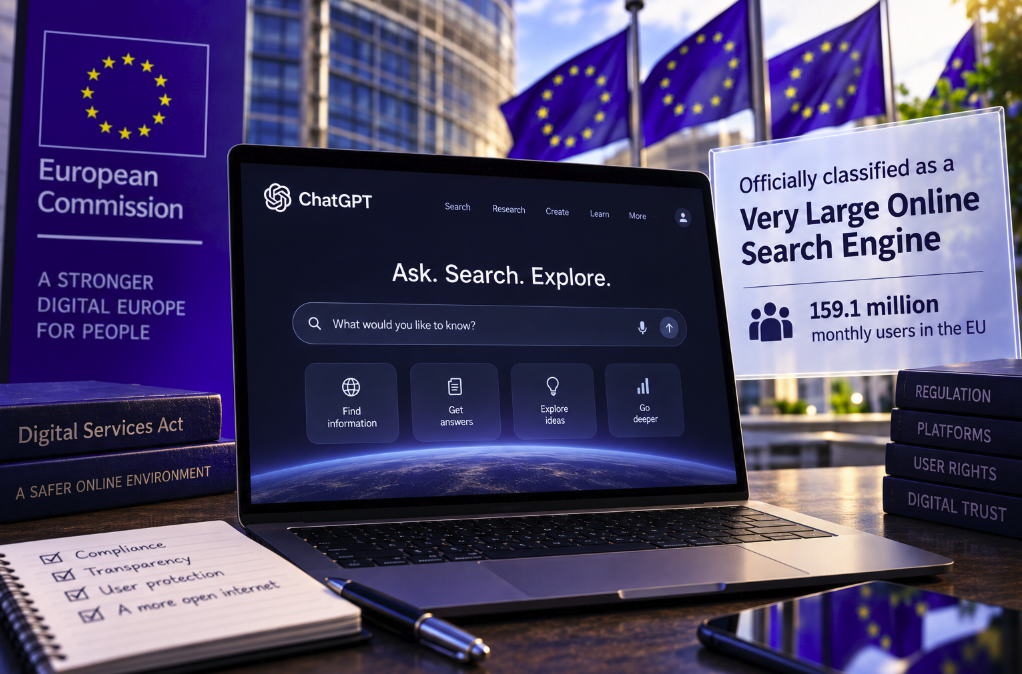
The European Union has turned a long-running debate about AI search into a regulatory fact. On August 31, the European Commission officially designated ChatGPT as a Very Large Online Search Engine, or VLOSE, under the Digital Services Act. In EU law, ChatGPT now sits in the same top-tier search category that already includes Google Search and Microsoft Bing.
The designation matters beyond terminology. The European Commission announced that ChatGPT had crossed the Digital Services Act threshold for a very large service, alongside Reddit and Roblox, which were separately designated as Very Large Online Platforms. ChatGPT will consequently face the DSA's additional obligations for the largest online services, including requirements to assess and mitigate systemic risks connected to its service and algorithmic systems.
The 159.1 million figure refers specifically to ChatGPT search
The scale behind the designation is striking, but the number needs to be described precisely. The Commission's register of designated VLOPs and VLOSEs lists ChatGPT at 159.1 million average monthly active users for DSA purposes. OpenAI provides the more exact definition behind that figure: it refers to average monthly active recipients of ChatGPT search — the product's online search features — in the European Union over the six-month period ending March 31, 2026.
In its Digital Services Act disclosure, OpenAI explicitly cautions that the 159.1 million average was calculated for DSA compliance and should not be relied on for other purposes. It therefore should not be presented as a general count of all European ChatGPT users. The relevant regulated service is ChatGPT search.
Even with that qualification, the figure establishes the scale of conversational search in Europe. The DSA threshold for VLOSE designation is 45 million average monthly recipients in the EU. ChatGPT search reported more than three times that level.
ChatGPT is now legally a search engine in the EU
The designation is significant because regulators are no longer treating AI-assisted retrieval as merely a feature attached to a chatbot. For purposes of the Digital Services Act, the European Commission has classified ChatGPT as a search engine large enough to create systemic effects comparable to other major information-discovery services.
That does not mean Brussels has declared ChatGPT technically identical to Google Search. The interfaces and retrieval models remain very different. Conventional search typically presents ranked links and other result modules, while ChatGPT can search the web, synthesize information and return a conversational answer that may contain citations to selected sources.
But the regulatory logic focuses on function and scale. When a service helps more than a hundred million Europeans retrieve information from the web, the fact that the answer arrives as generated prose rather than ten blue links does not remove its influence over what users see, which sources receive attention and how information is interpreted.
The designation puts ChatGPT alongside Google Search and Bing
The Commission's supervision register now lists OpenAI Ireland Limited and ChatGPT among the designated VLOSE services. Google Search and Microsoft Bing were already designated under the DSA in April 2023.
The comparison is useful because it demonstrates how quickly the search market has expanded beyond its traditional boundaries. Google and Bing were obvious candidates when the DSA's very-large-service regime began. ChatGPT entered the market as a conversational AI product, added web search capabilities and has now reached the legal threshold for the EU's highest category of online search engine.
For the search industry, that transition formalizes something publishers and marketers have already been experiencing. Visibility is no longer determined exclusively by whether a URL ranks on a conventional results page. A source can now be discovered, summarized or cited inside an AI answer, and that answer itself is part of a search service used at very large scale.
OpenAI has four months to meet the additional VLOSE obligations
The designation triggers a new compliance timeline. The Commission says ChatGPT, Reddit and Roblox have four months from notification — until January 2027 — to comply with the additional Digital Services Act obligations that apply to VLOPs and VLOSEs.
Those obligations are substantially broader than ordinary platform compliance. The largest services must assess and mitigate systemic risks arising from their services and algorithmic systems. The Commission specifically points to risks involving illegal content, negative effects on minors, users' physical and mental well-being, fundamental rights, electoral processes and public security.
For a conversational search engine, those categories raise distinctive questions. An AI system does not simply order existing pages. It can select sources, combine claims from several documents, paraphrase information and produce a new answer. Risk assessment therefore has to consider not only which information is available to the system but also how the model transforms and presents it.
AI search concentrates editorial decisions inside the answer
Traditional search engines exercise enormous influence through ranking, snippets and result features, but users can usually see multiple competing sources on the same page. Conversational search can compress that information landscape into one synthesized response.
That makes source selection unusually consequential. If an AI system cites three websites rather than displaying dozens of results, those three sources receive disproportionate visibility. If it summarizes a disputed issue, the wording of the synthesis can shape the user's understanding before any source link is opened.
This is one reason the VLOSE classification matters to publishers. ChatGPT search is not merely another referral channel. It is an intermediary capable of turning web documents into an answer and determining which parts of the underlying information environment remain visible to the user.
The DSA puts algorithmic systems at the center of the compliance problem
The Commission's announcement explicitly includes systemic risks stemming from services and algorithmic systems. That language is particularly relevant to AI search because the ranking layer and the answer-generation layer can both influence the final result.
A conversational search system may decide which queries require web retrieval, which sources to retrieve, which passages are relevant, which claims deserve inclusion and which citations support the response. The resulting information pathway is more complex than a simple index lookup.
From a regulatory perspective, complexity does not reduce responsibility. It increases the need to understand how systemic effects can emerge. A service used by 159.1 million average monthly search recipients in the EU can influence access to health information, political material, news, consumer choices and public debate at a scale that clearly exceeds the DSA's threshold for enhanced oversight.
The designation is important for SEO even though it is not an SEO rule
The Digital Services Act does not tell marketers how to rank in ChatGPT, and VLOSE designation should not be confused with an endorsement of any particular AI-search optimization tactic. Yet the decision is strategically important for SEO because it recognizes AI search as a major information-discovery layer rather than an experimental side channel.
Search professionals have spent years debating whether optimizing for AI answers should be called SEO, GEO, AEO or something else. The European Commission has taken a more functional approach: ChatGPT's search service is an online search engine, and its scale makes it a very large one.
For businesses, that reinforces the case for measuring visibility beyond traditional rankings. A brand may be highly visible in Google while being absent from conversational answers about the same market. A publisher may receive fewer direct clicks from an AI answer while still influencing the response as a cited source. These are different visibility patterns, but they increasingly belong to the same broader search ecosystem.
Being cited may matter even when the user never clicks
One of the fundamental differences between conventional and conversational search is that the answer can satisfy the query without requiring a visit to the source. That makes attribution and citation particularly important.
A citation can still deliver traffic, but it also performs another function: it tells the user which source contributed to the answer and gives that source a visible role in the information chain. For publishers, citation visibility can therefore have value even when click-through behavior differs from classic organic search.
This creates a measurement challenge. Search Console and web analytics were built around impressions, rankings and visits generated by result pages. AI answers can create brand exposure, influence and source selection that are only partially visible through referral traffic. The more ChatGPT search grows, the more important that measurement gap becomes.
The EU's decision also changes the language of the AI-search debate
Until now, calling ChatGPT a search engine could sound like an industry argument. Critics could reasonably note that its core experience was built around conversation and generative models rather than a conventional web index interface. Supporters could point to its ability to search the live web and answer information-seeking queries.
The Commission's decision does not settle every technical definition, but it removes ambiguity in one important jurisdictional context. Under the Digital Services Act, ChatGPT is officially a Very Large Online Search Engine.
That legal recognition matters because regulatory categories influence compliance, oversight and eventually product design. OpenAI now has to operate ChatGPT search under obligations created specifically for online services with enough scale to create systemic societal effects.
ChatGPT's path from chatbot to regulated search infrastructure has been fast
The speed of the transition is itself remarkable. ChatGPT popularized the modern consumer chatbot interface at the end of 2022. Within a few years, OpenAI added increasingly capable web retrieval, source citations and research features. By the six-month period ending March 2026, ChatGPT search was reporting 159.1 million average monthly active recipients in the EU for DSA purposes.
The Commission's designation follows the product rather than the historical category. Once a conversational AI service begins functioning as a large-scale gateway to online information, regulators can treat that function as search even if the interface looks nothing like the search engines that defined the previous era.
This may become relevant beyond OpenAI. Other AI assistants increasingly retrieve live web information, cite external sources and act as discovery interfaces. If their European reach crosses the DSA threshold and their services meet the relevant legal definitions, the regulatory distinction between “assistant” and “search engine” may matter less than the role they actually play for users.
Search regulation is expanding from ranked links to generated answers
The European Commission's August 31 decision marks a broader shift in how the information economy is being understood. Search is no longer defined only by a box, an index and a ranked page of links. It can also be a conversation in which software retrieves information, synthesizes it and answers directly.
For OpenAI, the immediate consequence is regulatory: ChatGPT now falls under the DSA's enhanced VLOSE regime and must meet the additional obligations by January 2027. For publishers and marketers, the consequence is conceptual. AI search has become large enough that one of the world's most important digital regulators formally places it in the same category of information intermediary as Google Search and Bing.
The 159.1 million figure should be handled carefully because it measures ChatGPT search recipients for a specific DSA reporting period, not the entire ChatGPT audience. But the broader conclusion is difficult to miss. Conversational AI is no longer approaching the search market from the outside. In the European Union, ChatGPT is now officially part of it.