
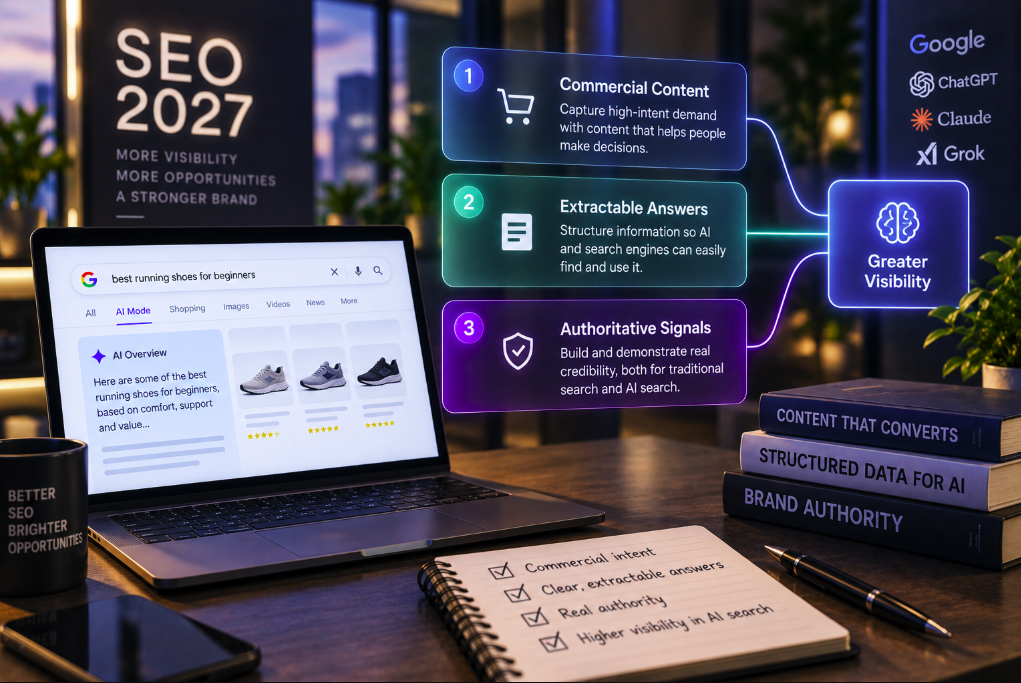
SEO in 2027 is not splitting neatly into two disciplines called traditional search and AI search. The same commercial pages, clear answers and authority signals increasingly influence whether a brand earns a conventional organic visit, appears inside an AI-generated response or becomes one of the entities a user considers during a buying decision. What is changing is the economics of where SEO teams should concentrate their effort.
In a September 3 Search Engine Land analysis, Paul DeMott reduces that problem to three priorities: allocate more resources toward commercially valuable content, structure information so useful answers can be extracted easily, and strengthen authority through links, brand mentions and appropriate machine-readable signals. The framework matters because it does not require abandoning SEO fundamentals to chase a separate generative-engine playbook. It asks marketers to apply those fundamentals where they can produce value across both search environments.
Priority one: protect the searches that can still produce business
AI answers have changed the economics of informational search most aggressively. Users asking definitions, simple questions or broad research queries can increasingly receive enough information directly in the results interface that they never need to visit a publisher. That does not make top-of-funnel content useless, but it makes indiscriminate informational publishing harder to justify when resources are limited.
DeMott cites 2026 Seer Interactive data showing AI Overviews appearing across 36% of informational queries in its sample, compared with 8% of commercial and 5% of transactional queries. Query format complicates that picture: comparison and “best of” searches can trigger AI answers at much higher rates even when the underlying intent is commercially valuable. The implication is not that mid-funnel comparison content should disappear. It is that ranking alone no longer describes the full competitive environment.
A page targeting a query such as “best CRM for multi-location businesses” can rank highly while an AI Overview occupies the most prominent part of the result and cites competitors. Search Engine Land points to Seer data suggesting cited pages receive materially more clicks per impression than uncited pages on AI Overview results, although even citation does not restore the click behavior of a comparable SERP without an AI Overview. The strategic objective therefore becomes dual: compete for the organic position and make the page strong enough to be considered as a source within the generated answer.
Bottom-of-funnel pages remain especially important because transactional and navigational searches are generally more resistant to zero-click behavior. Pricing pages, product pages, service pages, location pages and other assets close to conversion deserve deliberate protection. They may have less search volume than broad educational topics, but the clicks they preserve can be worth substantially more.
Traffic volume is no longer enough to allocate content budgets
This changes how SEO teams should prioritize editorial calendars. For years, keyword research encouraged publishers to see large informational search volumes as obvious opportunities. In 2027, the relevant question is not merely how many people search for a topic. It is whether ranking for that topic creates a meaningful opportunity to earn attention, influence consideration or generate revenue in a results environment increasingly capable of answering the query itself.
Top-of-funnel content still has strategic roles. It can fill gaps in topical coverage, attract links, support internal architecture and introduce a brand earlier in a customer journey. But a company with limited resources should be able to explain why a new informational article deserves investment before a commercial page that directly supports revenue.
The strongest content portfolios will therefore become more selective. Instead of publishing hundreds of interchangeable explainers, teams can build fewer resources with proprietary data, firsthand testing, strong examples and internal links that reinforce commercially important hubs. That creates assets capable of serving human visitors while also supplying distinctive information to search and AI systems.
Priority two: make the best answer easy to extract
The second priority is structural. A page can contain excellent information and still make that information unnecessarily difficult to identify. Long introductory passages, ambiguous headings and paragraphs that depend heavily on surrounding context create friction for readers and for systems attempting to extract a concise answer.
DeMott recommends patterns familiar from featured-snippet optimization: short definition-led answers, descriptive H2 and H3 headings, self-contained responses beneath question headings, and useful lists or tables when the information genuinely fits those formats. The objective is not to reduce every article to fragments. It is to ensure that important passages can stand on their own.
This is increasingly relevant because AI search interfaces synthesize answers from passages rather than reproducing entire webpages. A sentence that clearly identifies an entity, answers the question and supplies the necessary context is easier to reuse responsibly than a statement that only makes sense after reading three previous paragraphs. Good extraction structure is therefore also good editorial structure: readers can scan it, machines can parse it and search engines can understand the page’s information hierarchy.
The lesson should not be distorted into writing exclusively for bots. Pages composed of disconnected answer blocks can become unpleasant for humans and weak as complete resources. The better model is layered content: concise answers where users need them, followed by evidence, explanation, examples and nuance for readers who need more depth.
Depth and extractability are complements, not opposites
There is a false choice in some AI-search discussions between concise, quotable passages and comprehensive long-form content. Strong pages can provide both. A clear two-sentence answer can introduce a section, while the paragraphs beneath it explain methodology, limitations and implications. A comparison table can summarize a decision while the surrounding analysis explains why the differences matter.
This matters in a web flooded with low-cost generated summaries. If every publisher can produce a generic definition instantly, merely answering the obvious question becomes less differentiating. Original research, expert commentary, unique graphics, demonstrations and firsthand experience give a page information that competing summaries cannot reproduce without citing or learning from the source.
That is the deeper connection between conventional SEO and AI visibility. Search engines have long needed reasons to rank one useful page above another. AI systems need reasons to select one source rather than another when constructing an answer. Distinctive evidence helps with both problems, even though the mechanisms and measurement are not identical.
Priority three: authority has to exist beyond your own domain
The third priority is authority, but the definition is becoming broader than backlinks alone. Links remain important to Google Search, and high-quality editorial links can signal that independent sources consider a page or brand worth referencing. AI visibility, however, is also drawing attention toward unlinked brand mentions, earned media, video, podcasts and discussions on third-party communities.
Search Engine Land cites Ahrefs research finding stronger correlations between branded web mentions and AI Overview visibility than between backlinks and the same visibility measure, with a later analysis showing a particularly strong correlation for YouTube mentions across several AI surfaces. Those findings are correlations, not proof that generating mentions will directly cause AI citations. They are still strategically interesting because they suggest that a brand’s wider information footprint deserves attention alongside its traditional link profile.
In practical terms, digital PR, expert commentary, original research and credible appearances in relevant media can support both worlds. They can earn conventional links while also creating independent references that establish what a company is known for. A brand repeatedly discussed by authoritative sources provides search and AI systems with more external evidence than a brand that describes its expertise only on its own website.
Schema still matters, but not as an AI citation hack
Structured data belongs in the authority and comprehension conversation with an important caveat. Schema can clarify entities and relationships and remains necessary for Google search features that explicitly support it. But current evidence does not justify presenting schema as a proven shortcut to AI citations.
The Search Engine Land analysis highlights recent experiments in which adding JSON-LD did not produce a meaningful increase in citations across AI Overviews, AI Mode or ChatGPT. Separate retrieval testing found several AI systems reading visible HTML while ignoring hidden structured-data implementations during real-time fetching. Google’s own guidance for AI features in Search says there are no special schema requirements for appearing in AI Overviews or AI Mode.
That does not make structured data obsolete. Organization, Product, Article and other relevant markup can improve machine-readable accuracy and support eligible search features when implemented correctly. The more defensible strategy is to use schema because it accurately describes the visible content and reduces ambiguity, not because a vendor promises that adding JSON-LD will force ChatGPT or Google AI Mode to cite the page.
The same asset should increasingly serve several discovery surfaces
These three priorities converge in a useful way. A strong commercial comparison page can target a high-value organic query, contain concise passages and tables that are easy to extract, present firsthand testing or original data, and earn references from external publications. The work is not divided into an SEO asset and a GEO asset. It is one authoritative information asset designed to perform across a fragmented discovery environment.
This is a more sustainable model than creating separate “AI content” whose only purpose is to manipulate an emerging interface. Search systems will continue changing. Citation behavior will change. Individual AI products may gain or lose market share. A useful commercial resource backed by genuine expertise and external recognition retains value even when a particular generative feature changes.
Measurement has to broaden accordingly. Traditional rankings, clicks, conversions and Search Console performance still matter, but teams increasingly need to monitor AI citations, referral traffic from AI assistants, brand mentions and visibility inside generative search experiences. No single metric replaces the others because the customer journey is becoming distributed across them.
The 2027 SEO strategy is a prioritization strategy
The most important shift in the Search Engine Land framework is not a new technical tactic. It is resource allocation. SEO teams cannot optimize every informational query, every AI engine and every potential authority signal with equal intensity. They have to decide where the business can still win meaningful attention and then create assets capable of working across multiple surfaces.
That points toward a simple 2027 playbook: defend and improve commercially valuable content, structure the most useful information so it can be understood and extracted without losing depth, and build a reputation that exists beyond the company’s own pages. Traditional organic search and AI visibility are not identical objectives, but the strongest work increasingly supports both.
The future of SEO is therefore less about choosing between Google rankings and AI citations than about creating information worthy of either. Commercial relevance determines where to invest. Clear structure makes the information usable. Real authority gives search engines, AI systems and customers a reason to trust the source. Those three priorities form the bridge between the traffic SEO has historically measured and the visibility it now has to earn.