
Yesterday, the idea that websites may soon receive visitors that aren't human sounded like a prediction.
Now there is another piece of the puzzle: people are already experimenting with ways for websites to tell AI agents how they want to be used.
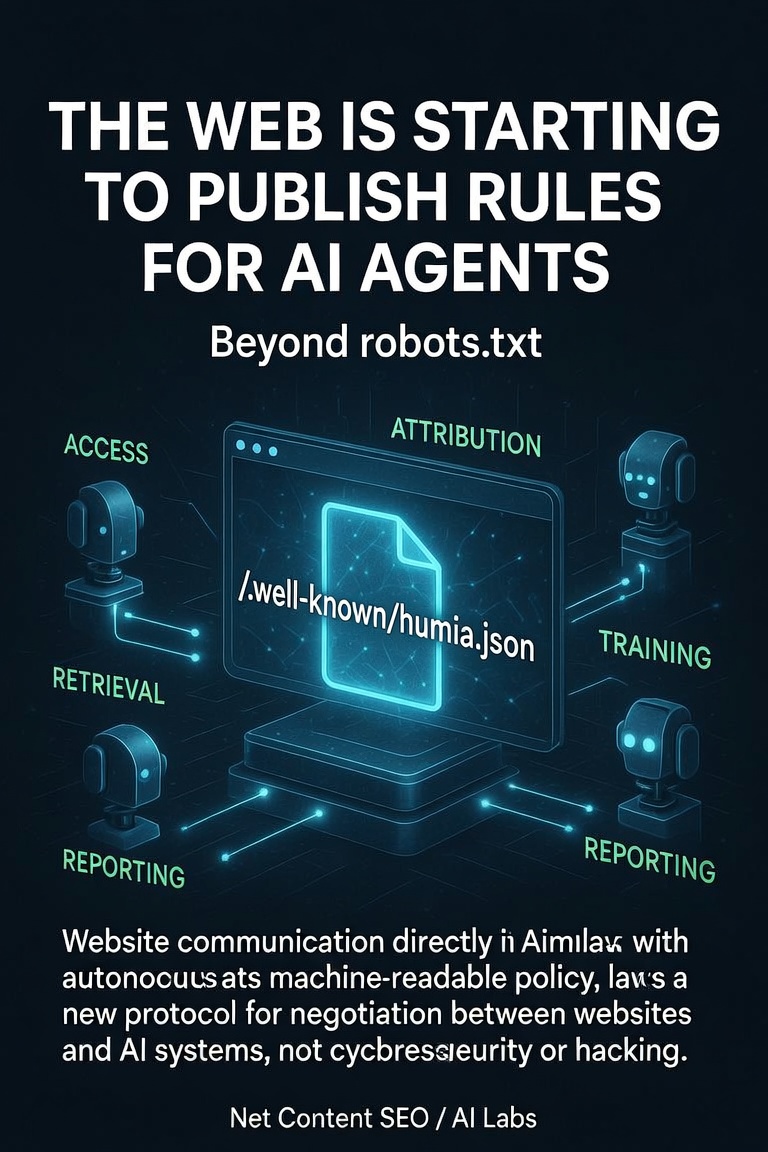
On August 19, 2026, an experimental Internet-Draft called HUMIA proposed a machine-readable cooperation policy for AI agents. A website would publish a JSON file at /.well-known/humia.json, allowing it to express conditions around public-content access, AI usage, attribution and optional usage reporting.
The interesting part is that HUMIA isn't intended to replace robots.txt.
Robots.txt primarily communicates crawling preferences. HUMIA proposes an additional layer where a publisher could distinguish between purposes such as user assistance, search retrieval, bulk crawling and model training. The draft even allows a site to state that attribution is required.
That is a subtle but potentially important change.
The web was designed largely around a relationship between website and human visitor. Search engines introduced another relationship between website and crawler. AI agents could create a third one: systems that don't simply index a page, but retrieve information and potentially act on behalf of a user.
We recently explored this idea in The Next Visitor to Your Website May Not Be Human. HUMIA doesn't prove that this will become a web standard, and it shouldn't be presented that way. It is currently an experimental Internet-Draft and may be changed, replaced or abandoned.
But its existence is interesting by itself.
We are beginning to ask questions that barely existed a few years ago: Can an AI use this information? For what purpose? Should it attribute the source? Can a website communicate different rules for retrieval and training?
The next evolution of the web may therefore involve more than making pages readable by machines.
Websites may eventually need a way to negotiate with them.
Primary source: IETF Internet-Draft — HUMIA: A Website-First Protocol for Human-AI Cooperation
Internal link: NetContentSEO — The Next Visitor to Your Website May Not Be Human