
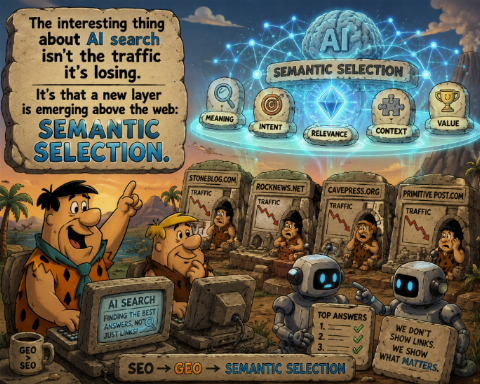
Traditional SEO focused on rankings and pages. AI visibility and GEO may increasingly reward structure, clarity, entities, and contextual understanding.
Traditional SEO Optimized Pages. AI Visibility May Optimize Understanding
For years, SEO was mostly about optimizing pages for search engines. You researched keywords, mapped search intent, built links, improved internal linking, optimized titles, and tried to make pages rank higher than competitors. The page itself was the center of the strategy. If the page ranked, traffic arrived. If traffic arrived, the system worked.
But AI search is starting to introduce a different layer on top of the traditional web, and the incentives already feel slightly different.
A lot of SEO pages from the last decade were built primarily to attract clicks. You can still recognize them immediately: long introductions that say very little, repeated keywords, oversized “ultimate guides,” filler sections designed to increase word count, and content structures made more for algorithms than for actual understanding. Traditional search engines tolerated a lot of that because ranking systems historically relied heavily on signals surrounding the page itself.
AI systems behave differently.
They do not simply “rank pages” in the old sense. They increasingly retrieve fragments, synthesize ideas, connect entities, compress information, and generate responses from multiple sources at once. That changes the nature of visibility. The question slowly becomes less “Can this page rank?” and more “Can this information be understood and reused?”
That may sound like a subtle difference, but it changes the direction of optimization quite a bit.
A page written only for search engines often feels mechanical when surfaced inside AI systems. Many AI-generated answers today already expose that contrast. Some sources feel easy to summarize, trustworthy, structured, and semantically clean. Others feel bloated, repetitive, or ambiguous. In traditional SEO, both pages might still rank reasonably well. In AI retrieval systems, however, clarity itself starts becoming an advantage.
This is one reason why conversations around GEO, AEO, and AI visibility have grown so quickly over the last year. Not because SEO is disappearing, but because another visibility layer is emerging above it.
Traditional SEO optimized discoverability. AI visibility may increasingly optimize interpretability.
That is a very different game.
A lot of the early discussion around GEO has focused on hacks and shortcuts. You already see endless conversations around llms.txt, chunking tricks, prompt injection theories, semantic manipulation, hidden embeddings, and other “AI SEO hacks.” Some experimentation is normal — every new ecosystem creates that phase — but historically these industries eventually move toward systems that reward quality signals more than exploit patterns.
And interestingly, AI systems seem to reward things that look surprisingly human.
Clear explanations. Logical structure. Strong context. Entity consistency. Reduced ambiguity. Content that sounds like it understands the topic rather than merely targeting the query.
That may become one of the biggest shifts in the industry.
For years, many SEO strategies optimized for algorithms that measured pages. AI systems increasingly attempt to measure understanding.
Entities also seem to matter more in this environment. Traditional SEO revolved heavily around keywords and queries. Modern AI systems increasingly operate through relationships between concepts, brands, people, products, and topics. In other words, they process semantic context more naturally than old retrieval systems did.
This is why many pages written purely around keyword formulas now feel outdated when surfaced inside conversational AI. They technically contain the “right terms,” but they often lack coherent conceptual structure. AI systems can still retrieve them, but they may not become preferred synthesis sources.
The pages that seem easier for AI systems to reuse often share similar characteristics:
they explain concepts directly,
they structure information well,
they define entities clearly,
they connect ideas naturally,
and they reduce interpretive friction.
In many ways, this resembles how humans evaluate expertise too.
Another important shift is that AI systems increasingly compress the traditional user journey. Search engines historically sent users somewhere. AI systems increasingly try to answer immediately. That changes the visibility funnel itself.
The old model was relatively simple:
Search → Click → Website.
The new model increasingly looks like:
Question → AI synthesis → selective citation → optional click.
That means some visibility may happen without the traditional visit ever occurring. Brands, concepts, frameworks, and sources can influence the answer layer itself even when the user never fully enters the website experience. This is one reason why impressions and clicks may diverge more frequently in the future. Visibility and traffic are no longer perfectly aligned concepts.
This does not mean SEO is dead. Far from it.
Technical SEO still matters. Crawling still matters. Indexing still matters. Authority still matters. Links still matter. Search intent still matters.
But AI visibility may become an additional optimization layer sitting above classic SEO foundations.
The relationship probably is not “SEO vs GEO.”
It is more likely:
SEO enables discoverability.
GEO improves interpretability.
And the sites that perform best long term may eventually be the ones capable of doing both simultaneously.
One interesting thing already happening is that AI-native content often feels structurally different from old SEO content. Many high-performing informational resources today look more like documentation, semantic explainers, educational frameworks, structured references, or modular knowledge systems rather than traditional “SEO articles.”
That trend may accelerate.
The web spent years optimizing for clicks. AI systems may push parts of the web toward optimizing for comprehension instead.
And that is probably a much harder problem than ranking ever was.
FAQ
What is AI visibility?
AI visibility refers to how easily AI systems can understand, retrieve, synthesize, and potentially cite information from a website or document.
Is GEO replacing traditional SEO?
Not necessarily. GEO (Generative Engine Optimization) appears more likely to evolve alongside SEO rather than completely replace it.
Why are entities becoming more important in AI search?
Modern AI systems increasingly process semantic relationships between concepts, brands, people, and topics instead of relying only on keyword matching.
Does AI visibility reward different content structures?
Yes. Structured, clear, contextual, and logically organized content may become easier for AI systems to interpret and reuse.
Are GEO “hacks” sustainable?
Historically, shallow manipulation strategies tend to lose effectiveness over time. Long-term visibility is more likely to depend on clarity, usefulness, trust, and semantic understanding.
Tags
seo, geo, ai visibility, generative engine optimization, ai search, semantic seo, entities seo, llm optimization, ai retrieval, search evolution, google ai, structured content, semantic search, seo future, answer engine optimization