
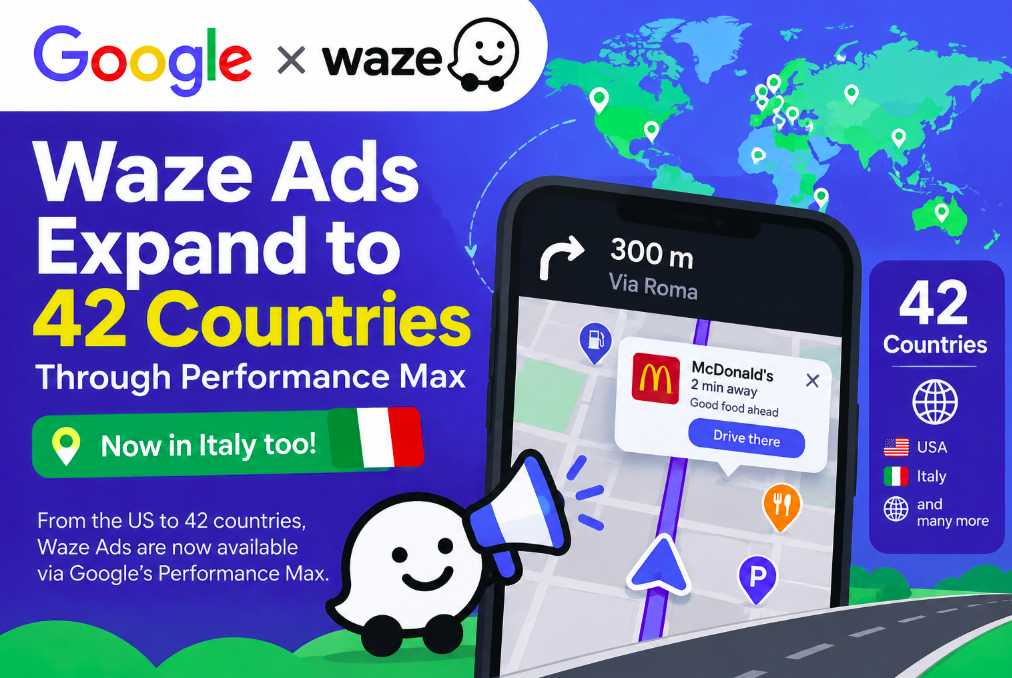
Google is taking Waze advertising international. After initially launching the new Waze ad experience in the United States, the company is expanding promoted-place inventory through Performance Max to 42 countries, including Italy, giving businesses another way to reach drivers when they are physically close to a store or location.
The expansion was reported on September 4 by Barry Schwartz at Search Engine Roundtable, who published the rollout details and country list from Google. The change connects Waze more directly to the existing Google Ads buying system rather than requiring advertisers to treat the navigation app as an isolated advertising channel.
For local marketers, that integration is the important part. Waze has a distinctive advertising context because users are not simply searching for a business from home; they are often already moving through the physical world with an active destination. Performance Max can now use that environment as another surface for campaigns designed to generate visits to physical locations.
Waze ads are becoming a global Performance Max inventory surface
Google's latest expansion takes Waze promoted places beyond the United States and into 42 markets. The rollout includes major European countries such as Italy, the United Kingdom, France, Germany, Spain, the Netherlands and Poland, alongside markets across Latin America, Asia-Pacific, the Middle East and Africa.
The ads are delivered through Performance Max campaigns configured for store goals. That means advertisers do not need to build a completely separate Waze campaign structure. Instead, Waze becomes another place where Google's automated system can show an eligible location-focused advertisement when it predicts that doing so can contribute to the campaign objective.
This follows Google's broader strategy of consolidating inventory behind Performance Max. Search, Maps, YouTube, Display, Discover, Gmail and other Google surfaces can already participate in the campaign type. Waze adds a particularly location-sensitive environment to that mix.
Italy is included in the expansion
For Italian advertisers, the rollout is immediately notable because Italy appears on Google's 42-country list. Businesses using Performance Max for store goals can therefore become eligible for Waze placements as the feature reaches supported accounts.
The geographic context makes Waze different from many conventional ad placements. A restaurant, retailer, fuel station, supermarket or other physical business can potentially reach a driver who is already nearby rather than someone merely researching the category.
That proximity can shorten the distance between advertising exposure and an offline visit. It also means location accuracy, opening hours and Business Profile information become especially important. An ad inviting a driver to visit a nearby store is useful only if the destination information is current and the location can actually serve the customer.
The format is built around promoted places
The Waze integration centers on promoted places: advertiser locations that can be surfaced to drivers in the navigation experience. Google says the ads are designed to help people discover relevant businesses near them while traveling.
That makes the placement closer to local discovery than to a traditional display banner. The commercial value comes from the relationship between the user's route, current location and the advertiser's physical presence.
For advertisers, this means the quality of location assets can matter as much as conventional creative. Correct addresses, map positions, store details and business information form part of the experience because the advertisement is connected to a place the user may actually navigate toward.
Performance Max decides when Waze is useful
Advertisers should not interpret the rollout as a new manual Waze-only buying tool inside Google Ads. The inventory is integrated into Performance Max, which uses Google's automation to determine where and when campaign assets should be shown based on the advertiser's objectives and available signals.
This has the same trade-off familiar from other Performance Max inventory. Automation can find opportunities across Google's surfaces without requiring marketers to build separate campaigns for each placement, but advertisers have less direct control over exactly where every impression appears.
The addition of Waze therefore increases the value of placement-level and channel-level transparency. Local marketers will want to understand how much delivery Waze receives, what interactions it produces and whether those interactions correlate with store visits or other offline outcomes.
Waze gives Performance Max a different kind of intent signal
Search advertising typically captures expressed intent: a person types a query describing what they want. Waze can provide a different context. The user may not have searched for a particular business category, but the platform knows that the person is traveling through a location where a relevant advertiser is nearby.
That does not automatically make the user interested in the advertiser. It does, however, create a strong geographic constraint. A coffee shop five minutes from a driver's route is a materially different advertising opportunity from a coffee shop across the city.
Google's automated campaign system can combine that location context with the broader signals available to Performance Max. The result is an ad product aimed at turning physical proximity into a conversion opportunity.
The expansion strengthens Google's local advertising ecosystem
Google already owns several of the most important interfaces people use to navigate the physical world. Search helps users find businesses, Google Maps helps them evaluate and navigate to locations, and Waze provides community-driven navigation and traffic information.
Bringing Waze inventory into Performance Max makes those surfaces more commercially interconnected. An advertiser can manage campaigns through Google Ads while Google's systems decide which combination of search, map, navigation and other inventory is most likely to produce the desired outcome.
For Google, this also increases the value of its location graph. Advertising around physical places works best when the platform understands not only where a business is but whether it is open, what category it belongs to and how users can reach it.
Local businesses need reliable location data before chasing the new inventory
The Waze expansion may tempt advertisers to focus immediately on creative and bidding, but location hygiene should come first. Incorrect store addresses, duplicated listings, outdated opening hours or poorly maintained Business Profile data can undermine campaigns designed to generate physical visits.
Performance Max store-goal campaigns depend on location assets to connect advertising with real-world destinations. The more Google distributes those locations across navigation products, the more consequential inaccurate information becomes.
Businesses with many branches should therefore audit their location groups and ensure that only active, customer-facing locations are eligible. A national campaign accidentally promoting a closed branch is more damaging when the ad appears to someone already driving nearby.
Measurement remains the difficult part of local advertising
Waze can place an advertiser in front of a driver at a highly relevant moment, but proving that the exposure caused a store visit is more complicated than measuring an online purchase. Drivers can see an ad, continue navigating, visit later or reach the business through another route.
Google's store-goal campaign infrastructure is designed around offline outcomes, but advertisers should still distinguish between observable interactions and modeled business impact. A navigation action is useful evidence of intent; it is not automatically equivalent to a completed purchase.
Businesses with strong first-party sales data will be in a better position to evaluate whether increased local exposure translates into incremental revenue. Otherwise, the risk is optimizing toward convenient platform metrics rather than genuine commercial outcomes.
The in-car context raises a relevance bar
Advertising inside a navigation application is unusually sensitive because the user's primary task is driving. Waze must balance commercial discovery with an interface designed to minimize distraction.
That makes relevance especially important. A nearby fuel station, restaurant or retailer can be useful when it aligns with the driver's immediate needs. An irrelevant ad in a navigation context can feel more intrusive than the same promotion on a conventional web page.
Google therefore has an incentive to keep the placement closely tied to location and likely usefulness. Performance Max's role is not merely to maximize inventory consumption but to identify situations where a promoted place can plausibly help the user.
The 42-country rollout makes Waze strategically more important for local PPC
When Waze ads were limited to the United States, many international advertisers could treat the format as an interesting experiment elsewhere. The September expansion changes that. Businesses across Europe and dozens of other markets now need to consider Waze as part of the Performance Max environment.
For agencies managing Italian retail, hospitality, automotive, fuel, restaurant and other location-based accounts, the feature deserves particular attention. It adds a navigation surface with strong geographic context to campaigns that may already be using Google's broader local inventory.
The rollout should still be treated as an expansion rather than a guarantee that every eligible account will see identical availability immediately. Google frequently phases advertising features across accounts and markets.
Waze is no longer a side channel in Google's advertising strategy
The broader significance is that Google is making Waze part of its automated advertising machine. The navigation app remains a distinct consumer product, but advertisers increasingly reach its users through the same Performance Max system that distributes campaigns across the rest of Google's ecosystem.
That simplifies buying and expands reach, while also making campaign transparency more important. Advertisers need to know when Waze contributes meaningful incremental visits rather than simply adding another surface to an already broad automated campaign.
With the expansion to 42 countries, including Italy, that question is no longer theoretical for international marketers. Waze has become another real-world discovery layer inside Performance Max — one designed to reach customers not just when they search for a place, but while they are already on the road near it.