
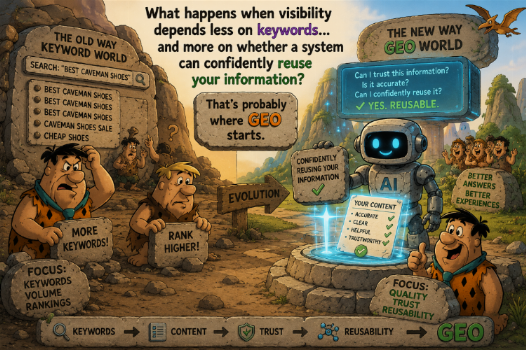
Traditional SEO optimized keywords and rankings. GEO and AI visibility may increasingly depend on whether systems can confidently understand and reuse your information.
What Happens When Visibility Depends Less on Keywords — and More on Whether AI Can Reuse Your Information?
For years, SEO was relatively straightforward conceptually, even if execution was often complicated.
You optimized pages around keywords, intent, links, internal structure, and technical signals. Search engines crawled the page, evaluated relevance and authority, and then decided whether the page deserved visibility for a given query.
That entire ecosystem trained the web to think in terms of rankings.
But AI search systems are starting to introduce a different dynamic, and you can already feel the shift happening quietly underneath the surface.
The interesting part is not that AI systems answer questions directly. We already know that. The more important change may be that visibility itself is slowly becoming connected to whether a system can confidently reuse your information.
That is probably where GEO really starts.
Not in hacks.
Not in tricks.
Not in llms.txt debates.
Not in artificial formatting experiments.
But in understanding how machines interpret information.
Traditional SEO optimized discoverability. AI systems increasingly seem to optimize interpretability.
That sounds subtle until you actually think about what it changes.
A lot of classic SEO pages were engineered primarily to attract clicks. You still see them everywhere: long intros saying very little, repetitive paragraphs, keyword-heavy subheadings, inflated “ultimate guides,” and content structures designed more for algorithms than for humans.
Traditional search engines tolerated a surprising amount of that because ranking systems historically evaluated pages differently. If the signals aligned correctly, the page could still perform.
AI systems behave differently.
They retrieve fragments.
They synthesize ideas.
They merge sources.
They reinterpret context.
They compress information into answers.
And suddenly the quality of the information structure itself starts mattering more.
A page can technically rank well while still being difficult for AI systems to reuse confidently. That distinction may become increasingly important over the next few years.
One thing becoming noticeable already is how AI systems seem to prefer information that feels structurally clean. Pages that explain concepts directly often survive AI summarization much better than pages overloaded with SEO friction.
This is probably why many pages that surface naturally inside AI-generated answers do not always feel like “traditional SEO pages.” They often resemble documentation, educational explainers, structured references, semantic frameworks, or high-quality knowledge resources.
Less marketing page.
More understanding layer.
And honestly, that may be a healthier direction for the web overall.
Another interesting shift involves entities and contextual relationships. Traditional SEO spent years heavily centered around keywords. AI systems increasingly appear to process semantic relationships more naturally. They try to understand how concepts connect rather than simply identifying exact keyword patterns.
That changes optimization incentives too.
You can already see situations where pages technically contain the “right keywords” but still feel weak semantically. The information exists, but the conceptual structure underneath it feels shallow. AI systems may retrieve those pages, but they do not always seem ideal for synthesis.
Meanwhile, pages with clearer entity relationships, cleaner explanations, and stronger contextual signals often appear easier for systems to interpret and reuse.
That is a very different kind of visibility.
It also explains why many GEO conversations online currently feel slightly confused. A lot of people are searching for shortcuts because every new ecosystem creates a “hack phase.” The industry already has endless discussions around chunking, AI manipulation tactics, hidden prompt theories, retrieval exploits, semantic injections, and similar experiments.
Some of that exploration is normal.
But historically, search systems evolve toward rewarding durable quality signals over shallow manipulation patterns. AI systems may end up doing the same thing.
And the fascinating part is that many of those “quality signals” increasingly resemble things humans naturally value too:
clarity,
coherence,
context,
structure,
and trustworthiness.
In many ways, AI visibility may slowly reward content that transfers understanding effectively.
That is a much harder problem than simply ranking.
The visibility funnel itself is also changing. Traditional search engines mostly acted as navigation systems. They sent users somewhere else. AI systems increasingly attempt to become part of the answer layer directly.
The old model looked like this:
Search → Click → Website
The new model increasingly looks more like:
Question → AI synthesis → optional citation → optional click
That changes how visibility works because influence can happen before traffic happens — or sometimes without the click happening at all.
This is probably why some publishers are starting to notice strange patterns where impressions remain relatively stable while clicks slowly decline on informational queries. Visibility and traffic may no longer move together perfectly in AI-driven environments.
And that creates a very different strategic conversation for SEO professionals.
Because now the question is not only:
“How do I rank?”
It increasingly becomes:
“How do I become a source AI systems trust enough to reuse?”
That may ultimately become one of the defining questions of the next phase of search.
None of this means traditional SEO disappears. Technical SEO still matters. Crawling still matters. Indexing still matters. Authority still matters. Links still matter. Search intent still matters.
But AI visibility may become an additional layer sitting above those foundations.
SEO may still determine discoverability.
GEO may increasingly influence reusability.
And honestly, the sites that adapt best will probably not be the ones trying to manipulate AI systems the hardest. They may simply be the ones building information structures that are genuinely easier for both humans and machines to understand.
Tags
geo, ai visibility, seo future, generative engine optimization, ai search, semantic seo, llm optimization, entities seo, ai retrieval, search evolution, answer engine optimization, semantic search, ai systems, search visibility, google ai