
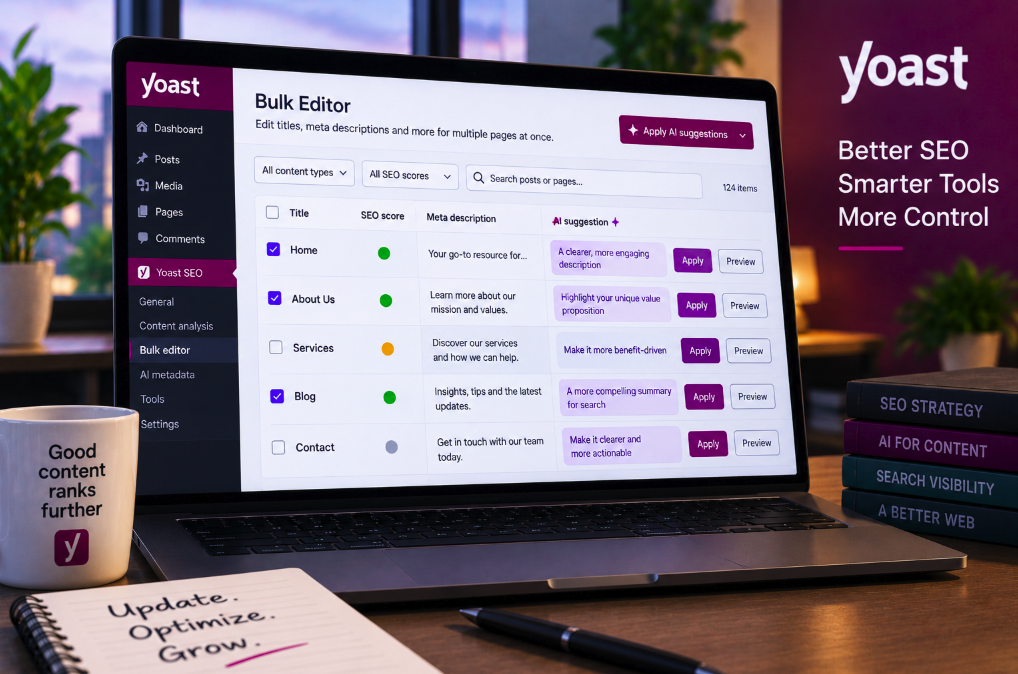
Generating SEO metadata with AI is easy. Deciding which pages need it, identifying weak drafts and reviewing hundreds of proposed changes without losing control is the harder problem. Yoast SEO 28.4 focuses on that operational layer, expanding its Bulk Editor so WordPress teams can find weak metadata faster and spot AI-generated suggestions that deserve additional scrutiny before they are saved.
The September 1 release does not introduce bulk AI metadata generation for the first time. Yoast had already added AI-assisted drafting to its Bulk Editor earlier in 2026. Instead, Yoast SEO 28.4 makes the workflow more usable at scale with quality-based filters and selection, faster row selection, warnings when AI suggestions are based on thin source content and direct access to the Bulk Editor from familiar WordPress content screens.
The Bulk Editor can now isolate metadata that actually needs work
Large sites rarely need every title and description rewritten at once. The useful question is which fields are missing or performing poorly according to the optimization criteria the team already uses. Yoast 28.4 adds “needs improvement” options to the Bulk Editor’s Filters menu for SEO titles, meta descriptions, social titles and social descriptions.
When one of those filters is applied, the editor shows the posts whose relevant field is empty or receiving a weak score. Yoast says the filter uses the same scoring logic available in the individual post editor, reducing the gap between page-by-page optimization and bulk maintenance.
This turns the Bulk Editor into more of an audit queue. Instead of scanning a long table looking for problems, editors can narrow the view to metadata that requires attention and work through that subset. For sites with hundreds or thousands of URLs, reducing the review surface can be more valuable than generating another batch of copy.
Quality-based selection connects diagnosis to action
Yoast has also added matching options to the Select menu. After filtering for weak metadata, users can select every affected post on the current page in one action rather than clicking each row manually. Because filtering and selection use the same quality score, the set of URLs shown as needing improvement can be turned directly into an editing batch.
There is also a smaller interface improvement that matters during repetitive work: Shift+click can now select a range of rows. It is conventional table behavior, but that familiarity makes the tool easier to use for editors who want to create a specific batch rather than apply changes to everything that matches a filter.
The broader pattern is important for AI-assisted SEO. Automation becomes more useful when it is targeted. Generating metadata for every page because the capability exists can waste credits, create unnecessary review work and replace copy that was already effective. Quality filters help direct AI assistance toward the places where it is more likely to add value.
Yoast now flags AI drafts generated from thin content
The most consequential AI change in 28.4 is a new warning after bulk generation. Yoast’s AI metadata tools create suggestions based on the content of the page. When a post contains very little usable text, the model has less evidence from which to produce an accurate title or description.
Previously, Yoast says those pages could still receive AI suggestions without making it obvious that the source material was unusually thin. The Bulk Editor now flags generated posts that had limited content, telling the editor which suggestions deserve a closer look. The recommended workflow is to improve the page content and regenerate the metadata where necessary.
This is a useful guardrail because metadata generation has an asymmetric failure mode. Fluent copy can look convincing even when it is based on insufficient information. A polished meta description may introduce a feature, promise or emphasis that the underlying page does not properly support. Flagging weak input helps reviewers identify where fluency should not be mistaken for confidence.
AI metadata is still a draft, not an automatic publishing decision
Yoast’s AI Generate documentation emphasizes that generated titles and descriptions are suggestions users can apply, dismiss or edit. The Bulk Editor similarly keeps approval between generation and saving. That human checkpoint becomes more important as the number of generated fields increases.
A single AI title is easy to inspect. A batch of 100 titles creates a different quality-control problem because repetition, factual errors and tone inconsistencies can become difficult to notice. The productivity gain from bulk generation therefore depends on the quality of the review interface as much as the quality of the model.
Yoast 28.4 addresses part of that problem by surfacing weak source inputs and making problematic fields easier to isolate. It does not eliminate the need for editorial review. In fact, the release effectively formalizes where that review should be concentrated.
Bulk editing now starts from the WordPress content list
The release also reduces the navigation required to begin a bulk optimization task. Users can select posts or pages from the normal WordPress overview, choose Yoast’s Bulk edit action and carry that selection directly into the Bulk Editor. Yoast’s release post says the same workflow applies to products where the relevant content type is supported.
The official Bulk Editor documentation explains that the tool can work with supported custom post types as well as standard posts and pages, including WooCommerce products and other content types added by plugins. The exact options therefore depend on the site’s configuration.
This sounds like a modest usability change, but it fits the way editorial teams actually encounter SEO problems. An editor reviewing the Posts screen may notice a group of older articles that need a metadata refresh. Requiring a separate trip into an SEO tools area breaks that context. Carrying the existing selection into the Bulk Editor turns the action into an extension of the content-management workflow.
The Bulk Editor has evolved beyond a title-and-description spreadsheet
Yoast’s bulk editing tool originally solved a straightforward problem: updating SEO titles and meta descriptions without opening every WordPress post individually. Its 2026 releases have steadily expanded that scope. The editor now includes search and status filters, views by content type, focus keyphrases, social metadata and AI-generated drafts.
Version 28.4 adds a stronger prioritization layer. The interface can identify weak fields, select them according to the same criteria and warn when AI output was created from insufficient page content. That shifts the tool from pure editing toward a workflow that combines diagnosis, generation and quality control.
For agencies and large publishers, this matters because metadata debt is rarely uniform. Some pages have no descriptions, some contain outdated messaging, some have titles that exceed practical display lengths, and others may already be perfectly adequate. A useful bulk tool should help separate those categories rather than encourage a site-wide rewrite.
AI generation is most valuable when the page itself is ready
The limited-content warning also reinforces a basic SEO principle: metadata cannot compensate for a weak page. An AI system can produce an attractive title from a few fragments of text, but if the page lacks substantive information, improving the snippet does not solve the underlying content problem.
Yoast’s AI Generate feature says its metadata suggestions are built from what the user has actually written. That is a sensible constraint because a title or description should accurately summarize and position the page rather than inventing information to improve click appeal.
The 28.4 guardrail makes that dependency visible. If there is not enough meaningful source material, the correct next step may be to strengthen the page before asking AI for a better description. In that sense, the warning is not merely about model quality; it can identify a content-quality issue upstream from the metadata.
Sites that Yoast AI cannot reach get a new fallback
Yoast is also gradually rolling out an option for sites where its AI service cannot access the content normally. The company cites firewalls, offline environments and disabled REST APIs as examples of configurations that can prevent Yoast AI from reaching a site.
Instead of ending the workflow with an error, affected users can be offered a connection to MyYoast from the message itself. Once connected, Yoast says its AI features can continue working in those more difficult hosting configurations. Because the feature is rolling out gradually, not every user will see the option immediately.
This is another reminder that AI features inside CMS plugins depend on infrastructure outside the text editor. A local WordPress installation, remote AI service, authentication layer and site-access policy all have to cooperate. Better fallback paths reduce the amount of technical troubleshooting required before editorial teams can use the feature.
The official changelog shows a focused 28.4 release
The official Yoast SEO changelog lists direct Bulk Editor access from the Posts and Pages bulk-actions menu as the core enhancement in version 28.4. It also documents a bug fix related to the AI generator’s recommendation to add more content: posts consisting largely of block markup could previously be misread as having enough content because the markup itself was counted.
That technical fix connects directly to the new quality-control message described in Yoast’s release article. Determining whether a page contains enough substantive material for AI generation requires distinguishing actual content from the structural code used to represent it. Otherwise the system can overestimate how much evidence the model has available.
The Premium changelog for 28.4 is comparatively narrow, including an improvement to messaging around automatically created redirects after slug changes. The headline story of the release is therefore the Bulk Editor workflow rather than a broad change to Yoast’s ranking analysis or AI model.
Bulk AI creates a new editorial bottleneck: approval
Tools that can generate metadata across large content libraries remove one bottleneck and expose another. Writing 200 descriptions manually is slow. Generating them in bulk can be fast, but someone still needs a defensible process for deciding whether the results are accurate, useful and consistent with the brand.
That makes prioritization features strategically important. If an SEO team can isolate only the fields that need work, identify the pages with weak AI inputs and review batches in a familiar table, it can spend human attention where automation is least reliable rather than treating every generated suggestion equally.
This is likely to be a recurring pattern in AI-powered CMS tools. As generation becomes cheap, the differentiating feature becomes control: knowing what should be generated, understanding why a suggestion might be weak and making approval efficient without turning it into a rubber stamp.
Yoast 28.4 is more about control than more AI
The release is easy to describe as an expansion of AI metadata editing, but the more interesting change is the layer around the AI. Yoast is not simply adding another button that produces text. It is improving the system that decides which pages should enter the workflow and which outputs deserve extra human attention.
For WordPress teams, that is a more mature use of generative AI than indiscriminate automation. Metadata can be drafted quickly, but it still has to reflect the page, satisfy search and social requirements and communicate the right message to users. Weak source content remains weak source content, no matter how fluent the generated description sounds.
Yoast SEO 28.4 therefore makes bulk optimization faster without pretending that scale removes the need for judgment. The Bulk Editor can find the weak fields, AI can draft replacements and new warnings can point reviewers toward higher-risk suggestions. The final decision still belongs to the editor — which is exactly where a bulk AI workflow needs its strongest control.