
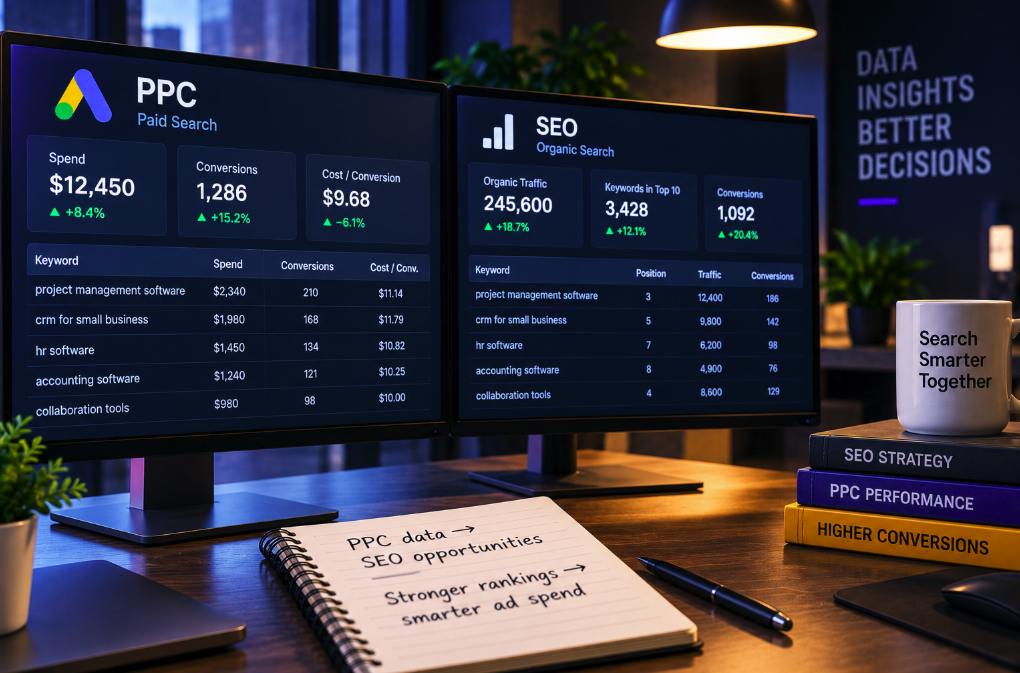
Some of the most useful SEO keyword research may already be sitting inside the paid-search account. Every expensive click, conversion and failed campaign is a live market test showing which queries attract buyers, which messages move them and which landing pages turn search demand into revenue.
That makes PPC data more than a reporting input for the advertising team. It can become a prioritization system for organic search. If a business is repeatedly paying significant amounts to capture a keyword that produces profitable conversions, earning durable organic visibility for the same commercial intent may deserve more SEO investment than a higher-volume topic with weaker business value.
The relationship also works in reverse. When a site already holds strong organic positions, produces reliable conversions and faces limited paid competition, continuing to buy every available click may not always be incremental. SEO data can identify places where advertisers should test whether some paid budget can be reduced or redirected without sacrificing total revenue.
This is the central argument behind Search Engine Land's latest analysis of the insights SEO and PPC teams leave unused when they operate separately. The opportunity is not to make one channel replace the other. It is to let the channels tell each other where the next marginal dollar or hour of work is most likely to matter.
PPC has something SEO often lacks: fast commercial feedback
Organic keyword research is rich in visibility data. Search Console can show impressions, clicks, positions and queries. SEO platforms can estimate volume, difficulty and competitor rankings. Analytics can connect landing pages with conversions.
What organic teams often lack is the ability to run a rapid, controlled market test on a keyword that does not yet rank. SEO may require weeks or months of content, links, technical work and iteration before a page earns enough visibility to reveal whether the query was commercially valuable in the first place.
PPC compresses that feedback loop. An advertiser can bid on a query, expose an offer to real searchers and measure whether those visits become leads, sales or other business outcomes. The test costs money, but the resulting data can reduce uncertainty elsewhere.
That is why paid conversion data can be a better SEO prioritization signal than search volume alone. Volume tells you how often people search. Paid performance can tell you whether the people searching are valuable to the business.
Your expensive keywords are not automatically bad keywords
High cost per click is usually discussed as a problem to control. From an SEO perspective, however, expensive keywords can also reveal where businesses are competing hardest for valuable demand.
A keyword that consumes substantial paid budget month after month and still meets profitability targets is sending a clear signal: the business is willing to pay for access to this audience because the downstream economics justify it.
That does not mean every expensive PPC keyword should become an SEO project. CPC can be inflated by competition, poor account structure or inefficient bidding, and some paid queries may be too narrow or volatile to support a meaningful organic asset.
But when high spend coincides with consistent conversions, qualified leads and meaningful revenue, the term deserves serious organic attention. SEO can potentially create an asset that keeps capturing part of that demand without charging the company for every click.
Prioritize conversion value, not just conversion count
A keyword generating 100 form fills is not necessarily more important than one generating 20. If the first attracts low-quality leads and the second produces high-value customers, optimizing around raw conversion volume will send both PPC and SEO in the wrong direction.
The useful handoff from paid to organic therefore needs deeper-funnel data where possible: qualified opportunities, signed contracts, revenue, margin, customer lifetime value or another measure tied to the business model.
This principle mirrors a broader shift in paid search. Ad platforms increasingly optimize toward the conversion signals advertisers provide. If those signals stop at the first form submission, the machine can become very efficient at producing actions the sales team does not value.
SEO teams inherit the same risk when they use PPC reports. The question is not merely “which keywords convert?” It is “which search intents repeatedly create valuable business outcomes?”
Paid search can validate an SEO investment before months of work
Imagine an enterprise software company considering a major organic landing page for a highly competitive commercial query. The page will require subject-matter expertise, design, technical implementation, internal links and potentially months of authority building.
Instead of committing entirely on keyword-volume and difficulty estimates, the company can use paid search to test the intent. If qualified traffic consistently converts, the SEO business case becomes stronger. If hundreds of paid visits fail to produce meaningful outcomes, the organic team has learned something before investing heavily.
The paid test is not a perfect forecast of organic performance. Ads occupy different positions, carry different messaging and can attract different click behavior. But it supplies direct evidence about the commercial audience behind the query.
Search Engine Land's broader guide to organic and paid search makes the same strategic point: PPC data can reveal which keywords, headlines and calls to action resonate, giving SEO teams real behavioral information rather than forcing them to guess.
Search-term data can expose opportunities keyword tools miss
Paid accounts can also reveal the language customers actually use when they are close to a decision. Search-term reports contain variants, modifiers and problem descriptions that may not appear prominently in conventional keyword-research workflows.
Those terms can expose entire organic content opportunities. A cluster of converting searches around implementation, pricing, compatibility or alternatives may justify a dedicated comparison page, product page, FAQ or commercial guide.
The SEO team gains more than a keyword. It gains evidence about the underlying intent and the language associated with conversion.
That is particularly valuable as exact keyword targeting becomes less central to both paid and organic search. The goal is increasingly to understand the commercial problem represented by a family of queries rather than optimize a separate page for every wording variation.
PPC creative is also an SEO messaging laboratory
Paid campaigns test more than keywords. They test propositions. Advertisers rotate headlines, descriptions, offers and calls to action while receiving performance feedback much faster than most organic pages can generate it.
If one paid message repeatedly produces stronger engagement or conversion quality, the organic team should understand why. The winning language may identify a customer concern that deserves greater prominence on the SEO landing page.
This does not mean copying ad headlines into title tags mechanically. Paid and organic results operate under different constraints, and ad performance is influenced by bidding, placement and audience signals.
The opportunity is conceptual. PPC can reveal which benefits, objections and differentiators matter to searchers. SEO can then build richer content around those validated themes.
The feedback loop works in the opposite direction
SEO can also help PPC decide where money is being spent unnecessarily. Search Engine Land has long recommended comparing organic visibility with paid coverage rather than managing each channel as an isolated budget.
Its co-optimization audit framework suggests examining queries where organic performance is strong, weak or absent and then using that information to guide paid decisions. Older Search Engine Land analysis similarly identifies situations where a top organic position and little paid competition may create an opportunity to conserve advertising budget.
The logic is intuitive. If a company ranks first organically, receives a high share of clicks and would capture most of those users even without an ad, buying the same traffic may have low incremental value.
But this is exactly where simplistic SEO-versus-PPC thinking becomes dangerous.
Ranking number one does not prove an ad is wasteful
A strong organic ranking is only one input. The modern results page can place several ads, shopping units, maps, AI answers and other features above the first traditional organic result.
Search Engine Land's July analysis, “Why the SEO vs. PPC debate is finally over,” describes an architect ranking first for important queries but receiving almost no clicks because numerous SERP features appeared before the organic listing. Moving budget toward paid search improved performance.
That example demonstrates why “we rank first, switch off PPC” is not a strategy. The correct question is whether the ad generates incremental conversions beyond what organic would have captured alone.
Answering that requires testing, not assumption.
Use controlled budget tests to measure cannibalization
Where organic rankings are strong, advertisers can reduce bids or pause selected campaigns for a defined period and measure what happens to total search performance. The relevant outcome is not whether paid conversions fall — they almost certainly will — but whether organic conversions rise enough to replace them.
If most paid conversions migrate naturally to organic, the business may be able to redirect advertising budget to queries where organic visibility is weak. If total conversions collapse, the paid placement was adding real incremental reach.
The test needs safeguards. Seasonality, competitor promotions, brand demand and algorithm changes can distort short experiments. High-value terms may require geographic or time-based holdouts rather than a universal pause.
The principle is nevertheless powerful: let observed incrementality determine the budget rather than assuming that paid and organic clicks are interchangeable.
Brand and non-brand terms need different treatment
Branded queries are often the first place teams look for paid-search savings because organic results usually perform strongly. Yet even here, the answer depends on the auction.
If competitors bid aggressively on the brand name, removing the ad can hand the most prominent commercial placement to a rival. If the SERP is uncontested and the company's organic listing dominates, the incremental value of paying for every branded click may be lower.
Non-brand commercial terms present the opposite problem. They often carry higher CPCs but represent users who have not yet chosen a company. Strong organic visibility can be strategically valuable precisely because the advertiser otherwise has to keep purchasing access to that demand.
A useful SEO/PPC integration model therefore separates branded demand, category demand and competitor demand instead of treating all shared keywords equally.
AI search makes channel isolation even less defensible
The relationship between paid and organic is becoming more complicated as AI answers enter the search journey. Search Engine Land's August analysis of the new search journey argues that AI answers, ads, organic results and follow-up queries now influence one another across a loop rather than a linear funnel.
A user may encounter a brand inside an AI answer, click a paid result on the next query and later return through organic search before converting. In that journey, assigning the sale exclusively to PPC because it generated one click misses the role of earlier visibility.
The same article cites Seer data showing an association between AI Overview citations and higher organic and paid click-through rates, although the study could not prove causation and the paid sample was limited.
The strategic lesson is broader than the statistic: paid and organic visibility can reinforce one another, which makes budget decisions based on last-click channel reports increasingly unreliable.
Build one search opportunity table, not two reporting silos
The operational solution is surprisingly simple. SEO and PPC teams need a shared query-level view containing the metrics each side normally keeps to itself.
For paid search, that means spend, clicks, CPC, conversions, conversion value and ideally deeper-funnel revenue or lead quality. For organic search, it means position, impressions, clicks, CTR, landing page and conversions. Competitive density and SERP features add useful context.
Once those signals sit together, four opportunity types become visible. High-value paid terms with weak organic visibility become SEO candidates. Strong organic terms with expensive paid coverage become incrementality-test candidates. Queries weak in both channels expose coverage gaps. Terms strong in both may justify continued dominance when the combined presence produces better economics.
The objective is not to eliminate overlap. It is to understand which overlap is valuable.
The most expensive PPC keyword may be an SEO business case
SEO prioritization often begins with volume, ranking difficulty and content gaps. Those metrics describe the search landscape, but they do not automatically describe business value.
Paid search can add the missing commercial layer. If a company has spent significant money on a keyword for months because it consistently produces profitable customers, the SEO team no longer needs to speculate about whether the intent matters.
That does not guarantee an organic page will rank or convert at the same rate. It does mean the organization has evidence that the demand is worth competing for.
Conversely, SEO can show the paid team where durable organic visibility may reduce the need to purchase every marginal click — provided controlled testing confirms that total conversions survive the reduction.
The smartest search strategy is therefore not SEO or PPC. It is using paid search as a fast market-research system, organic search as a compounding visibility asset and the combined data to decide where the next investment should go.