
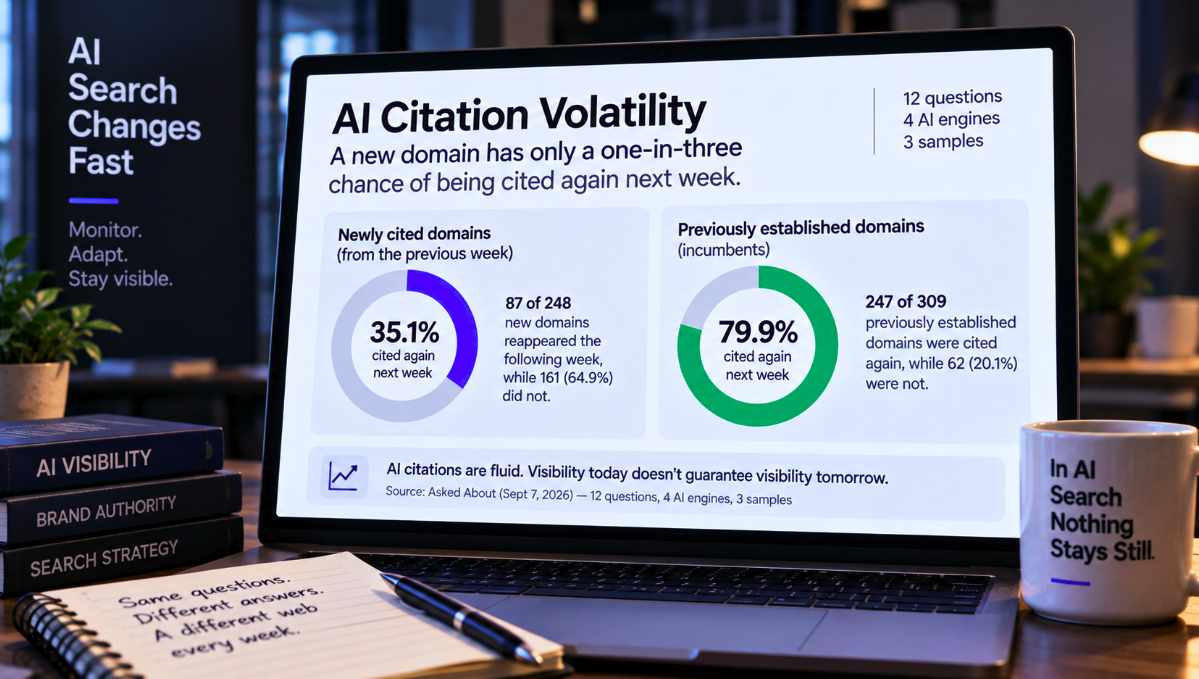
A first AI citation can feel like a breakthrough. A small longitudinal dataset suggests marketers should treat it more like a provisional observation.
AskedAbout tracked the same 12 buyer-oriented questions across ChatGPT, Perplexity, Gemini and Claude and found that only 87 of 248 domains newly entering its citation set on August 31 appeared again one week later.
That is a survival rate of 35.1%.
Domains that were already established in the panel behaved very differently. Of 309 sources that had been cited in consecutive runs and were therefore classified as incumbents, 247 were cited again on September 7 — a 79.9% persistence rate.
The September 7 AskedAbout study is small and highly specific. It measures domain persistence across 12 fixed questions, four AI engines and three samples per engine. It does not establish that every new AI citation on the web has exactly a one-in-three probability of surviving another week.
But the latest result is not isolated. Across five consecutive weekly transitions, new domains have repeatedly been much less durable than sources already established in the citation set.
That makes the study useful for a practical GEO question: when an AI monitoring tool reports a new citation, how much confidence should a marketer place in that single appearance?
The answer appears to be: not much until it repeats.
The latest entrant survival rate was 35.1%
AskedAbout defines an entrant as a domain cited in the current weekly run that was not cited in the previous one.
On August 31, 248 domains met that definition. When the identical panel was rerun on September 7, 87 appeared again in at least one citation array from any of the four engines.
The remaining 161 disappeared from the measured citation set.
That produces the 35.1% survival figure behind the headline.
The unit matters. AskedAbout is measuring domains, not individual URLs or individual citation positions. If one page disappears but another page from the same hostname is cited, the domain still counts as surviving.
“A new AI citation has a one-in-three chance of surviving” is therefore a useful editorial shorthand for this dataset, but the precise statement is narrower: 35.1% of domains newly cited in the August 31 run were cited again somewhere in the same 12-question, four-engine panel on September 7.
Established sources survived at 79.9%
The contrast with incumbent domains is the more important result.
AskedAbout defines incumbents as domains cited in both the run before the current one and the current run. In other words, these sources had already demonstrated at least one week of persistence.
There were 309 incumbents in the August 31 set. One week later, 247 remained.
That 79.9% survival rate is more than twice the rate for newly appearing domains.
The pattern suggests that citation persistence is not evenly distributed. A source that has already survived one transition appears substantially more likely to remain visible than a domain appearing for the first time.
That does not reveal why. Persistent sources may be more authoritative, relevant across more prompts, retrieved by more engines or simply better matched to the fixed question set.
The study measures the outcome, not the causal mechanism.
The entrant-versus-incumbent gap has appeared five weeks in a row
The strongest feature of the experiment is repetition.
Across five measured weekly transitions, new-domain survival rates were 29.4%, 27.5%, 30.1%, 33.2% and 35.1%.
Incumbent survival rates over the same transitions were 77.9%, 76.5%, 75.0%, 73.9% and 79.9%.
The exact percentages move, but the shape has remained consistent: roughly three in ten new entrants return, while roughly three-quarters or more of established sources return.
AskedAbout had pre-registered ranges before the latest run. It predicted that 20% to 40% of entrants would survive and 65% to 85% of incumbents would survive. Both September 7 results landed inside those bands.
The publisher has kept the same ranges for the September 14 test rather than narrowing them after a successful prediction.
That pre-registration improves the evidential value of the repeated observation because the ranges were stated before the result was known.
It still does not transform a 12-question proprietary panel into an industry-wide benchmark.
One citation in one answer was especially fragile
The study becomes more useful when new domains are divided by how broadly they appeared during their first week.
Of 171 entrants cited in only one answer on August 31, just 42 returned on September 7. That is 24.6%.
Entrants cited in two answers survived at 61.5%, with 24 of 39 returning. Domains cited in three or more answers survived at 55.3%, with 21 of 38 returning.
The ordering between the two multi-answer groups moved compared with the previous week, so it would be a mistake to conclude that exactly two citations are somehow better than three.
The durable split is simpler: a domain appearing in only one answer is much more fragile than a domain appearing repeatedly.
For AI visibility reporting, that argues against treating every first citation as an equally meaningful win.
Multi-engine visibility also looked more durable
Breadth across AI engines showed a similar pattern.
Among entrants cited by only one engine on August 31, 82 of 242 survived to the following week, or 33.9%.
Five of the six entrants initially cited by two engines survived, producing an 83.3% rate.
The difference is large but the multi-engine sample is extremely small. Six domains are nowhere near enough to estimate a stable 83.3% benchmark.
Still, the directional idea is plausible: appearing across multiple independent retrieval systems may be stronger evidence of durable source relevance than appearing once in one generated response.
That is a hypothesis the panel can continue testing as more transitions accumulate.
The engine that introduced a source mattered — but the ranking changed
AskedAbout also grouped entrants by the AI engine that first introduced them.
For the August 31 cohort, domains introduced by ChatGPT survived somewhere in the four-engine panel at 49.4%. Perplexity-introduced domains survived at 46.4%, Claude at 37.1% and Gemini at 24.6%.
Those numbers should not be turned into an engine-quality leaderboard.
The previous week, Perplexity had the highest entrant survival rate at 66.7%, while ChatGPT was at 38.8%. The top two therefore swapped positions in a single transition.
AskedAbout itself warns that the ordering is unstable.
The safer observation is that the engine associated with a new citation appears related to its persistence in this panel, but the magnitude and rank can move substantially from week to week.
Returning somewhere is easier than returning in the same engine
The headline survival definition is deliberately broad.
If Gemini introduces a domain one week and ChatGPT cites it the next, AskedAbout counts that domain as surviving.
When the test requires the same engine to cite the domain again, persistence falls.
For the latest cohort, same-engine survival was 42.9% for ChatGPT-introduced entrants, 39.3% for Perplexity, 25.7% for Claude and 21.9% for Gemini.
This distinction matters for brand reporting.
A domain can maintain broad AI visibility while moving between engines. Conversely, a brand monitoring only one platform can experience substantial apparent volatility even if other AI systems continue citing it.
“AI visibility” is therefore not one metric unless the measurement system defines exactly which engines, prompts and recurrence rules it includes.
The September 7 run itself replaced hundreds of domains
The churn is visible at the full-panel level as well.
Of the 557 domains cited on August 31, 223 were absent on September 7. That is a 40% dropout rate.
Another 334 stayed, while 218 domains entered the set that had not appeared the week before.
The September 7 run cited 552 distinct domains in total. Of those, 452 appeared in only one engine, 67 in two engines, 28 in three and just five across all four.
The citation ecosystem therefore combines a relatively small durable core with a much larger layer of sources that appear narrowly or temporarily.
That structure has major implications for how GEO dashboards should present changes.
A weekly visibility report can confuse churn with progress
Imagine a brand receives its first ChatGPT citation on Monday.
A dashboard might mark that as a green upward trend. A marketing report might announce that a GEO initiative has “earned ChatGPT visibility.”
If the source disappears the following Monday, the original claim becomes much weaker.
The AskedAbout data suggests first appearances should be labeled differently from persistent visibility.
A practical dashboard might distinguish new citations, repeat citations, multi-week incumbents and cross-engine citations rather than collapsing everything into a single citation count.
This is similar to the distinction between a one-day ranking spike and a stable search position. Both are observable, but they do not carry the same strategic meaning.
Persistence may be a better KPI than raw citation acquisition
Most GEO measurement currently emphasizes acquisition: how many prompts cite the brand, how many engines mention it and how citation share changes.
Those metrics are useful but incomplete if the underlying sources churn rapidly.
Persistence asks a different question: once the brand or domain enters the citation set, does it stay there?
A campaign that generates 100 new citations with 20% weekly persistence may create less durable visibility than one generating 30 new citations that repeatedly survive.
That does not mean persistence should replace citation count. It means the two metrics describe different dimensions of visibility.
Acquisition measures entry. Persistence measures durability.
The fixed 12-question panel is both a strength and a limitation
AskedAbout sends the same 12 questions each week, which is useful because it reduces one major source of variation.
If the questions changed every week, citation churn could simply reflect changing information needs.
Keeping the prompts pinned makes week-to-week comparisons more meaningful.
But the same design sharply limits generalization.
The questions are focused on issues a small business might ask about its own AI visibility. A panel about medical advice, travel planning, software procurement, financial research or consumer products could produce a different source ecosystem and different persistence rates.
The observed 35.1% is a property of this instrument and this week’s cohort, not a universal constant of generative search.
Three samples per engine reveal variation, but only partially
Each question is run three times on each engine, producing 144 answers per weekly measurement.
Multiple samples are important because generative systems are nondeterministic. Asking the same question twice can produce different wording, sources and citation sets.
Three samples provide more information than one.
They still cannot capture the complete distribution of possible answers.
A domain absent from all three samples might appear on a fourth. A source cited once could be a low-probability retrieval candidate or simply the result of ordinary generation variance.
This is another reason why repeated appearances are more informative than isolated ones.
Domain-level survival hides page-level volatility
AskedAbout strips “www” and evaluates citation persistence at the hostname level.
That is useful for measuring whether a source organization remains represented, but it can hide churn underneath.
Suppose an AI engine cites example.com/report-a one week and example.com/report-b the next. At the domain level, example.com survives. At the page level, the cited document changed completely.
For brands, both views matter.
Domain persistence can indicate durable source authority. URL persistence can indicate whether a specific product page, study or article has become a stable retrieval asset.
Future GEO measurement will likely need both.
Some domains are genuinely persistent
Despite the churn, the experiment also shows that durable AI sources exist.
AskedAbout reports that 139 domains have appeared in all seven weekly runs since July 28.
The most frequently cited persistent sources include community platforms, software review sites, marketing technology companies and specialist AI-search publishers.
The presence of a seven-week core is important because it shows the system is not random source rotation.
Some domains repeatedly satisfy the information needs represented by the panel across engines and over time.
The research question then shifts from “how do I get cited once?” to “what distinguishes sources that become incumbents?”
The study cannot tell us why incumbents persist
Several explanations are possible.
Incumbent domains may contain more authoritative information. They may have stronger traditional search visibility. Their pages may be easier for retrieval systems to access. They may answer multiple related questions rather than one narrow prompt. They may be cited across several engines, creating more opportunities to survive the next run.
They may also simply align unusually well with this particular set of 12 questions.
The observational design cannot isolate those variables.
It would therefore be premature to call “incumbency” itself a ranking factor. The incumbent label describes past citation behavior; it does not explain the mechanism producing that behavior.
The next week's result is already pre-registered
The study has created a useful falsification mechanism for its own pattern.
On September 7, 218 domains entered the citation set. Those domains become the next entrant cohort.
AskedAbout has pre-registered that 20% to 40% should be cited again on September 14. It also predicts that 65% to 85% of the 334 incumbents will return and that single-answer entrants will survive at a lower rate than both multi-answer groups.
If any result falls outside its stated condition, the publisher says it will report the falsification.
That does not eliminate all methodological limitations, but it is a stronger research practice than repeatedly adjusting a narrative after seeing each week’s numbers.
GEO teams should stop celebrating a citation before checking whether it repeats
The practical lesson from five transitions is not that a new citation is worthless.
It is that first appearances contain less information than persistent ones.
A new citation is evidence that an engine retrieved and exposed the domain for at least one sampled answer. A repeat citation suggests that visibility survived another independent run. Repeated appearances across answers, questions, engines and weeks provide progressively stronger evidence that the source occupies a durable position in the retrieval environment.
This suggests a more mature GEO reporting hierarchy.
Instead of simply counting citations, marketers should monitor citation frequency, prompt breadth, engine breadth, week-over-week survival and the age of each citation relationship.
A source cited once yesterday and a source cited across four engines for six consecutive weeks should not receive the same status in a dashboard.
One in three is the headline, not a law of AI search
AskedAbout’s latest transition is memorable: only 35.1% of newly cited domains returned one week later, while 79.9% of incumbents did.
The preceding four transitions tell a similar story, with entrant survival between 27.5% and 33.2% and incumbent survival between 73.9% and 77.9%.
That repeated gap is meaningful evidence that, inside this fixed panel, new citations are substantially more volatile than established ones.
It is not evidence that every new citation earned by every brand has a mathematically fixed 35% survival probability.
The sample contains only 12 questions. It combines four engines with different citation systems. It uses three samples per engine. It aggregates at the domain level and observes weekly snapshots rather than continuous behavior.
Those limitations do not erase the result. They define it.
For GEO teams, the most defensible takeaway is simple: a citation should not be considered durable merely because it appeared once.
In AI search, visibility is not only something to acquire. It is something to survive.