
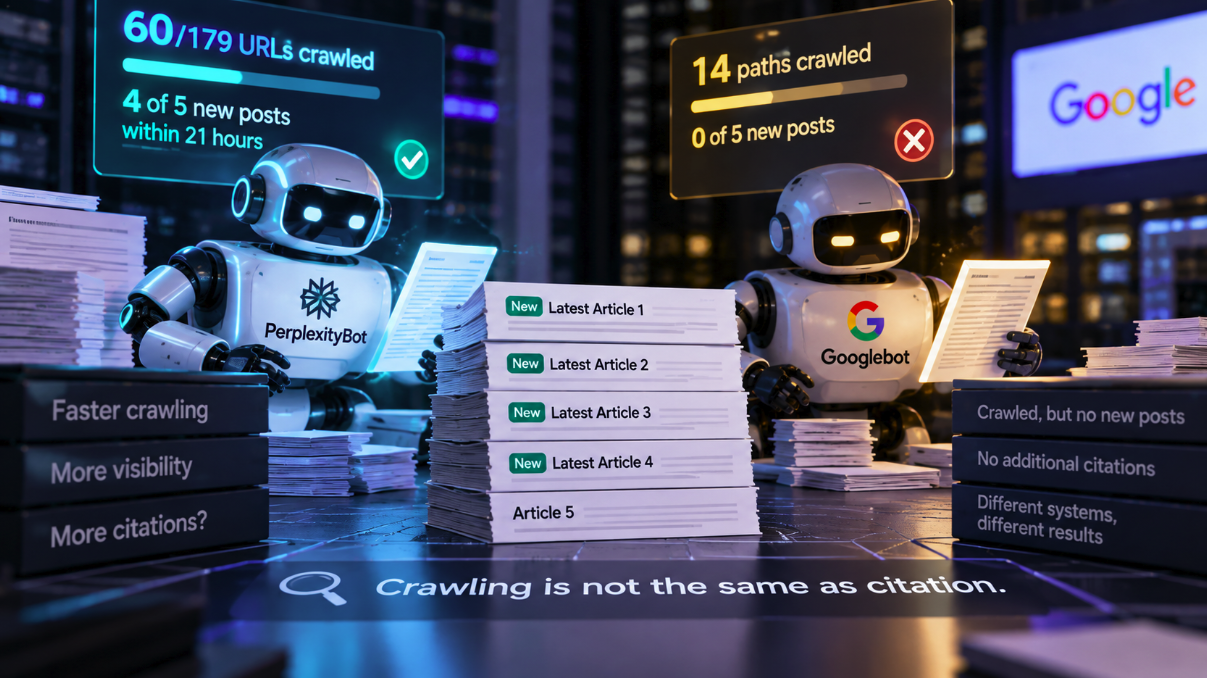
Getting an AI crawler to fetch a page is not the same as getting an AI system to cite it.
A small server-log study from AskedAbout makes that distinction unusually visible. During a 28.5-hour comparison window, PerplexityBot requested 60 distinct paths on the site and reached four of its five newest posts. Googlebot requested 14 distinct paths and reached none of those five new articles.
Perplexity’s faster retrieval did not translate into more citations in the publisher’s fixed weekly test.
The September 7 AskedAbout analysis found that Perplexity still cited the site in three of 36 measured answers, all pointing to the same older comparison page. One week earlier, before the new sweep, the result had also been three of 36 answers citing exactly the same page.
That does not prove crawling had no effect on citations. The citation panel is tiny, the post-crawl measurement happened only 5.4 hours after the sweep ended and the experiment cannot observe every possible Perplexity query.
What it does demonstrate cleanly is a principle that matters for generative engine optimization: crawler access is a prerequisite for some retrieval systems, but access alone does not establish relevance, authority or citation selection.
PerplexityBot covered 60 distinct paths in two short bursts
The most striking behavior in the server logs was not simply how much PerplexityBot fetched but how it fetched it.
AskedAbout recorded two major PerplexityBot bursts between September 6 and September 7. The first generated 44 requests across 44 paths in nine minutes. The second generated 17 requests across 17 paths in about 20 minutes.
The bursts overlapped on only one path, robots.txt, producing 60 distinct paths collectively.
Fifty-nine of those 60 paths were present in the site’s 179-URL live sitemap, meaning the sweep covered roughly one-third of the sitemap inventory in less than a day.
But the source also reports that PerplexityBot did not fetch the sitemap during the seven-day observation period. The data therefore does not support saying that a sitemap submission triggered the sweeps.
The behavior looked more like periodic broad refreshes than continuous page-by-page discovery.
The crawler reached four fresh articles within about 14 to 20 hours
The newest-content comparison is particularly interesting.
Four posts had been live for more than a day when AskedAbout took its measurement. PerplexityBot had fetched all four, with the first requests occurring 14.4, 17.1, 19.4 and 20.4 hours after publication.
The fifth and newest article had been live for only 2.8 hours and had not yet been fetched by PerplexityBot.
This makes “four of five within 21 hours” accurate for the measured set, but it should not be converted into an expected Perplexity discovery SLA.
All four fetches occurred during the broad sweeps. Between those sweeps, the publisher observed PerplexityBot fetching only about two paths per day, one of which was often robots.txt.
The previous broad sweep had occurred 5.3 days earlier.
On this site, a new article was discovered quickly because its publication happened to precede a sweep. Another article published just after a sweep could plausibly have experienced a very different delay.
Googlebot generated 39 requests but reached only 14 distinct paths
Googlebot’s traffic had a different shape.
During the same 28.5-hour window, AskedAbout recorded 39 Googlebot requests across 14 distinct paths. Eighteen of those requests were for robots.txt and three were for the sitemap.
Googlebot fetched nine news articles, but all had been published before September 5. It also requested one guide, one comparison page and one data page.
None of the five newest posts received a Googlebot request.
This is why comparing raw request counts can be misleading. Thirty-nine Googlebot rows did not mean 39 pieces of content were crawled; repeated requests to robots.txt and other resources reduced the number of unique paths reached.
PerplexityBot, by contrast, generated 63 requests across 60 paths during the window, almost a one-request-per-page pattern.
Google does not promise to crawl every discovered URL immediately
The contrast should not be interpreted as evidence that Googlebot is generally slower than PerplexityBot.
Google’s official Search documentation says Googlebot uses algorithmic systems to decide which sites to crawl, how often to visit them and how many pages to fetch. Google also explicitly says it does not crawl every URL it discovers.
Its crawl troubleshooting guidance says most sites should expect new pages to take at least several days to be noticed and generally should not expect same-day crawling unless time sensitivity is central to the site.
AskedAbout is one small website during one short observation period. Large news organizations and highly crawled domains can show completely different Googlebot behavior.
The experiment is evidence about this site, not a crawler-speed leaderboard for the web.
When Googlebot finally fetched one sampled page, indexing followed quickly
AskedAbout’s parallel indexing experiment provides another useful detail.
The publisher had pre-registered 14 URLs on August 28 and was monitoring their Search Console status. By day 11, three were indexed.
One newly indexed URL received its first Googlebot request on September 7 at 12:42 UTC. Search Console subsequently reported it as submitted and indexed less than four hours later.
The publisher had observed a similar first-fetch-to-index transition on another sampled page the previous day.
That leads AskedAbout to characterize its local bottleneck as waiting for Googlebot to fetch the page rather than a long processing delay after fetching.
It is an interesting site-level observation, not a general rule. Google can crawl a URL and still choose not to index it, and the relationship between crawling and indexing varies by page and site.
Perplexity officially separates its search crawler from its user fetcher
The identity of the crawler matters when interpreting the logs.
Perplexity’s official crawler documentation says PerplexityBot is designed to surface and link websites in Perplexity search results. The company explicitly says it is not used to crawl content for training AI foundation models.
Perplexity separately operates Perplexity-User, which can fetch a page in response to a user request so the system can answer a question and potentially link to that page.
The AskedAbout experiment specifically measured requests classified as PerplexityBot.
That makes the crawl relevant to search visibility, but it still does not mean every fetched URL becomes a candidate for every answer. Retrieval and citation systems have additional selection stages after access.
The citation panel did not move after the sweep
AskedAbout ran its weekly citation gauge 5.4 hours after PerplexityBot’s second sweep ended.
The test consists of 12 questions, each sampled three times in Perplexity, creating 36 answers.
Three of those 36 answers cited AskedAbout. All three linked to the same comparison page.
The previous week’s gauge had produced exactly the same result: three of 36 answers, all citing the same page.
The sweep had fetched 60 paths. The measured citation set remained one path.
This is the cleanest illustration in the experiment of why crawl coverage and citation visibility should not be treated as equivalent metrics.
But “no new citations” is narrower than it sounds
The citation result has several important limitations.
First, 12 questions cannot represent everything people ask Perplexity. A newly crawled page might have become eligible for a different query outside the panel without the experiment detecting it.
Second, the post-sweep measurement occurred only a few hours later. The study does not establish how quickly a PerplexityBot fetch propagates through whatever indexing, retrieval and ranking systems ultimately support citations.
Third, the experiment is observational. It did not randomly expose one set of URLs to PerplexityBot while withholding another comparable set.
AskedAbout itself is careful about this point. It reports the citation gauge beside the crawl data but explicitly says the panel cannot attribute a citation to a crawl.
The result is therefore “the measured citation count did not increase,” not “Perplexity crawling has no effect on citations.”
Crawling answers “can the system access this?”
A crawler request establishes something relatively narrow: the crawler reached the URL at a particular time.
That is valuable information.
If PerplexityBot is blocked by robots.txt, a firewall or server configuration, the page may not be available to the crawler that Perplexity says it uses to surface websites in search results.
Allowing legitimate crawler access removes that obstacle.
But once the page is fetched, the harder questions begin. Is the page relevant to a user’s prompt? Does it contain information worth quoting or linking? Is another source more authoritative or direct? Does the retrieval system consider the page fresh enough, specific enough or useful enough for the particular answer?
Server logs cannot answer those questions by themselves.
Retrieval is a second filter
In information-retrieval terms, a fetched document joins a larger corpus from which a system may select candidates.
Being present in that corpus does not guarantee retrieval for a query.
A page about enterprise accounting software is unlikely to be selected for a question about running shoes merely because Perplexity crawled it recently. Even within the correct topic, many documents can compete to answer the same question.
This is where GEO moves beyond crawler configuration.
Publishers need content that maps clearly to real information needs, contributes useful facts and gives the system a reason to select it over alternative sources.
Fast crawling improves freshness potential. It does not manufacture relevance.
Citation is a third filter after retrieval
Even retrieval does not necessarily equal citation.
An AI system can retrieve multiple documents while citing only a subset in the final answer. It can use one source to verify a fact and another as the visible supporting link. Product design can also limit the number of citations displayed.
This means AI visibility should be measured as a funnel rather than a single crawler metric.
At the top is accessibility: can the crawler reach the content? Then comes discovery and ingestion. Then retrieval: does the page appear for the prompts that matter? Then citation or mention: does the user actually see the brand or URL? Finally comes business impact: does that visibility produce qualified visits, leads, purchases or brand lift?
Optimizing one stage does not guarantee the next.
The site’s broader crawler data also prevents a simplistic Perplexity-versus-Google story
PerplexityBot was not the only crawler aggressively visiting AskedAbout during the comparison window.
Meta’s crawler generated 573 rows across 72 distinct paths. Other bot-shaped agents collectively reached 73 paths. Amazonbot requested 34 distinct paths, while OpenAI’s GPTBot and OAI-SearchBot group reached 22.
PerplexityBot’s 60-path sweep was distinctive because of its broad one-request-per-page shape and its rapid reach into recent articles, not because it was the only automated system discovering the site.
That broader context matters. Different AI and search companies operate different crawlers for different purposes, with different schedules and retrieval architectures.
A single server-log window cannot rank their overall freshness capabilities.
The crawler identities were based on user agents, not reverse-DNS verification
AskedAbout discloses another methodological limitation that should remain attached to the result.
Its ledger classifies crawler vendors based on user-agent strings. The rows were not reverse-DNS verified.
Every relevant Perplexity request declared the expected PerplexityBot/1.0 token, but a user-agent string can theoretically be spoofed.
Perplexity recommends that webmasters verify its crawler using both the published user-agent and its official IP ranges when configuring firewalls.
For operational bot auditing, that stronger verification is preferable to relying on the header alone.
Faster crawling matters most when freshness matters
The lack of an immediate citation increase does not make PerplexityBot’s faster discovery irrelevant.
For fast-changing information, retrieval systems need a recent copy before they can accurately represent a new product, price, policy, research result or breaking event.
A crawler that revisits fresh pages quickly has the potential to reduce information lag.
But the value of that freshness only appears when the page is relevant to an actual user question and survives the system’s later selection stages.
A fresh page nobody asks about can be perfectly crawled and never cited.
Conversely, an older authoritative page can continue receiving citations because it remains the strongest answer to a recurring question — exactly what happened with AskedAbout’s single comparison URL in the weekly panel.
Server logs and citation monitoring measure different things
The study also demonstrates why GEO teams need more than one dashboard.
Server logs can show crawler access with high precision. They reveal which user agent requested which path and when. They can expose blocks, burst behavior, repeated fetches and differences in freshness across crawlers.
Prompt monitoring measures something downstream: what AI systems actually say and which sources they expose for selected questions.
Neither metric replaces the other.
A brand could have excellent crawler coverage and poor citation visibility. It could also be cited from an older indexed page while its newest content remains uncrawled.
Without both views, teams can easily misdiagnose the problem.
Do not mistake bot traffic for AI visibility
As AI crawler traffic becomes more visible in analytics and server logs, publishers will be tempted to treat rising bot requests as progress.
That can be useful as an accessibility metric. It is not an outcome metric.
One hundred crawler requests do not equal 100 citations. A broad site sweep does not mean the engine now recommends the brand. A fetch of a product page does not mean the product will appear in a commercial answer.
The AskedAbout data makes this especially clear: PerplexityBot covered 60 paths, yet the fixed citation panel continued to expose exactly one AskedAbout URL.
That gap is where most of the difficult GEO work lives.
The strongest lesson is about the retrieval pipeline, not crawler speed
The headline comparison is visually dramatic. PerplexityBot reached 60 distinct paths while Googlebot reached 14. Perplexity fetched four of the five newest posts within roughly 21 hours, while Googlebot fetched none.
On this site, during this window, Perplexity clearly refreshed recent content faster.
But the more important result comes afterward.
The Perplexity citation panel did not change. Three of 36 answers still cited the same older comparison page that had been cited one week earlier.
That does not prove the new pages will never be cited. It does not establish that Perplexity is always faster than Google, and it certainly does not show that crawl frequency is a ranking factor.
It shows that access, retrieval and citation are separate events.
For publishers chasing AI visibility, getting crawled is necessary enough to monitor — but insufficient to celebrate.