
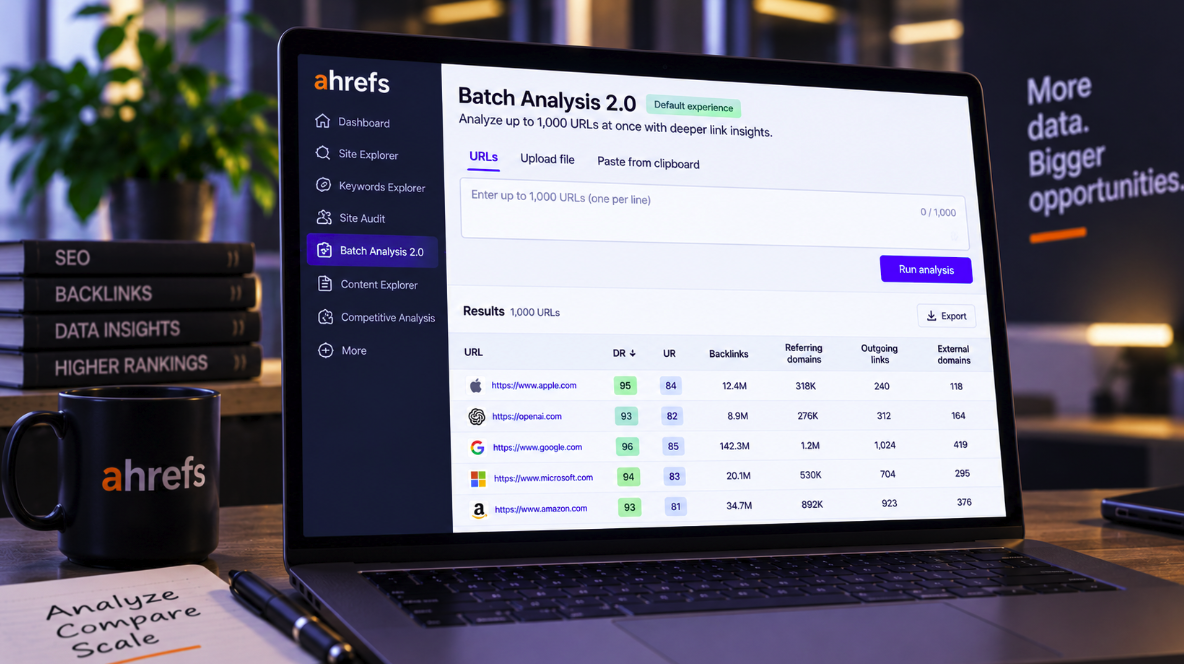
Bulk SEO analysis becomes substantially more useful when it moves beyond a handful of headline metrics. Ahrefs is making that shift with Batch Analysis 2.0, which became the default experience on September 2 and expands the amount of link data users can compare across as many as 1,000 URLs at once.
The update gives SEO teams a denser comparative view of backlinks, referring domains and outgoing links without forcing them to open each URL individually in a deeper analysis tool. The practical effect is straightforward: Batch Analysis is becoming less of a quick screening utility and more of a research surface for evaluating large sets of pages, domains and prospects.
Bulk analysis is most valuable before the deep dive
SEO workflows frequently begin with a long list rather than a single site. An analyst may have hundreds of competing pages from a SERP export, potential link prospects collected during outreach research, domains identified through competitive analysis or URLs gathered during a content audit. The first problem is deciding which of those targets deserve closer inspection.
That is where batch analysis earns its place. Opening hundreds of URLs individually creates unnecessary friction when the immediate goal is comparison. A bulk report can expose differences in link profiles quickly enough to separate promising targets from noise, allowing more expensive manual investigation to focus on a smaller subset.
With Batch Analysis 2.0 supporting up to 1,000 URLs, that screening layer can cover datasets large enough for serious competitive and prospecting work. The richer link metrics also mean analysts can make those first-pass decisions using more context than a single authority score or backlink total.
Backlink counts alone rarely tell the whole story
A raw backlink number can be misleading. One URL may have thousands of links concentrated across a relatively small group of websites, while another has fewer total backlinks distributed across a broader set of referring domains. Those profiles can imply very different levels of link diversity and competitive strength.
Bringing backlink and referring-domain metrics together in a bulk comparison helps analysts see that distinction immediately. It becomes easier to identify pages whose apparent link strength comes from sitewide or repeated links, as well as pages supported by a wider range of independent domains.
That is useful in competitor research because the question is rarely just how many backlinks a ranking page has. Teams want to understand the scale and shape of the link gap they may need to overcome. A table that compares many ranking URLs side by side can reveal whether a SERP is dominated by heavily referenced resources or whether several competitors are succeeding with relatively modest link profiles.
Outgoing-link data adds another dimension
The inclusion of richer outgoing-link metrics makes the bulk dataset useful for more than measuring inbound authority. Outgoing links can reveal how pages participate in a wider web ecosystem: whether they reference many external resources, point toward particular kinds of domains or function as curated hubs rather than isolated documents.
For link prospecting, that information can help distinguish websites that actively link to external resources from those that rarely do. A domain can look attractive based on authority and referring domains while still being a poor outreach target if its publishing model almost never sends readers elsewhere. Conversely, a resource-heavy site with a healthy external-link pattern may deserve closer review.
Outgoing-link metrics should not be treated as a mechanical qualification rule. A high number of external links can reflect useful editorial sourcing, a large directory, user-generated content or lower-quality link practices depending on context. The value is in giving researchers another signal to investigate rather than another score to optimize blindly.
One thousand URLs changes the scale of competitive research
The 1,000-URL ceiling is particularly relevant when SEO analysis moves beyond a single keyword. A team researching an entire topic cluster can collect ranking URLs across dozens or hundreds of queries, deduplicate the list and compare the remaining pages in one batch. Patterns that are difficult to see in individual reports can become obvious when the dataset is viewed together.
The same applies to digital PR and link building. Prospect lists are often assembled from multiple sources and can grow rapidly. Bulk metrics allow teams to triage those lists before spending time reviewing editorial fit, contact information and individual pages. The result is not automated prospect selection, but a faster way to decide where human attention should go first.
Agencies can also use the larger batch size when comparing portfolios of client competitors or reviewing groups of domains during pitches and audits. Instead of creating a collection of disconnected snapshots, analysts can establish a common comparative table and then investigate the outliers.
Richer bulk data can reduce misleading shortcuts
There is an important methodological benefit to putting more metrics in the same view. When a bulk tool exposes only one or two numbers, users naturally overemphasize them. A domain rating or backlink count can become a proxy for quality simply because it is the easiest field available to sort.
A richer dataset encourages comparison across several dimensions. Referring domains can qualify backlink totals; outgoing links can add context about publishing behavior; URL-level and domain-level signals can help separate the strength of a specific page from the broader site behind it. None of those metrics determines quality by itself, but together they can produce a more informed shortlist.
The limitation remains the same as with any large SEO table: scale makes patterns visible but cannot replace inspection. A thousand URLs can be sorted in seconds, yet relevance, editorial standards, topical fit and the reasons a page attracts links still require human judgment. Batch Analysis is best understood as a prioritization layer rather than an automated verdict.
SEO platforms are making large datasets easier to interrogate
Batch Analysis 2.0 also reflects a broader product trend in SEO software. The competitive advantage is no longer only access to large indexes. Users increasingly expect tools to let them manipulate those indexes efficiently, compare larger sets and move from broad discovery to targeted investigation without repetitive manual work.
Making the 2.0 experience the default suggests Ahrefs sees the expanded workflow as the new baseline rather than an optional advanced mode. That matters because bulk analysis sits between raw exports and detailed site reports: it is where analysts decide what deserves the next click.
For SEO teams, the September 2 update therefore makes Batch Analysis more than a convenience for checking several URLs at once. With deeper backlink, referring-domain and outgoing-link information across as many as 1,000 URLs, Ahrefs is turning the tool into a larger comparative workspace—one designed to make the first stage of link research faster without removing the deeper analysis that should follow.