
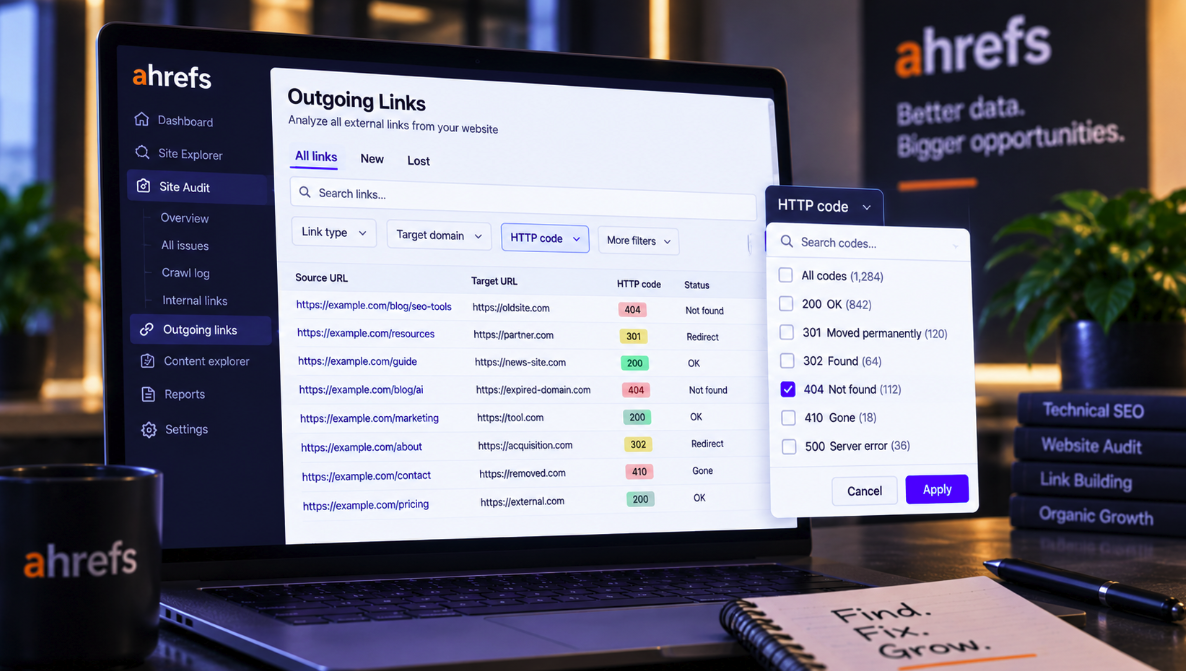
Ahrefs has simplified one of the most routine link-auditing tasks in Site Explorer. Instead of sending users to a separate Broken Links report to find dead outbound destinations, the main Outgoing Links report can now be filtered directly by HTTP status code, including 404 responses.
The change appeared in the Ahrefs changelog on September 4. Ahrefs says the new status-code filter replaces the old Broken Links report, effectively folding broken-link discovery into the broader outgoing-link dataset. For SEOs, the important change is not that Ahrefs can suddenly detect 404s—it has supported broken-link analysis for years—but that the audit no longer needs a dedicated report to answer what is fundamentally a filtering question.
Broken links become one state inside the full outgoing-link dataset
The previous workflow treated broken outbound links as a separate category. Ahrefs’ existing Help Center documentation describes the older Outgoing Links > Broken Links report as a place to find pages linking to unavailable external destinations, with failure reasons such as 404 Not Found or an unresolved host attached to each result.
The new interface takes a more unified approach. Users stay inside Outgoing Links and narrow the table by the response code returned by the destination. Selecting 404 isolates missing pages, while the underlying concept naturally extends to other HTTP states that can matter during an audit, such as redirects and server errors.
That makes the report more flexible than a binary live-versus-broken view. An SEO reviewing outbound links may want to investigate 404s first, then inspect redirects, then look at other non-200 responses without jumping between purpose-built reports. The link dataset remains the same; the analyst changes the lens.
HTTP codes explain more than a “broken” label
A broken-link label is useful, but the response code gives the analyst more diagnostic information. A 404 means the target resource could not be found. A 5xx response points toward a server-side failure. A redirect may still work for visitors but could lead somewhere different from the destination originally selected by the publisher. Other codes can indicate access restrictions or temporary conditions that deserve different treatment.
Ahrefs already uses this status-oriented model elsewhere. Its HTTP status-code documentation explains how response codes can be filtered across Site Explorer, Site Audit and Content Explorer. The September 4 change brings the Outgoing Links workflow closer to that same model instead of maintaining broken outbound links as a special report type.
This distinction matters because not every suspicious outgoing link should be fixed in the same way. A genuine 404 may justify replacing the destination with a current source or removing the link. A temporary server error might simply need to be rechecked. A redirected resource may still be valid, although publishers may prefer updating the link to point directly to the final URL when appropriate.
Why outgoing 404s still deserve routine attention
Broken outbound links are often less dramatic than broken internal navigation, but they still create a poor experience. A reader who clicks a citation, documentation link, product reference or recommended resource and lands on a missing page has reached a dead end. On older editorial sites, these failures can accumulate quietly as external publishers reorganize their websites, delete content or let domains expire.
Ahrefs’ Site Audit guidance notes that links pointing to 4xx or 5xx destinations can create dead ends for visitors and search-engine crawlers. Its recommended fixes depend on the situation: restore a destination when it is under your control, update the link to a relevant working page, remove it when it is no longer useful or use an appropriate redirect for pages you own.
For external outgoing links, publishers generally cannot repair the target server themselves. The practical task is therefore editorial: determine whether the linked resource moved, whether a better replacement exists and whether the citation still supports the surrounding content. A 404 filter provides the queue; human judgment determines the fix.
The consolidated report should make mixed-status audits faster
The biggest efficiency gain appears when an audit is broader than simply finding dead links. A technical SEO may want to understand the health of all outbound destinations on an important section of a site. With status codes inside the main Outgoing Links report, that investigation can remain in one context while filters change.
A publisher could begin with 404s, review redirected destinations next and then inspect server-error responses. Combined with the report’s other link attributes, status filtering can help narrow the audit by target, link type or other dimensions without first deciding which specialized report contains the relevant data.
This is consistent with the way Ahrefs already handles link analysis in Site Audit. Its Link Explorer documentation describes internal and external links as a filterable dataset, with presets for identifying broken destinations. The updated Site Explorer experience moves in the same direction: fewer separate report concepts and more composable filters over the underlying link information.
There is an important difference between outgoing links and broken backlinks
The interface change should not be confused with Ahrefs’ broken-backlink workflows. An outgoing broken link is a link from the analyzed website to a destination that fails. A broken backlink is an incoming link from another website pointing to a broken page on the analyzed domain. Both can involve a 404, but the SEO implications are different.
Broken backlinks can represent lost link equity and are often addressed by restoring a page or redirecting an old URL to a relevant replacement. Broken outgoing links are primarily links the publisher controls on its own pages, so the usual task is to update or remove the reference. Ahrefs continues to provide separate tools for analyzing incoming backlink problems; the September 4 consolidation specifically concerns Site Explorer’s Outgoing Links workflow.
A small UI change makes the audit model more coherent
Replacing the Broken Links report with a status-code filter is unlikely to transform technical SEO, but it makes the information architecture cleaner. A broken link is not really a unique class of link. It is an outgoing link whose destination returned a failure state when Ahrefs crawled it. Treating that state as a filter makes the interface reflect the underlying data more directly.
For users, that means fewer decisions about which report to open and a more natural path from discovery to diagnosis. The same table can answer whether a destination is live, redirected or missing, and the analyst can move between those states without leaving the report.
That is the practical value of Ahrefs’ September 4 update. Broken outgoing-link auditing has not disappeared; it has been absorbed into a more general workflow. Instead of asking for a special report of broken links, SEOs can now ask the broader Outgoing Links dataset a simpler question: which HTTP status codes do I want to see?