
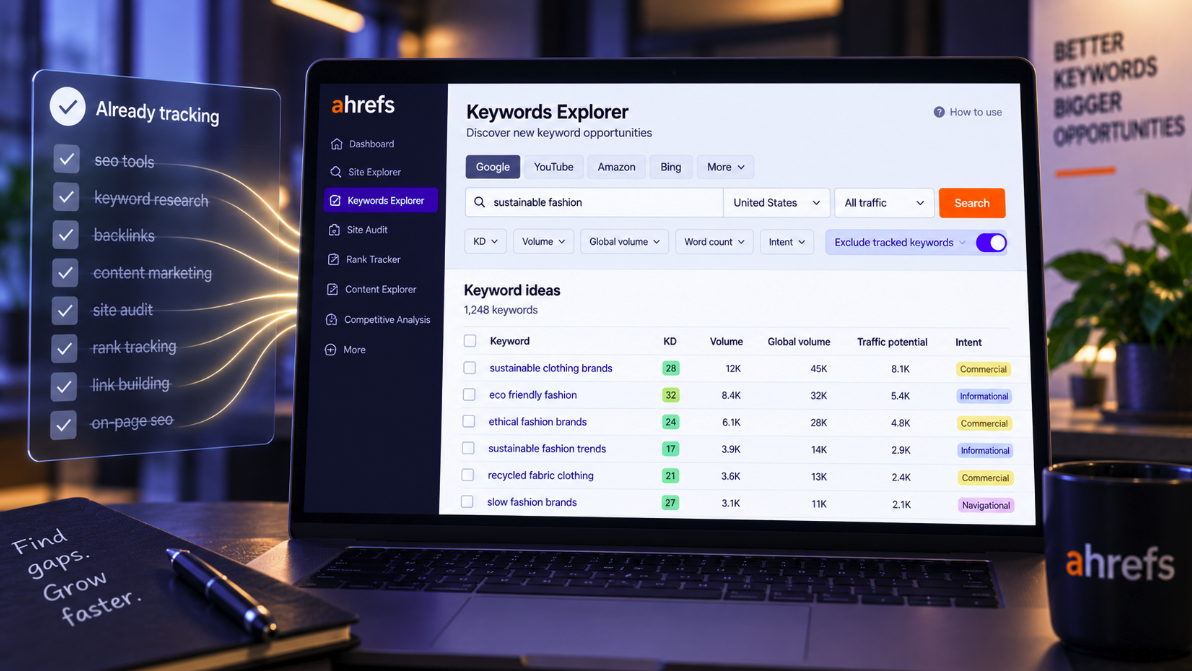
Keyword research has a recurring efficiency problem: the larger an SEO program becomes, the more time analysts spend rediscovering opportunities they have already found. Ahrefs is addressing that problem directly in Keywords Explorer with a new exclusion control that can remove keywords already saved in a list or associated with a project from fresh idea reports.
The update appeared in the Ahrefs changelog on September 5. According to Ahrefs, users can now exclude keywords from any keyword list or project while browsing keyword ideas. The result is a deceptively simple workflow improvement: research can focus on genuinely untracked territory instead of repeatedly surfacing terms the team has already evaluated, organized or begun monitoring.
Keyword research gets harder as the research library grows
Most keyword discovery tools are optimized for expansion. Enter a seed topic and the system returns related terms, questions, matching phrases and other ideas. That is useful when a project is new, but the same abundance becomes noisy after months or years of SEO work. A mature team may already have hundreds or thousands of relevant keywords distributed across content plans, tracking projects and research lists.
At that point, another keyword-ideas report can contain a substantial amount of familiar material. Analysts have to recognize terms they have seen before, cross-check spreadsheets or lists, and distinguish real gaps from keywords already assigned to an existing page or campaign. The work is not difficult, but it is repetitive and creates opportunities for duplicate briefs and overlapping content.
Ahrefs’ new filter changes the starting point. Instead of producing a broad opportunity set and asking the user to manually subtract known keywords afterward, Keywords Explorer can perform that subtraction during discovery. The report becomes a view of what is left.
Lists and projects become exclusion sets
The feature is particularly useful because Ahrefs already gives keyword lists a persistent role in research. Its Keywords Explorer documentation describes lists as a way to save keyword ideas for later analysis, with metrics refreshed when a list is opened. Teams commonly use them to organize topics, campaigns, content clusters or terms that have passed an initial review.
Those lists can now serve a second purpose: defining what should not appear in the next discovery session. A content team could maintain a list of approved editorial targets and exclude it while searching for additional opportunities. An SEO agency could keep a client’s researched keyword universe in a list and suppress those terms when exploring adjacent categories. A strategist could separate completed research from the next wave without maintaining a parallel spreadsheet purely for deduplication.
Projects add another practical layer because they connect research with active SEO work. Ahrefs’ Rank Tracker documentation explains how projects monitor target keywords over time. Excluding project-associated keywords from new idea research means terms already inside an operational workflow do not have to keep competing for attention with undiscovered opportunities.
The useful metric becomes incremental opportunity
This update reflects a broader shift in how mature SEO teams should think about keyword volume. The most valuable question is often not “How many relevant keywords exist?” but “How many relevant keywords have we not already covered, evaluated or started tracking?” Those are very different numbers.
A report containing 10,000 keyword ideas can look impressive while producing little strategic value if 7,000 of them are already represented in the team’s research system. Removing known terms makes the remaining set smaller but potentially more actionable. It turns keyword discovery from an exercise in maximizing rows into one focused on incremental opportunity.
That can also improve prioritization. Metrics such as search volume, Keyword Difficulty, Traffic Potential and intent become easier to compare when the analyst is not mentally filtering out familiar terms at the same time. The researcher can spend more attention evaluating whether a genuinely new keyword fits the site, deserves its own page or belongs inside an existing topic cluster.
It can reduce accidental content duplication
One of the less obvious benefits is content governance. Large publishing programs frequently have multiple people researching similar topics. Without a shared system, two writers or SEO specialists can independently identify the same keyword and create competing briefs. The problem becomes more likely when a company operates across regions, products or editorial teams.
Exclusion filters do not solve keyword cannibalization automatically. A keyword can be absent from a tracking list while still being covered by an existing page, and one page can rank for many terms that were never explicitly saved. Teams still need to inspect the SERP, existing content and ranking URLs before deciding that a term requires new content.
But the feature can remove one common source of duplication: knowingly tracked or previously saved terms resurfacing as though they were fresh discoveries. When lists and projects are maintained consistently, they become a lightweight memory system for the research process.
The quality of the filter depends on workflow discipline
There is an important limitation. Ahrefs can only exclude the keywords a team has actually placed in the relevant lists or projects. If research is scattered across personal spreadsheets, documents and disconnected tools, Keywords Explorer cannot infer that those terms have already been evaluated. The feature therefore becomes more valuable as teams centralize more of their keyword workflow inside Ahrefs.
That creates an incentive to treat lists as operational assets rather than temporary bookmarks. Clear naming conventions can help distinguish, for example, approved targets from rejected ideas, existing content from future briefs, and one market from another. An exclusion based on a poorly maintained list could hide terms a researcher actually needs to reconsider.
Used carefully, however, the control gives teams more flexibility than a universal “hide tracked keywords” switch. Different research sessions can exclude different sets. A keyword already targeted in the United States may still deserve investigation for another market, while a term rejected for one product line might be relevant to another. The analyst decides which existing body of work should count as known territory for the task at hand.
SEO tools are starting to optimize the workflow around the data
The September 5 change is small compared with launching a new keyword database or ranking metric, but it reflects an important stage in SEO software maturity. When tools already contain enormous datasets, the next productivity gains often come from reducing what users have to process rather than adding more information.
Ahrefs is effectively letting Keywords Explorer remember part of the work a team has already done. Lists and projects no longer only store targets; they can actively shape future discovery by removing known keywords from view. That creates a cleaner loop between research, selection, tracking and the next research cycle.
For SEO teams with substantial keyword libraries, that is the real value of the update. The goal is not to discover the same promising terms more efficiently. It is to stop rediscovering them at all, so the next research session begins where the previous one ended.