
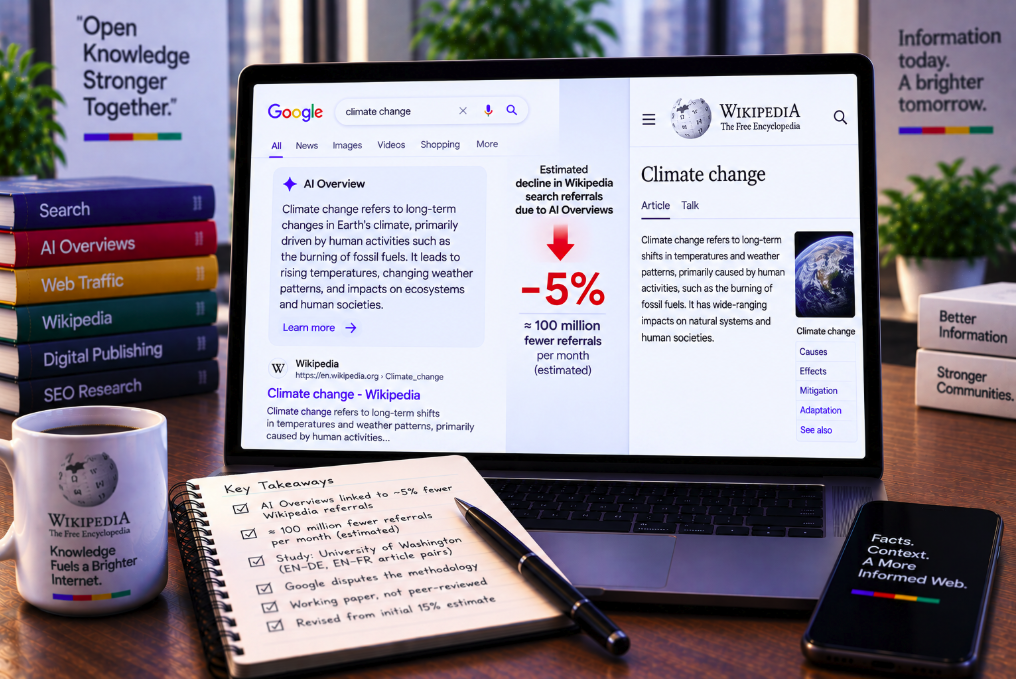
A heavily revised University of Washington working paper estimates that Google's AI Overviews reduced external-search referrals to English Wikipedia by roughly 5% after the feature became the default for U.S. users in May 2024. Applied across English Wikipedia, the authors estimate that effect at about 100 million fewer search referrals per month.
The finding is striking, but so are the caveats. Google disputes whether the underlying Wikimedia data can isolate the effect of AI Overviews at all, because Wikipedia's public clickstream groups referrals from external search engines together rather than reporting Google separately. The paper is also not peer reviewed and has changed substantially since an earlier version produced a much larger estimate of roughly 15%.
Those methodological changes are not a footnote; they are central to understanding the result. The latest analysis by University of Washington researchers Mehrzad Khosravi and Hema Yoganarasimhan uses monthly search-referral data and matched English-German and English-French Wikipedia articles, rather than the daily pageview design used in earlier versions.
Search Engine Journal's September 11 analysis provides a detailed account of the revisions, Google's objection and the limits of what the study can establish. The current working paper is available through SSRN and arXiv.
The revised estimate is 5.45% against German Wikipedia and 4.82% against French
The researchers compare traffic to English Wikipedia articles with traffic to corresponding articles in other language editions. The idea is to exploit Google's staggered geographic rollout of AI Overviews.
Google made AI Overviews the default in the United States in May 2024. According to the paper, Germany and France had not received the same default availability during the study period.
If external-search referrals to an English article declined after May 2024 relative to referrals to the equivalent German or French article, the model attributes that relative change to the environment in which AI Overviews became available by default.
Using this design, the authors estimate a 5.45% reduction when English Wikipedia is compared with German Wikipedia and a 4.82% reduction when English is compared with French.
The study uses almost one million matched article pairs
The scale of the dataset is one of the paper's strengths. The English-German panel contains 499,927 matched article pairs, while the English-French panel contains 530,873.
The data covers December 2023 through December 2024, giving the researchers several months before and after the May 2024 U.S. AI Overview rollout.
The authors use a difference-in-differences framework estimated with Poisson pseudo-maximum likelihood, a method suited to modeling changes in count data while expressing the result as a relative percentage effect.
This is not a simple before-and-after chart. The purpose of the control language editions is to account for broader changes that might have affected interest in the same underlying topics over time.
The 100 million figure is a model-based translation
The researchers average the two main estimates and apply the implied decline to English Wikipedia's search-referral volume. They calculate approximately 100.27 million fewer external-search referrals per month.
Annualized, that becomes roughly 1.20 billion fewer referrals if the estimated effect remained constant throughout a year.
These figures should not be described as 100 million Google clicks directly observed disappearing from Wikipedia's logs. They are extrapolations from the causal model using the estimated relative effect.
The annual figure introduces an additional assumption: that the effect persists at approximately the same magnitude across the year.
Google disputes whether the referral metric can isolate AI Overviews
The largest measurement limitation comes from Wikimedia's public data itself. Wikipedia's monthly clickstream categorizes referrals from external search engines together.
Google has argued that this makes it impossible to isolate Google traffic specifically and therefore impossible to cleanly attribute the measured decline to AI Overviews.
That objection is important because the treatment being studied is a Google Search feature, while the outcome variable includes search-engine referrals more broadly.
The researchers respond that competing search engines account for a relatively small portion of the relevant traffic and that the May 2024 rollout creates a distinct timing break. But the aggregate-referrer limitation remains real and is acknowledged in the paper.
This is an intent-to-treat style estimate, not exposure-level measurement
The study does not know whether an AI Overview actually appeared for every search that could have sent traffic to each English Wikipedia article.
Instead, it measures what happened when English-language users were in an environment where AI Overviews became available by default, compared with language editions associated primarily with countries where that rollout had not yet occurred.
This distinction is essential. The estimate is about default feature availability at the market level, not the click effect of showing one specific AI Overview on one specific query.
A query-level experiment that compares searches where an AI Overview actually appears with searches where it does not would answer a related but different question.
Only about 40% of English Wikipedia traffic came from the United States
The treatment is also diluted because English Wikipedia is global. According to the paper, roughly 40% of traffic to the English edition during the sample period came from the United States.
That means most English Wikipedia traffic was not necessarily coming from users in the country where AI Overviews had become the default at the start of the treatment period.
The measured 5% decline is therefore an average across a much broader English-language traffic base than U.S. users alone.
The authors interpret this as one reason the reduced-form effect can be smaller than the effect among users who were actually exposed to AI Overviews.
The paper was substantially rebuilt after its initial 15% estimate
The revision history is unusually important because the headline number changed dramatically.
Earlier versions of the working paper used daily Wikipedia pageviews and compared English articles with a different collection of language editions. Those analyses produced an estimated traffic reduction of roughly 15%.
The current version instead focuses on monthly external-search referrals and uses German and French articles as the main controls. Search Engine Journal notes that the major methodological change arrived in version five in late August, followed by further revisions in early September.
The new 4.82% and 5.45% estimates therefore do not simply represent a minor numerical update to the same analysis. They come from a materially different outcome metric and comparison design.
The revision makes the paper more informative, not necessarily weaker
A headline falling from 15% to about 5% can look like a study being disproved, but that is not the right way to read an evolving working paper.
Research drafts are supposed to change as authors refine identification strategies, respond to criticism and obtain better data. A large revision can reveal uncertainty in the original estimate while improving the relevance of the newer one.
Monthly external-search referrals are more directly connected to the question of search-engine traffic than total daily pageviews, which can include visits from many sources and repeated browsing within Wikipedia.
The appropriate takeaway is not that the original 15% number and the new 5% number can be averaged. The current paper should be evaluated on its current methodology.
A Japanese comparison still produces a much larger decline
The current paper includes an English-Japanese robustness check that estimates a 16.53% reduction.
That number might appear to revive the original 15% headline, but the authors caution against treating it as equivalent to the main estimates. The Japanese comparison uses a shorter time period and a different control environment.
Search Engine Journal characterizes the authors' treatment of this result as directional support rather than the central estimate.
The German and French comparisons remain the primary results because they form the paper's main identification strategy.
Wikimedia suppresses low-volume clickstream pairs
Another data limitation comes from privacy and reporting thresholds in Wikimedia's clickstream files. Low-volume referrer-article pairs are omitted.
That creates a problem after treatment because a decline could push some previously visible pairs below the reporting threshold, leaving the researcher without the exact post-treatment count.
The authors test several assumptions for those suppressed observations and report that the resulting estimates remain nearly unchanged.
This robustness exercise helps address one potential source of bias, although it does not solve the separate issue that external search engines are grouped together.
One search referral is not the same as one Wikipedia pageview
The switch from pageviews to search referrals changes the interpretation of the outcome.
If a user clicks from a search engine to Wikipedia and then reads three more Wikipedia articles, the external-search referral represents the original arrival rather than four separate search referrals.
That makes the metric better suited to studying traffic acquisition from search, but it means the 100 million estimate should not be described as 100 million fewer total Wikipedia pageviews.
The downstream browsing behavior after a user enters Wikipedia is a separate question.
The paper does not establish the effect for ordinary publishers
Wikipedia is an unusually useful research setting because the same concepts are documented across many language editions and Wikimedia releases article-level clickstream data.
Those characteristics make the multilingual comparison possible. Most commercial publishers do not have parallel German, French and English versions of hundreds of thousands of equivalent pages with public referral data.
Wikipedia is also unusually prominent for informational searches and is frequently cited in AI-generated answers.
The study therefore does not prove that news publishers, ecommerce sites, SaaS companies or affiliate sites experienced a 5% decline from AI Overviews. Their query mix, ranking positions, brand demand and user intent can be very different.
Informational content may be particularly vulnerable to answer substitution
Even with those limits, Wikipedia is strategically important because it represents the type of content AI summaries can potentially substitute for most directly.
A user asking a factual or explanatory question may be satisfied by a concise synthesized answer and decide not to open the underlying encyclopedia article.
That substitution mechanism is central to publisher concerns about answer-first search. A site can remain highly visible as a source while receiving fewer visits if the search engine extracts enough information to resolve the user's need on the results page.
The University of Washington paper attempts to quantify that mechanism at scale rather than relying solely on anecdotal traffic reports.
Independent click behavior research points in the same general direction
The Wikipedia estimate is not the only evidence that AI summaries can alter click behavior. Search Engine Journal cites research from Pew Research Center based on U.S. browsing data showing that users clicked traditional search results less often on pages containing AI summaries than on pages without them.
In that analysis, traditional-result clicks occurred on 8% of visits to search pages with an AI summary, compared with 15% when no AI summary appeared. Only 1% of visits to pages with an AI summary resulted in a click on a source link inside the summary.
Those numbers come from a different dataset, period and methodology and should not be combined mathematically with the University of Washington estimate.
They are relevant because they provide independent evidence for the behavioral mechanism: answer-rich search pages can change whether users click onward.
Google argues that AI search can broaden discovery
Google has consistently presented a different interpretation of AI Overviews. Its Search documentation for AI features says AI experiences can help users ask more complex questions and discover a broader range of websites.
Google has also said overall organic click volume has remained relatively stable while arguing that clicks generated from AI-enhanced results can be higher quality.
Those claims are not directly disproved by a Wikipedia-specific decline. Overall ecosystem clicks could remain stable while traffic shifts between publishers, query categories or types of search.
Conversely, aggregate stability would not mean every individual publisher is protected from losses.
Wikimedia itself has reported broader human-traffic declines
The Wikimedia Foundation has separately reported that human pageviews across Wikipedia languages declined after it improved bot detection and reclassified substantial automated traffic.
In October 2025, Wikimedia said human pageviews were down roughly 8% year over year and linked the broader change partly to generative AI and social platforms.
That figure cannot be added to the University of Washington's 5% estimate. The Foundation's number measures overall human pageviews, covers a different period and is not a causal estimate of AI Overview exposure.
The two findings nevertheless point to the same strategic concern: users increasingly consume Wikipedia-derived information through intermediaries without necessarily visiting Wikipedia itself.
Machine demand for Wikipedia is moving in the opposite direction
While human referrals have become a concern, automated demand for Wikimedia content has grown dramatically.
Wikimedia engineers have reported sharp increases in bandwidth consumption from bots scraping images and media, including systems collecting material for AI-related uses. Automated requests can impose substantial infrastructure costs even when they do not create human pageviews.
This creates an unusual economic asymmetry for open-web publishers. Their content can become more valuable as an input to search and AI systems while the number of users visiting the original site declines.
Referral traffic and machine consumption are different metrics, but together they illustrate how AI changes the exchange between platforms and information producers.
Wikipedia's case is not primarily about lost advertising revenue
The working paper calculates a hypothetical revenue impact for an ad-supported publisher experiencing a comparable loss of traffic. Search Engine Journal reports a range of roughly $10.82 million to $37.08 million annually using typical advertising assumptions.
That calculation does not describe Wikimedia's actual finances because Wikipedia does not monetize its pages through conventional display advertising.
No money in that estimate was literally transferred from Wikipedia to Google.
The more relevant concern for Wikimedia is whether lower direct visitation eventually affects donations, editing activity, community participation or other forms of engagement. The current paper does not estimate those long-term outcomes.
Wikipedia is developing a different economic relationship with AI companies
Wikimedia has increasingly encouraged high-volume commercial users of its content to access it through Wikimedia Enterprise, a paid service that provides structured feeds, support and service guarantees.
Google is among the companies using Wikimedia Enterprise, alongside other major technology and AI firms.
The model charges for high-volume access and services rather than licensing Wikipedia's freely available content itself.
This does not compensate Wikipedia directly for each lost search referral, but it represents one possible adaptation to a world in which machine consumption of publisher content grows faster than human click-through.
The SEO lesson is that citations and visits are no longer equivalent
Traditional search strategy often assumed that visibility, ranking and traffic moved in broadly the same direction. AI answers weaken that relationship.
A publisher can be an important source for an answer, contribute factual material to the search experience and still receive fewer visits if the user no longer needs to click.
That makes citation visibility useful but insufficient as a business metric. Publishers need to track actual referral traffic, branded demand, direct audience growth and downstream conversions alongside appearances in AI answers.
The Wikipedia case demonstrates the difference particularly clearly because the site can remain foundational to online information even as the path to its pages changes.
Publishers should be cautious with percentage headlines
The revision from roughly 15% to roughly 5% is a useful warning for anyone reporting fast-moving AI-search research.
Working papers are provisional. Data definitions change, identification strategies improve and authors revise conclusions. A striking early estimate can remain embedded in presentations and social posts long after the underlying paper has changed.
For SEO teams, methodology should therefore travel with the headline. Ask what traffic metric was measured, what counts as treatment, what the control group was and whether the result is observational, experimental or model-based.
The current Wikipedia study is more informative when described as a revised difference-in-differences estimate than when reduced to “AI Overviews killed 100 million clicks.”
The current evidence supports a meaningful effect, not a final number
The University of Washington working paper now points to a substantially smaller effect than its earliest version, but the revised estimate is still economically meaningful. A roughly 5% decline across a property as large as English Wikipedia translates into an enormous number of potential visits.
At the same time, Google's methodological objection is legitimate enough to remain part of every responsible summary: Wikimedia's public referral data combines search engines, so the outcome does not directly isolate Google traffic.
The study's design attempts to overcome that limitation through rollout timing and matched language editions, but no quasi-experimental model can make the underlying data more granular than it actually is.
The right conclusion is therefore neither that AI Overviews definitively cost Wikipedia exactly 100.27 million Google clicks every month nor that the study tells us nothing. It provides revised, large-scale evidence consistent with a roughly 5% reduction in external-search referrals after default AI Overview availability, using an unusually rich natural experiment. Whether that estimate survives peer review and further revisions will matter as much as the headline number itself.