
Apple has drawn a clearer technical line between traditional web search and the controls publishers can use to restrict their content from training the company's generative AI models.
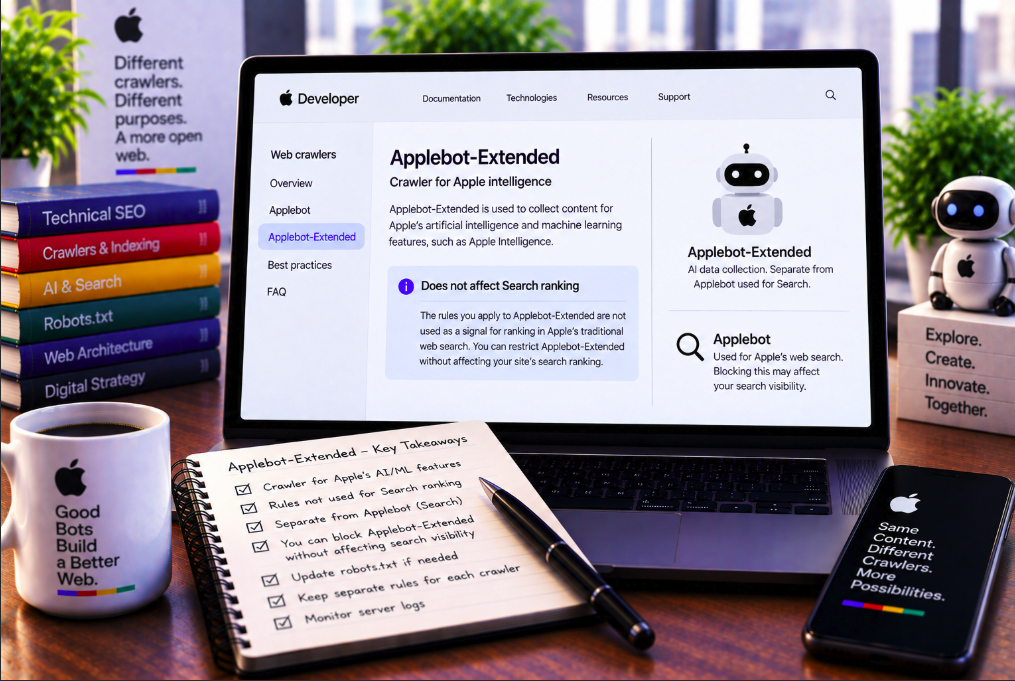
In updated Applebot documentation, Apple now states explicitly that site rules for Applebot-Extended are not considered when ranking results in Search. Search Engine Roundtable highlighted the newly added sentence on September 7, noting that it removes an important ambiguity for publishers deciding whether to opt out of Apple's AI-training use.
The practical takeaway is straightforward: a site can disallow Applebot-Extended without that robots.txt decision itself becoming a negative Apple Search ranking signal. That is not the same as blocking Applebot, the crawler Apple uses for web search and other discovery experiences.
The distinction is important because Applebot-Extended is often described casually as an “AI crawler.” Apple's own documentation is more precise: Applebot-Extended does not crawl webpages at all. It is a secondary user agent that tells Apple how content already crawled by Applebot may be used.
Apple added an explicit ranking clarification
Search Engine Roundtable's September 7 report identified a new line in Apple's support page: site rules for Applebot-Extended are not considered in Search ranking.
That sentence matters because robots.txt decisions can have very different consequences depending on which crawler or control they target.
If a publisher wants its pages discoverable in Apple's search ecosystem but does not want the content used to train Apple's general-purpose foundation models, Apple now explicitly says the Applebot-Extended rule itself does not count against the page in Search ranking.
This makes the opt-out a data-use decision rather than a ranking trade-off, at least as far as the Applebot-Extended directive itself is concerned.
Applebot and Applebot-Extended are not interchangeable
Apple's terminology can be confusing because the two user agents share a name.
Applebot is the actual web crawler. Apple says data collected by Applebot powers search technology across Apple experiences including Spotlight, Siri and Safari.
Applebot-Extended is different. It provides publishers with an additional control over whether content crawled by Applebot can be used to train Apple's general-purpose foundation models for generative AI features.
Blocking one therefore should not be assumed to have the same effect as blocking the other.
Applebot-Extended does not crawl pages
Apple states this unusually clearly in its documentation.
Applebot-Extended “does not crawl webpages.” Instead, it is used only to determine how data collected by the Applebot crawler can be used.
This architecture is conceptually similar to having one crawler collect the content and a separate policy signal govern a downstream use of that content.
That is why server-log analysis should not necessarily expect to see a conventional Applebot-Extended crawl pattern comparable with Applebot itself.
A robots.txt opt-out can restrict AI model training
Publishers can place an Applebot-Extended rule in robots.txt to prevent specified content from being used to train Apple's general-purpose foundation models.
A site-wide opt-out can be expressed by targeting the Applebot-Extended user agent and disallowing the relevant paths.
Apple says allowing Applebot-Extended helps improve the capabilities and quality of its generative AI models over time. Disallowing it communicates that the publisher does not want the affected content used for that training purpose.
The new ranking clarification means that choice is not itself fed into Apple Search ranking.
Pages can remain eligible for Search after the AI-training opt-out
Apple explicitly says webpages that disallow Applebot-Extended can still be included in search results.
This is the operational separation publishers have been asking crawler providers to document: search discovery can remain enabled while model-training permission is withheld.
For SEO teams, it means the robots.txt file can express different policies for Apple's search crawler and its AI data-use control.
A blanket block against every Apple-related user agent would remove that distinction and could produce consequences very different from blocking Applebot-Extended alone.
Blocking Applebot is a different decision
Apple says enabling Applebot in robots.txt allows website content to appear in search results for Apple users across supported products.
Applebot follows standard robots.txt directives for general search crawling.
Preventing Applebot from crawling content can therefore affect Apple's ability to discover and surface that content through its search experiences.
Publishers whose goal is only to restrict AI model training should avoid treating Applebot and Applebot-Extended as equivalent controls.
The ranking clarification does not mean Applebot-Extended controls every AI use
This is the most important nuance in Apple's updated documentation.
Applebot-Extended is specifically described as a control over the use of content for training Apple's general-purpose foundation models.
Apple separately says data crawled by Applebot can be used as additional context and current information when AI models generate outputs in Apple products and services.
That means an Applebot-Extended training opt-out should not be described as a universal “do not use my content in any Apple AI response” switch.
Apple has a separate nosnippet control for generative context
For publishers that do not want particular content used in broad general-knowledge generative answers, Apple points to the nosnippet directive.
Apple says its AI-generated outputs can include links to source websites used to help produce a response. Applying nosnippet to specific content can exclude that material from the general-knowledge context described in Apple's documentation.
The page can still be crawled by Applebot if the crawler remains allowed.
This creates at least three distinct policy questions for publishers: search crawling, foundation-model training and use as generative context.
One robots.txt decision is no longer enough for AI governance
The Apple documentation illustrates why crawler governance is becoming more granular.
Historically, publishers mainly decided whether a search engine could crawl a page. Generative AI creates additional downstream uses that may need separate controls.
A site might want to remain searchable, decline model training and still allow some content to be cited or used as current context in AI-generated answers. Another publisher may choose a different combination.
Technical teams now need to map directives to purposes rather than maintaining one undifferentiated “bots allowed” list.
Paywalled content receives another separate treatment
Apple also supports the Schema.org isAccessibleForFree property for identifying paywalled, metered or subscription content.
According to Apple's documentation, pages marked isAccessibleForFree: false remain eligible to appear in search results.
However, Applebot will not use that paywalled content as additional context when AI models generate output for Apple products and services.
Apple notes that this signal applies at page level and does not support section-level marking through hasPart.
Search ranking uses a different set of signals
Apple's documentation lists several factors its Search systems may consider when ranking web results.
These include aggregated user engagement with search results, relevance and matching between search terms and webpage content, the number and quality of links from other webpages, approximate user-location signals and webpage design characteristics.
Apple says those factors can be used without a predetermined ranking importance.
The company now adds Applebot-Extended site rules to the other side of that boundary: they are not considered in Search ranking.
This is a direct answer to a common publisher concern
When AI companies introduce opt-out controls, publishers naturally ask whether exercising those controls will reduce their visibility elsewhere in the provider's ecosystem.
If the answer is unclear, a publisher may feel forced to choose between AI governance and search traffic.
Apple's new sentence removes that uncertainty for one specific signal. Disallowing Applebot-Extended is not treated as a ranking factor in Apple Search.
That does not guarantee identical traffic outcomes under every configuration, because blocking the separate Applebot crawler or using other directives can affect discovery and presentation.
Robots.txt configurations should name the intended user agent precisely
For technical SEO teams, the practical implementation lesson is precision.
A rule written for Applebot-Extended expresses a different policy from a rule written for Applebot. A wildcard rule can affect both depending on the rest of the robots.txt configuration.
Teams should review the complete file rather than adding an isolated directive without understanding which user agents inherit broader rules.
After any change, the configuration should be tested and documented so future developers understand why each crawler is allowed or disallowed.
Applebot can fall back to Googlebot rules
Apple's documentation contains another detail that can surprise site owners.
If robots.txt does not mention Applebot but does contain rules for Googlebot, Apple says Applebot will follow the Googlebot instructions.
This fallback behavior makes explicit Applebot configuration useful for sites that want Apple crawling to differ from Google crawling.
It also reinforces why crawler-policy audits should evaluate the whole robots.txt hierarchy rather than looking only for the word “Apple.”
Applebot supports standard search directives
Applebot follows standard robots.txt rules for search crawling and also supports page-level or HTTP-header directives for presentation controls.
Apple documents directives including noindex, nosnippet, max-snippet, max-image-preview, max-video-preview and noarchive.
These controls affect different aspects of search indexing, snippets or generative context and should not be conflated with Applebot-Extended's model-training purpose.
The growing directive set gives publishers more control but also increases configuration complexity.
Server logs should focus primarily on Applebot crawling
Because Applebot-Extended does not independently crawl webpages, publishers monitoring crawl activity should primarily expect Applebot to be the fetcher.
Apple says Applebot traffic can be verified through reverse DNS under the *.applebot.apple.com domain or by matching IP addresses against Apple's published CIDR ranges.
That verification is important before making infrastructure or blocking decisions based on a user-agent string alone.
As AI crawler policies proliferate, authenticated or verifiable crawler identification becomes increasingly valuable for distinguishing legitimate bots from spoofed traffic.
Apple says Applebot adapts its crawl rate
Apple describes Applebot as designed to minimize infrastructure impact.
The crawler adjusts its crawl rate when a site slows down or returns errors, and Apple says it caches crawled content to reduce unnecessary fetching.
This operational behavior is separate from the Applebot-Extended policy control.
A publisher concerned about AI training should therefore not block the search crawler merely as a way to reduce an imagined Applebot-Extended crawl load, because Extended itself is not the crawler making those requests.
SEO teams need an AI crawler policy matrix
Apple's clarification is part of a broader change in technical SEO operations.
Sites increasingly encounter separate agents or directives for search crawling, AI training, retrieval, assistants and other downstream uses. The names can be similar while the consequences differ substantially.
A useful governance document should record each provider, user agent, technical mechanism, purpose, current allow/disallow policy, business rationale and expected search consequence.
That turns robots.txt from an improvised list of bot names into an auditable publishing policy.
Legal and editorial decisions should be separated from ranking fears
Whether a publisher should permit model training is a business, legal and editorial decision that depends on its content and strategy.
Apple's clarification does not answer that policy question for publishers. It answers a narrower technical one: the Applebot-Extended site rule is not used to rank Search results.
That separation is valuable because organizations can evaluate AI-training permission on its own merits instead of assuming an SEO penalty for opting out.
Search teams can then focus on ensuring the chosen policy is implemented without accidentally blocking Applebot itself.
Do not turn the statement into a broader guarantee than Apple made
Apple did not say that every AI-related directive has no possible effect on search presentation.
For example, nosnippet affects how content can be shown or used, while noindex has obvious search-indexing consequences. Blocking Applebot can prevent crawling needed for search discovery.
The explicit ranking assurance applies to site rules for Applebot-Extended.
Accurate crawler guidance should preserve that scope rather than simplifying it to “blocking Apple AI never affects search.”
The update gives publishers a cleaner separation between Search and training
Applebot-Extended was already available as a control over foundation-model training. What changed is the clarity of the contract.
Apple now says directly that rules for the Extended user agent are not considered in Search ranking, while also reiterating that Applebot-Extended does not crawl pages and that content opting out can remain in search results.
For publishers, this makes the architecture easier to reason about. Keep Applebot accessible if Apple Search visibility matters, use Applebot-Extended according to the organization's model-training policy, and evaluate nosnippet or paywall markup separately when controlling generative context.
The broader lesson is that “AI crawler” is becoming too imprecise a category for technical SEO. The same company can use one crawler for discovery, another user-agent token for training permission and separate page directives for generative use. Apple's new ranking statement makes one boundary explicit: saying no to Applebot-Extended is not, by itself, saying no to Apple Search.