
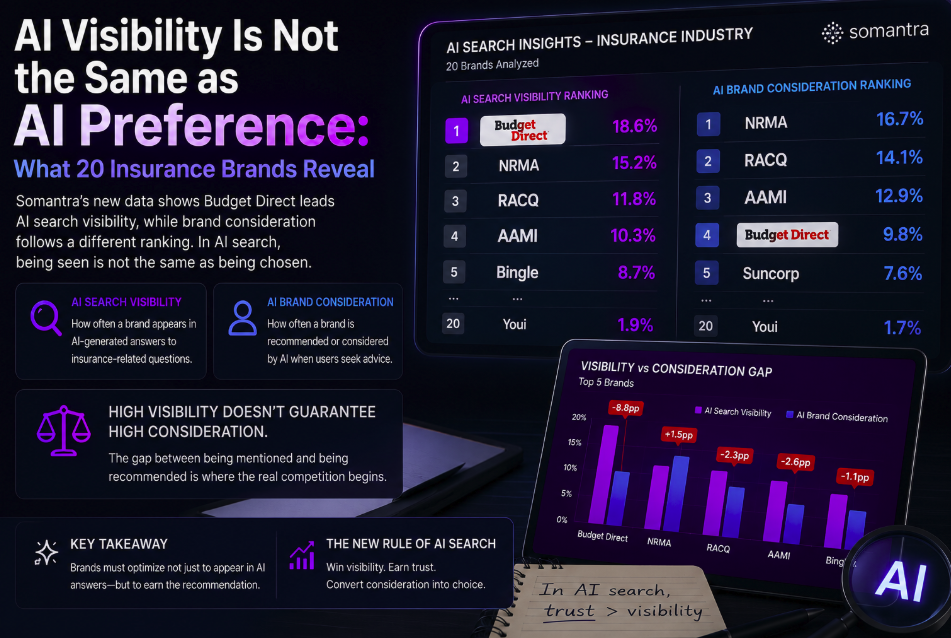
AI search measurement is reaching the point where counting mentions is no longer enough. A new August audit of 20 Australian insurance brands provides one of the clearest examples yet: the brands that appear most often in AI-generated answers are not necessarily the brands the system frames most strongly when a user is actually choosing.
The Somantra release published August 31 says Budget Direct remains the overall AI-search visibility leader, with 9,960 observed mentions across ChatGPT and Google AI Overviews. But farther down the leaderboard, the relationship between exposure and recommendation begins to break apart. Shannons ranks only tenth for raw visibility yet ranks first on Somantra’s new Brand Consideration measure in its specialist vehicle segment. ING ranks eleventh in visibility but third in consideration.
That distinction is more consequential than another monthly ranking change. It suggests that AI visibility is beginning to split into separate layers: whether a system knows the brand, whether it mentions the brand, where that mention appears, how the brand is framed, whether it survives comparison with competitors and whether the generated answer effectively moves the user toward choosing it.
Traditional SEO already learned that impressions are not clicks and clicks are not conversions. AI search is now developing its own version of that funnel. A mention is not a recommendation.
Budget Direct leads the visibility table, but the engine-level picture is split
Somantra’s August audit is the third in a series tracking 20 Australian general-insurance brands across more than 34,000 consumer conversations. The latest data puts Budget Direct first in combined observed visibility with 9,960 mentions. Its strongest platform remains Google AI Overviews, where it recorded 5,771 mentions.
ChatGPT tells a different story. NRMA has now led ChatGPT for two consecutive audits, recording 5,649 mentions in August and finishing 83 ahead of Allianz. That continues a pattern visible since Somantra’s May baseline study: Google and ChatGPT do not construct the same competitive landscape.
In May, Allianz led combined visibility with 13,437 mentions, followed by NRMA at 12,524 and Budget Direct at 10,708. Budget Direct was already the Google AI Overviews leader, but only about one fifth of its combined visibility came from ChatGPT. By July it had climbed to first overall. The August result keeps it there even as its matched-query visibility declined 4.4% from July to August.
Allianz fell 5.4% on that matched cohort and AAMI fell 6.0%, while ING gained 4.2%. Those month-to-month changes matter, but the deeper signal is that the engines themselves remain structurally different. A brand can lead one environment and trail in another without anything about the underlying company changing.
Visibility answers “were you named?” Preference asks “how were you positioned?”
Most AI monitoring tools began with a straightforward metric: run a set of prompts and count how frequently a brand appears. That is useful. A brand that is never mentioned when users ask relevant questions has an obvious discovery problem.
But the same mention can perform very different jobs inside an answer. Consider three hypothetical responses. An assistant might say a brand exists among ten available insurers. It might describe the brand as suitable for a narrow use case. Or it might explicitly frame that insurer as the strongest option for the user’s circumstances. All three responses create one brand mention. Their commercial implications are not remotely equivalent.
Somantra is trying to measure that difference through what it calls Brand Consideration: whether an AI answer frames a brand as the most-likely recommendation rather than merely naming it. The metric belongs to Somantra’s own methodology and should not be confused with measured consumer purchase behavior. It does, however, point toward a more useful question than raw share of voice.
When AI is functioning as an advisory interface, the competitive outcome is not simply presence. It is positioning.
Shannons is the most revealing brand in the study
Shannons provides the clearest example of why a visibility-only dashboard can mislead. In the August data, the specialist insurer sits at number ten in raw visibility. On Somantra’s most-likely recommendation framing, however, it ranks first within the elite, premium and vintage motor-vehicle segment — a nine-place difference.
That makes intuitive sense once AI search is treated as a recommendation environment rather than a page-ranking environment. A specialist brand does not need to be relevant to every generic insurance conversation. It needs to be unusually relevant when the user’s requirements match the brand’s specialization.
A mass-market insurer may accumulate thousands of mentions across broad car, home, travel and other insurance questions. A specialist can appear much less frequently overall while being the system’s strongest answer when the conversation narrows to the precise category it serves.
In conventional search analytics, this resembles the difference between enormous top-of-funnel impression volume and a smaller set of highly qualified commercial queries. AI makes the distinction more complex because the model itself can perform the qualification. The user describes circumstances in natural language, and the system decides which brands fit those constraints.
That creates a form of semantic market positioning. The question becomes not “How often does AI mention us?” but “For which type of customer does AI believe we are the right answer?”
ING shows the same pattern from a different position
ING ranks eleventh in visibility but third in Somantra’s consideration ranking. That gap suggests a brand can be relatively absent from the broad conversation while performing strongly once it enters the shortlist.
This is strategically important because optimizing the wrong metric can produce the wrong content strategy. If ING looked only at visibility rank, the obvious objective would be to increase mentions everywhere. If its stronger consideration position is robust, a better strategy may be to understand the scenarios in which the AI already prefers it and expand the evidence supporting those use cases.
The same logic applies in reverse. A brand with high visibility but weak consideration should not automatically celebrate its share of voice. It may be repeatedly included as background context while competitors receive the stronger recommendation language.
AI analytics therefore needs a concept analogous to conversion quality. Ten thousand weak mentions may be less commercially valuable than three thousand mentions concentrated around high-intent situations where the model actually places the brand near the top of the decision set.
“Preference” needs careful language
There is an important methodological boundary here. An AI system does not prefer an insurer in the human psychological sense. Nor does a “most likely” framing prove that the user subsequently buys a policy.
The output is generated from the model’s current context, retrieved sources, system behavior and the specific prompt. Somantra’s Brand Consideration metric attempts to classify how that output positions the brand. It is an observational model-output metric, not a controlled study of consumer conversion.
That distinction matters because the AI-search industry is quickly adopting terms such as mindshare, preference, recommendation and consideration. These labels can imply more than the underlying data demonstrates.
The safest interpretation is behavioral at the answer level: when the monitored prompts are run, some brands are more likely than others to receive recommendation-like framing. Whether that framing changes human purchasing behavior requires separate evidence.
Where a brand appears inside the answer is becoming another metric
Somantra’s August audit adds a “First Seen” analysis that reinforces the same theme. According to the company, Google AI Overviews placed a tracked brand before the scroll line 85.6% of the time, compared with only 34.0% for ChatGPT. In ChatGPT answers, the first brand appeared at a median position around word 186.
This is not simply a cosmetic difference between interfaces. It changes the meaning of a mention.
Google AI Overviews sit inside a search-results environment designed around rapid scanning. ChatGPT frequently produces longer explanatory responses before naming commercial options. A brand that appears eventually may technically be visible in both systems, yet the probability that a user notices or acts on that mention can differ substantially.
AI visibility therefore has a placement problem analogous to traditional SERP position, but it is not reducible to “rank number three.” A brand can appear early or late in prose, inside a comparison table, as an example, in a caveat, as a cited source or as the final recommendation. Each is a different kind of exposure.
The insurance market shows why prompt context matters more than a universal leaderboard
Insurance is unusually well suited to exposing this problem because the “best” product depends heavily on the user. Vehicle type, location, age, budget, coverage level, travel behavior, property characteristics and risk tolerance can all change the appropriate recommendation.
A universal brand leaderboard therefore compresses thousands of conditional decisions into one number. That number is useful for market-level monitoring, but it can hide where a brand actually wins.
Shannons does not need to dominate every generic insurance query to own the mental category around enthusiast, classic or premium vehicles. A different insurer may be stronger for budget-conscious drivers, another for roadside assistance and another for travel. AI assistants can turn those attributes into dynamic shortlists without requiring the user to know which search filters to select.
This is one reason AI search may reshape brand strategy more deeply than a simple shift from Google links to chatbot answers. Search engines traditionally asked brands to compete for queries. Conversational systems increasingly ask brands to compete for situations.
Most deep insurance conversations still contain no tracked brand at all
The other major August finding is almost the opposite of a visibility arms race. Somantra says 78.9% of detailed ChatGPT category-level conversations in its monitored set named none of the 20 tracked insurers. That is only a modest improvement from the roughly 82% brandless rate observed in earlier audits.
Life insurance is particularly sparse: 96.9% of ChatGPT conversation answers in that category contained no tracked brand, according to the August release.
This matters because it shows that AI recommendation markets are not necessarily saturated. In many conversations, the model is still answering at the level of principles, coverage considerations and decision criteria rather than moving into branded recommendations.
For insurers, that can be interpreted as whitespace — but not as permission to manufacture promotional pages for every long-tail prompt. The stronger opportunity is to become a credible source for the information the model needs before it can make a responsible recommendation.
If users repeatedly ask how exclusions work, what type of coverage a particular vehicle needs or how to evaluate a policy after a life event, the brand that publishes clear, trustworthy answers may improve both its source visibility and the evidence available when AI systems later construct a shortlist.
The citation layer is surprisingly stable
Somantra also analyzed 7,945 domains cited across ChatGPT and Google AI Overviews. Canstar remained the top-cited domain, and every one of July’s top 100 cited domains was still present in August even though thousands of long-tail sources entered and disappeared.
That persistence matters. AI answers can look fluid from one prompt to another, but the underlying source ecosystem may contain a relatively stable core of repeatedly trusted domains.
Somantra’s earlier 2.4-million-citation insurance study found that only a small fraction of domains persisted across every observed month, while established sources such as comparison publishers and brand-owned sites repeatedly appeared. It also found major differences between Google and ChatGPT in the types of domains they over-indexed.
This suggests that brand preference cannot be separated cleanly from source preference. Before an AI can frame a brand positively, it needs evidence from somewhere. That evidence may come from the insurer’s own site, comparison platforms, government information, editorial publishers, community discussions or other retrieved material.
The competitive unit is therefore larger than the brand website. It is the information environment surrounding the brand.
This is reputation engineering, not just content optimization
SEO historically gave marketers a reasonably direct optimization surface: improve the page, improve internal linking, earn external links, fix technical issues and target relevant searches. AI recommendation introduces a less controllable layer because models synthesize information across multiple sources.
A company can describe itself as the ideal insurer for classic cars. That claim becomes more persuasive to a retrieval-based AI system when independent sources, comparison sites, customer discussions and specialist publications consistently associate the brand with that category.
This is not an argument for manipulating third-party mentions. It is an argument that brand reality needs to be legible across the web. Products, differentiators, eligibility, exclusions, expertise and customer fit should be described consistently enough that an AI system can reconstruct them without guessing.
Our own AI Visibility Research methodology makes a related distinction: recognition alone does not guarantee accurate representation. A model may know that an entity exists while reconstructing its attributes or relationships incorrectly. The insurance data adds another layer. Even accurate recognition does not guarantee favorable recommendation framing.
Visibility, understanding and preference form different stages
A useful AI-search model now needs at least three stages.
The first is visibility: does the brand appear at all? This is what mention counts and share-of-voice dashboards measure.
The second is understanding: does the AI correctly know what the brand is, what it offers, who it serves and how it differs from competitors? This is where entity recognition, retrieval quality and source consistency matter. In our six-model reconstruction experiment, the same small publisher was correctly understood by some AI systems and misinterpreted by others despite an identical underlying web presence.
The third is consideration: when the user’s requirements match a commercial decision, does the generated answer move the brand into a strong recommendation position?
A brand can succeed at one stage and fail at another. It can be highly visible but poorly understood. It can be accurately understood but rarely mentioned. It can have modest overall visibility yet be strongly recommended for a narrow segment. Those states require different interventions.
Google and ChatGPT are not one AI channel
The Australian insurance data has repeatedly shown that treating “AI search” as a single channel is another analytical mistake. In Somantra’s May report, Google AI Overviews and ChatGPT agreed on the top brand in only 27.9% of the overlapping queries examined. The August engine-level rankings remain different, with Budget Direct strongest on Google AI Overviews while NRMA leads ChatGPT.
The interfaces have different retrieval systems, answer formats, source preferences and user behaviors. Google AI Overviews operates inside a conventional search session and can expose brands quickly. ChatGPT can spend hundreds of words understanding the problem before introducing a commercial option.
A brand’s combined visibility number can therefore hide two very different competitive positions. Marketers should resist averaging away the engine-level story.
This is similar to the mistake publishers made when they initially treated mobile and desktop search as interchangeable because both were “Google.” The aggregate metric was convenient until user behavior and result layouts diverged enough that separate analysis became necessary.
The next AI dashboard needs more than share of voice
If the August findings hold across other sectors, AI-search analytics will need to mature quickly. Mention frequency remains useful, but it should sit beside recommendation framing, first appearance, citation context, competitive co-occurrence, category fit and eventually downstream conversion.
A travel brand mentioned in 40% of answers but consistently introduced after three stronger alternatives has a different problem from a brand mentioned in 15% of answers but selected first whenever a particular high-value traveler profile appears.
Likewise, a company may discover that it is frequently cited as an information source while a competitor receives the actual recommendation. Citation authority and commercial preference can diverge too.
That produces a much richer funnel: source inclusion, entity recognition, brand mention, prominent placement, shortlist inclusion, recommendation framing, click or visit, and purchase. Current tools observe only parts of that sequence.
What 20 insurance brands actually reveal
The most useful lesson from Somantra’s August audit is not that Budget Direct, NRMA or Shannons has discovered a permanent formula for winning AI search. These rankings can change as models, retrieval systems, prompts and source corpora change.
The important lesson is measurement.
AI visibility was initially treated as a binary extension of SEO: either the model mentions your brand or it does not. The insurance data shows why that is inadequate. The system can know a brand without mentioning it, mention it without prioritizing it, prioritize it only in a narrow segment, cite its website without recommending its product or recommend it after synthesizing evidence from third-party sources.
Those are separate outcomes.
For brands, the strategic question therefore changes from “How do we get more AI mentions?” to “In which decisions does AI understand us well enough to choose us, and what evidence is producing that judgment?”
That is a harder question because it crosses SEO, product positioning, digital PR, reputation, structured information, editorial coverage and customer experience. It is also much closer to the commercial reason companies care about AI visibility in the first place.
Being seen is the beginning, not the win
Budget Direct’s overall visibility lead demonstrates the value of broad presence. Shannons’ nine-position consideration premium demonstrates the limitation of measuring presence alone. ING’s gap between eleventh in visibility and third in consideration reinforces the same point from another part of the market.
None of these figures proves that an AI recommendation converts directly into a policy sale. Somantra’s study is vendor-produced observational monitoring, and its Brand Consideration measure is a model-output metric rather than a consumer purchase study. The findings should be treated as evidence about how AI answers are structured, not as a substitute for revenue attribution.
But the direction is important. As consumers increasingly ask AI systems to narrow choices rather than merely retrieve websites, brands will need to measure more than whether they appear in the answer. They will need to know what role they play inside it.
Traditional search taught marketers to distinguish rankings from clicks and clicks from conversions. AI search is forcing the same maturation at a new layer. Visibility tells you that the system can surface your brand. Preference-like framing tells you whether the system sees a reason to put that brand ahead of alternatives.
Those are not the same achievement — and the 20 insurers in Somantra’s dataset make the difference increasingly difficult to ignore.