
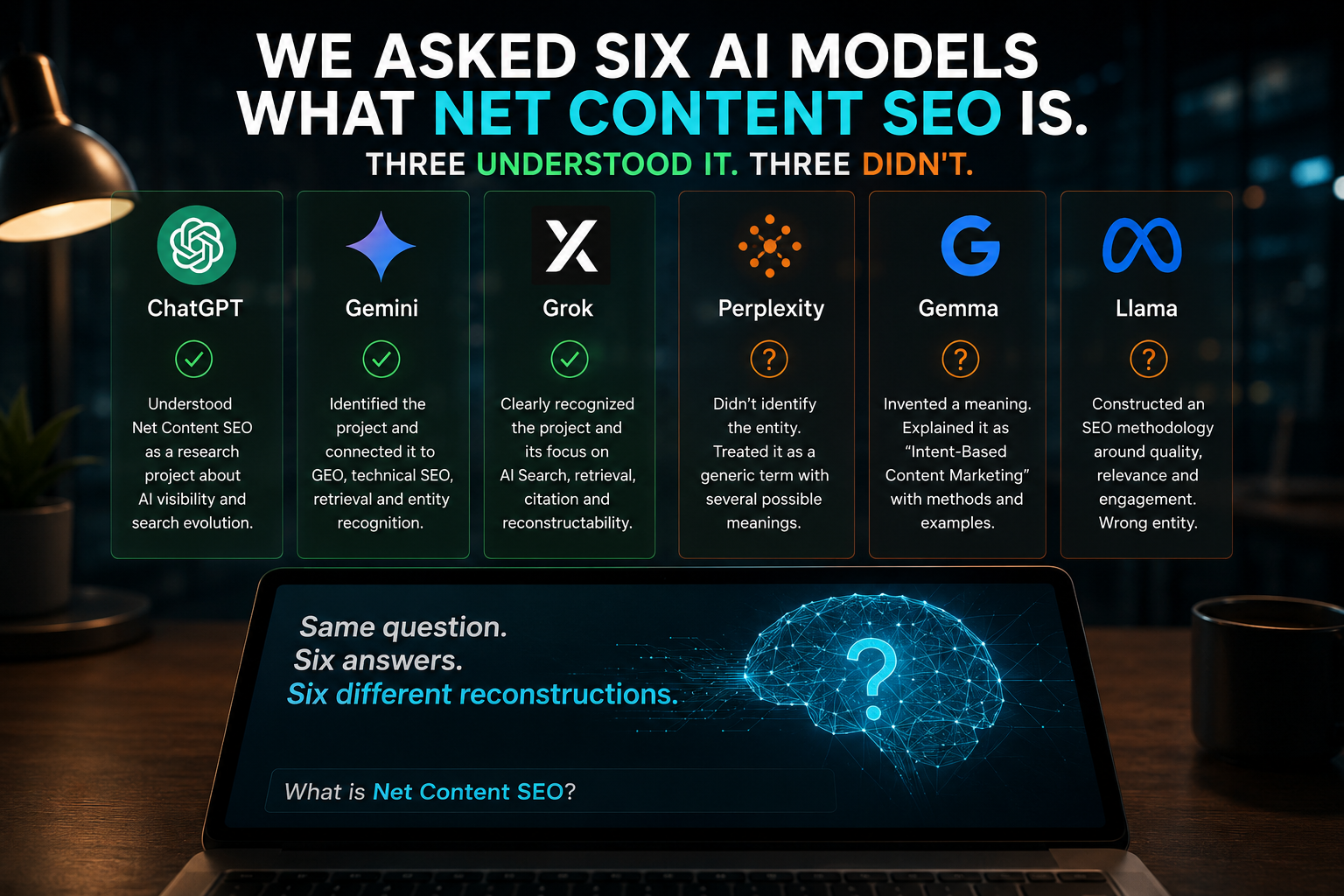
We asked ChatGPT, Gemini, Perplexity, Grok, Gemma and Llama the same question about Net Content SEO. Their answers show how differently AI systems can reconstruct a small web entity — from accurate recognition to confident invention.
Today we ran a very simple experiment. We asked six AI systems exactly the same question: “What is Net Content SEO?”
We weren't testing which model writes the nicest answer. We wanted a baseline for something we've been discussing and testing for months: how does an AI system reconstruct a small entity that doesn't yet have the enormous web footprint of an established company?
The results were surprisingly different.
ChatGPT understood Net Content SEO as an independent research and publishing project focused on AI visibility and the changing relationship between search and generative systems. More interestingly, it connected the project with retrieval, reconstruction and AI citations, and used LMBDA as a supporting source.
Gemini also identified the website correctly. Its description wasn't identical, but the entity was clear: Net Content SEO was associated with technical SEO, AI visibility, GEO, retrieval, RAG and entity recognition.
Grok was perhaps the clearest. It explicitly distinguished Net Content SEO as a project from the generic concept of content SEO and connected it with AI Search, retrieval, citation, reconstruction and meaning-first visibility.
Then things changed.
Perplexity didn't confidently identify the entity. Instead, it interpreted “Net Content SEO” as a potentially generic expression and proposed several possible meanings, including content SEO and “net-new content.” It even asked for a link or screenshot if we were referring to a particular company or framework.
Gemma went considerably further. It confidently explained Net Content SEO as another name for “Intent-Based Content Marketing,” complete with methodology, examples and recommendations. That isn't what Net Content SEO is.
Llama did something similar, constructing an apparently plausible SEO methodology around quality, relevance, engagement metrics and user intent. Again, reasonable SEO advice — but the wrong entity.
This is exactly why we're interested in reconstructability.
The six systems received the same three words, yet they did not reconstruct the same thing. Some connected those words to the actual project and its published ideas. Others treated them as a phrase whose meaning could be inferred from familiar SEO concepts. Once that happened, the answer could sound perfectly credible while describing something that doesn't exist.
There is also an important caveat. This test does not tell us that one model is inherently better at entity recognition than another. The systems may have different training data, retrieval capabilities, search access and surrounding context. We are measuring the answer we received, not establishing a universal model ranking.
What interests us is what happens next.
Today gives us a baseline. Net Content SEO is already reconstructable by some AI systems, partially or incorrectly reconstructable by others. We can now continue publishing around a deliberately consistent set of relationships — Net Content SEO, AI visibility, AI Search, retrieval, reconstruction and original experiments — and repeat exactly the same question over time.
We don't want to change the question until we get the answer we like. If Perplexity, Gemma or Llama still misunderstand Net Content SEO in a month, that's part of the result. If one of them suddenly identifies the project correctly, we'll have a date, a before state and a body of content published between the two tests.
That's considerably more useful to us than claiming we have discovered another GEO ranking factor.
The experiment has already started. And right now, the disagreement between the models may be the most interesting result we could have asked for.
Chatgpt
Net Content SEO is an independent research and publishing project focused on how search visibility is changing as AI systems become part of how people discover information.
Rather than treating SEO only as Google rankings and organic clicks, Net Content SEO explores AI visibility, GEO (Generative Engine Optimization), AI citations, retrieval, entity recognition, and how content can be structured so that both search engines and large language models can understand and reuse it.
A central idea behind the project is that the next stage of SEO may increasingly be about being understood, reconstructed, and cited by AI systems, not simply ranking a webpage.
Its work includes experiments and observations around AI Search, Google Search, LLM retrieval and the relationship between traditional SEO signals and visibility inside AI-generated answers. The related LMBDA research index describes NetContentSEO as a “research publishing lab documenting the evolution of search visibility in the AI era.”
So, in one sentence:
Net Content SEO studies what happens to SEO when visibility moves from search results toward AI-generated answers.
Net Content SEO (netcontentseo.net) is a specialized digital platform focused on modern Search Engine Optimization, technical web strategy, and AI-driven organic visibility.
Instead of traditional, surface-level keyword optimization, the platform concentrates on the evolving intersection between classical web indexing and modern search environments, particularly focusing on how information is parsed, indexed, and cited by AI models.
Key Focus Areas & Core Capabilities
-
Generative Engine Optimization (GEO): Structuring content and semantic data to ensure visibility, citation, and entity recognition across AI search interfaces and Large Language Models (LLMs).
-
Technical SEO & Architecture: Optimizing website infrastructure, rendering pipelines, crawl efficiency, and indexability for modern web frameworks.
-
Information Retrieval & RAG Frameworks: Aligning web content structure with Retrieval-Augmented Generation processes to maximize retrieval accuracy in AI-powered search engines.
-
Entity & Brand Recognition: Moving beyond simple keyword tracking toward establishing clear, machine-readable brand authority and entity association across digital ecosystems.
Perplexity
“Net Content SEO” is not a widely standardized SEO term. In most contexts, it likely means either content SEO—optimizing pages to earn organic visibility—or the amount of net-new, useful content a site adds after excluding duplicates, thin pages, or low-value updates.
Likely meanings
| Interpretation | What it means |
|---|---|
| Content SEO | Creating and improving content so search engines can understand it and users find it valuable: matching search intent, covering relevant entities/topics, structuring headings, using internal links, and maintaining accuracy/freshness. digitalmarketinginstitute+1 |
| Net-new content | Content that genuinely adds incremental value: a new page, original research, a materially expanded guide, or a substantially improved product/category page—not merely a rewrittten or duplicated page. This is common informal agency/reporting language rather than a formal SEO discipline. |
| “Net content” metric | In a content audit, it can mean the remaining inventory after removing duplicate, obsolete, cannibalizing, or no-value URLs. It is a planning metric, not a Google ranking factor. |
What it should imply in practice
A useful “net content SEO” program would prioritize:
-
Publishing pages only where there is a clear search demand, audience need, or conversion role.
-
Creating original information, experience, examples, data, or comparisons that make the page meaningfully better than existing results.
-
Optimizing the page around intent and topical relevance rather than repeating a target keyword.
-
Making content crawlable and understandable through descriptive titles, heading hierarchy, internal links, and—where appropriate—structured data.dxstudio.msu+1
-
Consolidating or pruning overlapping pages, so multiple URLs do not compete for the same intent.
-
Measuring net gains: incremental impressions, qualified organic clicks, rankings, conversions, assisted revenue, and AI-search citations/mentions—not simply article count.
Example
Suppose an ecommerce site has ten near-identical “best running shoes” articles. A net-content approach could consolidate them into one definitive hub, redirect obsolete URLs, then add genuinely distinct pages for intents such as “best running shoes for flat feet,” “trail running shoes in winter,” and a first-party sizing guide.
That reduces duplication while increasing the site’s useful topical coverage. Content SEO broadly aims to make content relevant, readable, valuable, and aligned with what a user is trying to accomplish.searchatlas+1
If you saw “Net Content SEO” used by a particular agency, tool, course, or person, share the link or screenshot—the phrase may be their proprietary framework or brand name.
Grok
Net Content SEO (or NetContentSEO) is primarily the name of an independent research and publishing project/brand focused on AI visibility, meaning, and modern search.
Its website (netcontentseo.net) describes it as studying how AI systems discover, interpret, and reconstruct information—and what it takes for brands, authors, and ideas to stay visible as search becomes more generative. The core idea is “visibility beyond ranking”: traditional ranking tricks are declining in effectiveness, and success increasingly depends on how well AI and humans understand the meaning of your content.
Key themes from NetContentSEO
- Emphasis on meaning-first approaches rather than keyword stuffing, mass content production, or short-term optimization hacks.
- Research into AI search behaviors (retrieval, citation, reconstruction of information, hallucinations, entity understanding, query fan-out, etc.).
- Topics such as the risks of aggressive anchor-text changes (“anchor churn”), precision over volume in SEO, context/trust/intent as ranking drivers, and adapting to AI agents as a new class of web users.
- The view that SEO itself is not dying, but shortcuts and purely ranking-focused tactics are; lasting visibility comes from being clearly understood and trustworthy.
It is not a widely established industry term or standardized SEO methodology like “Content SEO.”
Relation to regular Content SEO
Content SEO (a standard concept) is the practice of creating and optimizing high-quality, useful content so pages rank well in search engines. It typically includes:
- Keyword research aligned with search intent
- Clear structure (headings, readability)
- On-page elements (titles, meta descriptions, internal links, multimedia)
- E-E-A-T signals (Experience, Expertise, Authoritativeness, Trustworthiness)
- Focus on helpful, people-first content rather than search-engine manipulation
NetContentSEO builds on related ideas but shifts the emphasis toward the AI/generative-search era—how machines parse meaning, attribute information, and decide what to surface or cite—rather than classic ranking techniques alone.
In short, if you encounter “Net Content SEO,” it most often refers to this specific research-oriented project and its meaning- and AI-visibility-focused perspective on SEO, not a general technique.
Okay, let's break down Net Content SEO – it’s a surprisingly nuanced and increasingly important approach to search engine optimization. It goes beyond simply stuffing your website with keywords and building links. Here's a detailed explanation:
1. What is Net Content SEO?
Net Content SEO (often referred to as "Intent-Based Content Marketing") focuses on creating content that directly addresses the underlying need or intention behind a user’s search query. Instead of thinking about individual keywords, you think about what the person truly wants to achieve when they type those words into Google.
2. The Core Philosophy – Understanding User Intent
This is the key difference from traditional SEO. Traditional SEO often focused on matching keyword phrases; Net Content SEO digs deeper. Google’s algorithms are now incredibly sophisticated and recognize context. They understand:
- Informational Intent: The user wants to learn something (e.g., "what is blockchain?").
- Navigational Intent: The user wants to find a specific website or brand (e.g., "Facebook login”).
- Transactional Intent: The user wants to buy something or take an action (e.g., “buy Nike running shoes online”).
- Commercial Investigation Intent: The user is researching products before buying and comparing options (e.g., “best DSLR camera 2024”).
3. How It Works – Creating Content That Responds to Intent
Here’s how you translate this into action:
-
Keyword Research - Evolved: You still do keyword research, but it's not just about volume. You look for keyword clusters and analyze the search intent behind those terms. Tools like Ahrefs, SEMrush, and AnswerThePublic are invaluable here.
-
Content Mapping: Map each keyword cluster to a specific piece of content that directly answers the user’s question or fulfills their need. Don't just create a blog post about “dog training”; consider:
- "How to teach my puppy to sit" (Informational)
- "Best dog training treats for puppies" (Transactional - leads to product page)
- “Dog Training Near Me” (Navigational – links to your local services)
-
Comprehensive & High-Quality Content: The content must be excellent. It needs to:
- Be thorough and cover the topic completely.
- Provide genuine value to the reader - solve a problem, answer a question, or entertain effectively.
- Have strong internal linking – guiding users to related content.
- Be well-structured with headings, subheadings, images, videos etc.
-
User Experience (UX) is Paramount: Google rewards sites that provide a positive user experience. Fast loading times, mobile responsiveness, and easy navigation are all crucial.
4. Key Differences from Traditional SEO
| Feature | Traditional SEO | Net Content SEO |
|---|---|---|
| Focus | Keyword Matching | User Intent |
| Content Goal | Rank for keywords | Satisfy user need & intent |
| Approach | Quantity of links/words | Quality, depth of content |
| Algorithm Focus | Keyword density, backlinks | Contextual understanding |
5. Why is Net Content SEO Important Now?
- Google's Algorithm Updates: Google’s algorithms (like RankBrain) are increasingly reliant on semantic search – understanding the meaning behind queries, not just the words themselves.
- Voice Search & Featured Snippets: People use voice assistants to ask questions and get direct answers. Content that satisfies these conversational searches is more likely to earn featured snippets (the boxes at the top of Google results).
- User Satisfaction = Ranking: Ultimately, Google wants users to be happy with its search results. Providing valuable content leads to higher engagement, longer session times, and lower bounce rates – all signals Google uses to rank sites.
Resources for Learning More:
- Neil Patel's Blog - Net Content SEO: https://neilpatel.com/net-content-seo/
- Ahrefs Blog – Understanding Intent: https://ahrefs.com/blog/user-intent/
Do you want me to delve deeper into a specific aspect of Net Content SEO, such as:
- How to conduct user intent research?
- Examples of content mapping for different industries?
- Tools that can help with net content strategy?
Net content SEO (NCSEO) is a marketing strategy that focuses on the quality and relevance of the content you provide to your audience, rather than just the quantity. It's about creating valuable, engaging, and informative content that addresses the needs and pain points of your target audience.
The key principles of Net Content SEO are:
- Quality over Quantity: Prioritize creating high-quality, relevant, and useful content that resonates with your audience.
- Content Relevance: Ensure that your content is relevant to your target audience's search intent and provides value to them.
- Engagement Metrics: Focus on metrics such as dwell time, bounce rate, and engagement rates (e.g., likes, shares, comments) to measure the success of your content.
Net Content SEO involves several tactics, including:
- In-depth content creation: Write comprehensive guides, tutorials, or blog posts that address specific topics in detail.
- Optimizing for user experience (UX): Ensure that your website and content are easy to navigate, mobile-friendly, and provide a seamless user experience.
- Content localization: Tailor your content to the specific needs and preferences of different regions, languages, or cultures.
- Internal linking: Use internal links to connect relevant pages on your site, making it easier for users to find related information.
- Analytics-driven optimization: Use data from analytics tools (e.g., Google Analytics) to identify areas for improvement and optimize your content accordingly.
By focusing on net content SEO, you can:
- Improve search engine rankings: By creating high-quality, relevant content that resonates with your audience.
- Increase engagement: With more users interacting with your content and sharing it with others.
- Build trust and authority: Establish your brand as a thought leader in your industry or niche.
Remember, net content SEO is an ongoing process that requires continuous monitoring, analysis, and optimization of your content strategy to ensure its effectiveness over time.