
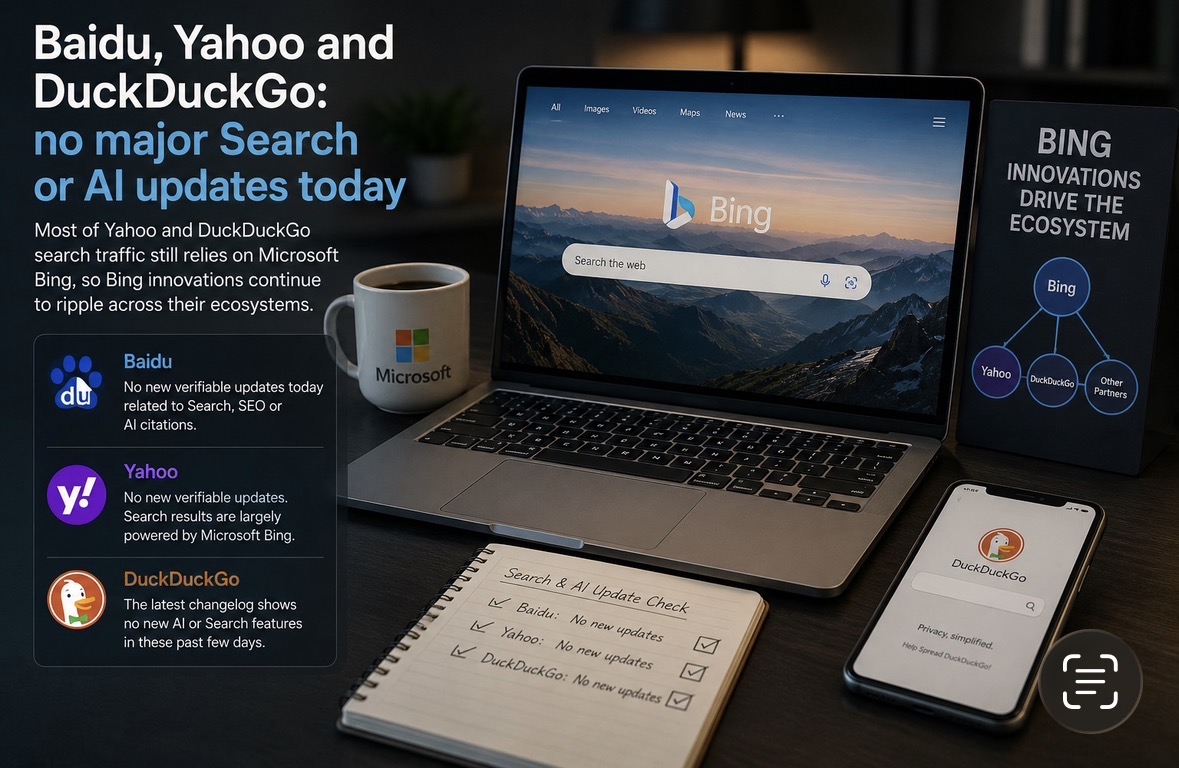
For search marketers tracking the daily flow of AI search updates, today appears to be a quiet one across Baidu, Yahoo and DuckDuckGo. There is no newly verifiable announcement today from Baidu specifically tied to Search, SEO or AI citation behavior, and Yahoo has not published a fresh search-side update of similar relevance. DuckDuckGo’s latest publicly visible help and product material also does not point to a new AI or Search feature from these very recent days. That absence matters because the search market is now moving so quickly that silence from a major platform can be as useful a signal as a launch announcement.
The clearest current Baidu context is not a new search product change, but the company’s broader AI and advertising pressure. Reuters reported in August that Baidu CEO Robin Li pledged to push Ernie back toward the AI frontier after the company missed second-quarter revenue expectations. The same report noted that Baidu’s online marketing services revenue fell year over year, while its AI-powered business grew, underlining the tension between Baidu’s legacy search-and-advertising base and its AI investment cycle. That is important background for SEO and AI citation watchers, but it is not the same thing as a verified change in Baidu search ranking, citation policy or generative-search presentation. See the Reuters coverage of Baidu’s latest earnings and AI positioning here.
Yahoo is also quiet on conventional search updates today, although its AI strategy has become more visible in 2026 through Scout, its AI answer engine. The Associated Press described Scout as Yahoo’s attempt to return to its search roots by offering AI-powered answers with supporting links, while Business Insider reported that Scout is built on Anthropic’s Claude and Microsoft’s Grounding with Bing, with Yahoo emphasizing clearer sourcing as a differentiator. Those reports are strategically relevant because they show Yahoo trying to participate in the AI search race, but they do not amount to a new same-day Search or SEO update. They instead reinforce that Yahoo’s search revival is being built partly through partners and partly through its own consumer ecosystem, rather than through a sudden independent search-index shift. See AP’s report on Yahoo Scout here and Business Insider’s sourcing-focused Scout coverage here.
DuckDuckGo presents a different but related case. The company has AI features, including Duck.ai and Search Assist, but its own help pages frame them as optional controls that users can disable or reduce from search settings. DuckDuckGo says users can turn off Duck.ai in search and set Search Assist to “Never,” which is a notable contrast with platforms that push AI answers more aggressively into the default search experience. Its public help documentation is useful for understanding DuckDuckGo’s product posture, but it does not show a new AI/Search changelog item from these last few days. DuckDuckGo’s opt-out documentation is available here.
The larger point for Yahoo and DuckDuckGo is Microsoft. Search professionals should not treat every Yahoo or DuckDuckGo search change as wholly independent, because both products are connected in important ways to the Bing ecosystem. DuckDuckGo says that while it uses Instant Answers, specialized sources, its own crawler and its own indexes, its traditional links and images are largely sourced from Bing. That means significant changes in Bing’s index, ranking systems or AI grounding infrastructure can ripple indirectly into parts of the DuckDuckGo search experience, even when DuckDuckGo has not announced a dedicated product change of its own. DuckDuckGo explains its result sources in its help documentation here.
Yahoo’s dependency picture is more complex because Yahoo now has Scout and a broader content-and-user-data strategy, but Microsoft remains highly relevant. The Associated Press notes Yahoo’s long-running history of licensing Bing search technology, while Business Insider’s Scout reporting points to Microsoft’s Grounding with Bing as part of the AI answer-engine stack. In practice, that means Microsoft search and AI-search changes can matter beyond Bing.com itself. They may affect the infrastructure, grounding layer or search monetization environment around partners that rely on Microsoft technology in different ways.
For SEO teams, the practical conclusion is to separate verified updates from ecosystem inference. A confirmed Bing change can be worth monitoring across Yahoo and DuckDuckGo surfaces, but it should not be reported as a Yahoo or DuckDuckGo update unless those companies announce it or observable evidence supports it. Likewise, Baidu’s AI investment, Ernie roadmap and advertising pressure are highly relevant to the Chinese search market, but they should not be converted into claims about AI citation changes unless Baidu publishes such changes or reliable testing identifies them.
Today’s search update check therefore points to a restrained conclusion: no major new, verifiable Baidu, Yahoo or DuckDuckGo Search, SEO or AI citation development appears to have landed today. The real editorial signal is structural rather than immediate. Baidu remains under pressure to turn AI investment into search and advertising strength, Yahoo is using Scout to re-enter the answer-engine conversation, and DuckDuckGo continues to balance AI choice with privacy-first search. Behind Yahoo and DuckDuckGo, Microsoft Bing remains the infrastructure player whose changes may propagate indirectly, making it essential to watch both direct announcements and the partner ecosystem around them.