
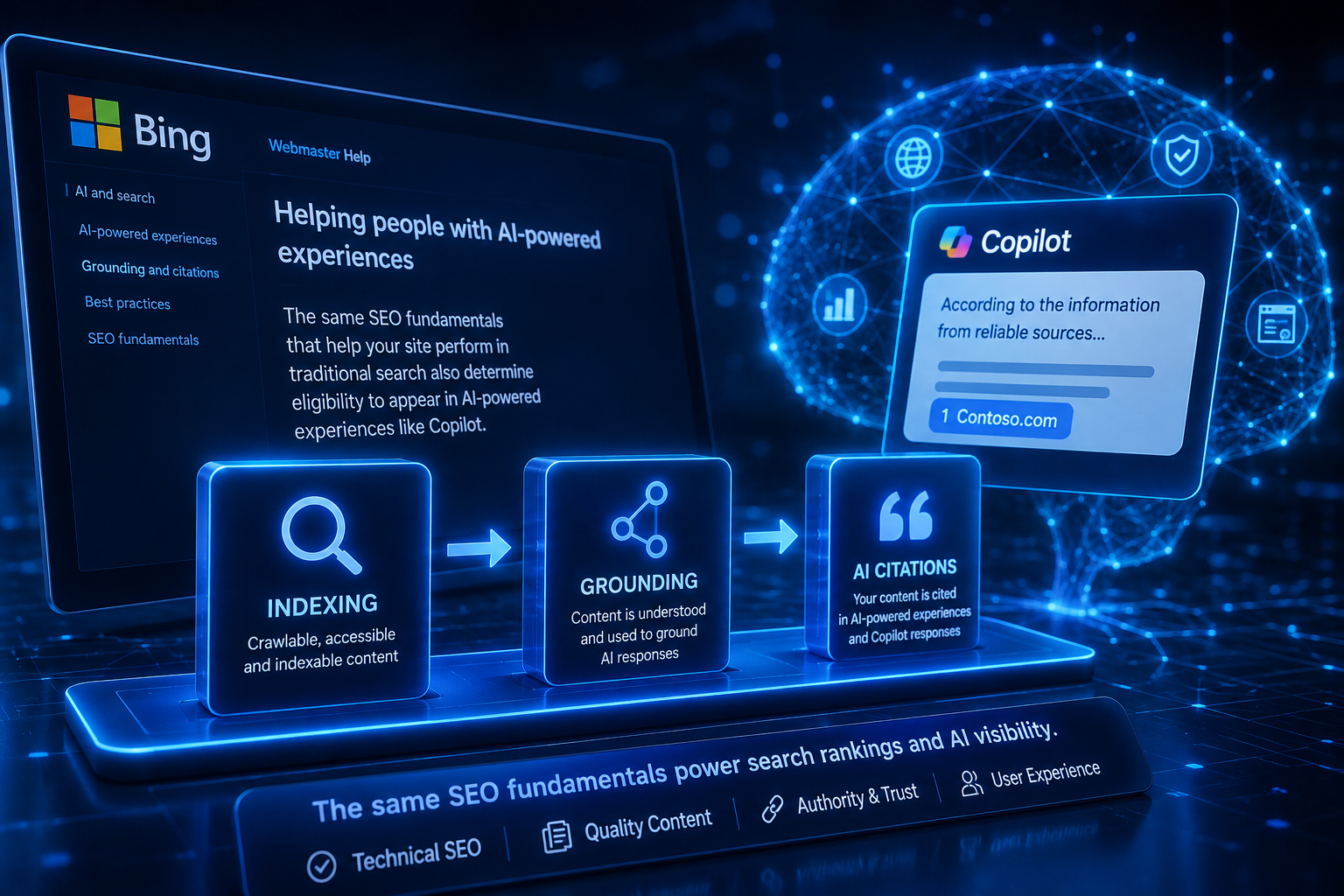
Microsoft has quietly made one of the clearest statements yet about how classic SEO connects to AI visibility. In its updated Bing Webmaster Guidelines, the company now frames Bing’s job as discovering, crawling, indexing, evaluating and surfacing content not only across Bing search, but also across Copilot and grounding API results. The change is more than a wording update. It turns the relationship between indexing, grounding and AI citations into an explicit pipeline that site owners can actually reason about.
For years, SEO teams have treated Bing mainly as an alternative search engine with its own crawl, index and ranking systems. Copilot changes the stakes. Microsoft’s AI experiences depend on search-grounded retrieval, which means Bing’s understanding of a page can determine whether that page becomes supporting evidence inside an AI-generated answer. The practical takeaway is simple but important: the same foundations that make a URL eligible for search visibility also influence whether it can be used as a grounded source in AI experiences.
Bing’s new AI search message is unusually direct
The clearest public evidence is Microsoft’s February 2026 introduction of AI Performance in Bing Webmaster Tools. Microsoft says the report shows how publisher content appears across Microsoft Copilot, AI-generated summaries in Bing and select partner integrations. It also identifies the URLs that are cited, the citation activity over time and the “grounding queries” used when AI systems retrieve content that later appears as a referenced source.
That vocabulary matters. Microsoft is not describing AI citations as a separate black box detached from search. It is describing a measurable chain: Bing understands and stores a page, Copilot or another AI surface issues retrieval-style grounding queries, relevant content is selected, and some of that content becomes a visible citation. The citation is therefore not the beginning of AI search optimization. It is the final observable output of earlier technical and editorial decisions.
This is also why Bing’s update is strategically important for publishers. Google has confirmed that ordinary search eligibility is required for links to appear in AI Overviews and AI Mode, but it still does not give site owners a dedicated citation report equivalent to Bing’s AI Performance dashboard. Microsoft, by contrast, is beginning to expose the middle layer of the system: not just whether a page received traffic, but whether it was used as a source in AI-generated answers.
Indexing is the first gate, not an old SEO chore
The first stage is still indexing. Microsoft’s documentation for generating answers from public data using Bing search tells site owners to check whether their public site is indexed in Bing and notes that content may need to be submitted or accelerated through Bing Webmaster Tools if it is not appearing. In other words, even in a Copilot context, Bing indexing remains the eligibility layer for public web content.
This makes technical SEO newly relevant rather than less relevant. Crawlable URLs, clean robots.txt rules, accurate sitemaps, stable canonical signals, useful metadata and accessible HTML content are not merely ranking inputs. They are prerequisites for participation in AI-grounded search. A page that Bing cannot crawl, cannot index or cannot confidently understand is unlikely to become a reliable source for Copilot, no matter how valuable it might be to a human reader.
IndexNow also fits into this picture. In the AI Performance announcement, Microsoft connects freshness to inclusion and citation in AI-generated answers, saying that IndexNow helps participating search engines discover added, updated or removed content more quickly. That does not mean IndexNow guarantees citation, but it does reinforce the same principle: an AI answer system can only ground itself in content that the search infrastructure has discovered and processed.
Grounding is the retrieval layer between search and citation
The second stage is grounding. In practical terms, grounding is the process of retrieving external information that can support an AI-generated response. Microsoft’s AI Performance documentation describes grounding queries as the key phrases the AI used when retrieving content that was referenced in AI-generated answers. This is the missing bridge between ranking reports and citation reports: it shows that AI answers are not simply reading a full website from top to bottom, but retrieving pieces of content that match a specific informational need.
That has major implications for content strategy. A page may be indexed and even rank in traditional search, but still fail to be selected for AI grounding if its answers are buried, vague or fragmented. Microsoft’s guidance on optimizing content for inclusion in AI search answers says traditional SEO fundamentals still matter, naming crawlability, metadata, internal linking and backlinks as essential for discoverability. It then explains that AI systems parse content into smaller structured pieces that can be evaluated for authority and relevance before being assembled into answers.
This is the crucial distinction for SEOs moving from classic search optimization to AI search optimization. Ranking is about competing for position in a results list. Grounding is about being retrievable as evidence for a specific claim, definition, comparison or recommendation. Strong pages therefore need clear headings, self-contained explanations, precise entity references, consistent product or topic details, and claims that are supported by evidence. The more easily Bing can identify what a passage says and why it should be trusted, the more likely that passage is to survive the grounding stage.
AI citations are the visible output of the system
The third stage is citation. Bing Webmaster Tools’ AI Performance report measures total citations, average cited pages, page-level citation activity and visibility trends. Microsoft is careful to say that these metrics reflect citation activity, not necessarily ranking, authority or placement inside a specific answer. That caveat is important because it prevents publishers from mistaking citation count for a full AI ranking score. Still, citation data gives site owners something they have lacked in most AI search environments: evidence that a URL is being used as a source.
For editorial teams, the report could change how content audits are prioritized. A page that already receives Copilot citations may be worth strengthening with updated statistics, better headings, clearer definitions and more trustworthy supporting references. A page that is indexed but rarely cited may need sharper structure or more complete answers. A page that is strong in Google Search Console but absent from Bing AI Performance may have a Bing-specific crawling, indexing or interpretation problem.
This is where the indexing → grounding → AI citations model becomes operational. Indexing tells you whether Bing can include the page in its searchable corpus. Grounding queries tell you what kind of AI retrieval activity is connecting to that page. Citations tell you whether the page actually surfaced as a visible source. These are not separate disciplines. They are stages in one search-to-answer pipeline.
What this means for SEO and GEO
Microsoft’s documentation also clarifies a broader industry point: Generative Engine Optimization should not be treated as a replacement for SEO. It is better understood as an extension of search quality into AI answer environments. The old foundations still matter because AI systems built on search still need crawlable, indexable, well-structured and trustworthy web documents. The new layer is that pages must be useful not only as destinations, but also as extractable sources for generated answers.
That does not mean publishers should write robotic one-line answer fragments or overload every page with artificial FAQs. Microsoft’s own guidance points toward clarity, structure and evidence, not spam. The strongest content for AI search is still good editorial content: accurate, current, specific and easy to parse. The difference is that the page should make its useful passages obvious to both readers and machines.
The best immediate workflow is practical. Verify important sites in Bing Webmaster Tools. Check indexing and crawl health. Submit sitemaps and key URLs where appropriate. Use IndexNow for faster discovery of updates. Review AI Performance data when available, especially cited URLs and grounding queries. Then improve pages by aligning title, H1, metadata, headings, structured data and body copy around clear entities, clear intent and verifiable claims.
Bing’s documentation is valuable because it removes some of the mystique from AI search visibility. Copilot citations are not magic mentions granted outside the search system. They are the visible result of content being discovered, indexed, retrieved for grounding and selected as a source. For publishers, that makes Bing one of the most important places to study the future of SEO, because it is beginning to show the mechanics behind the answer layer.