
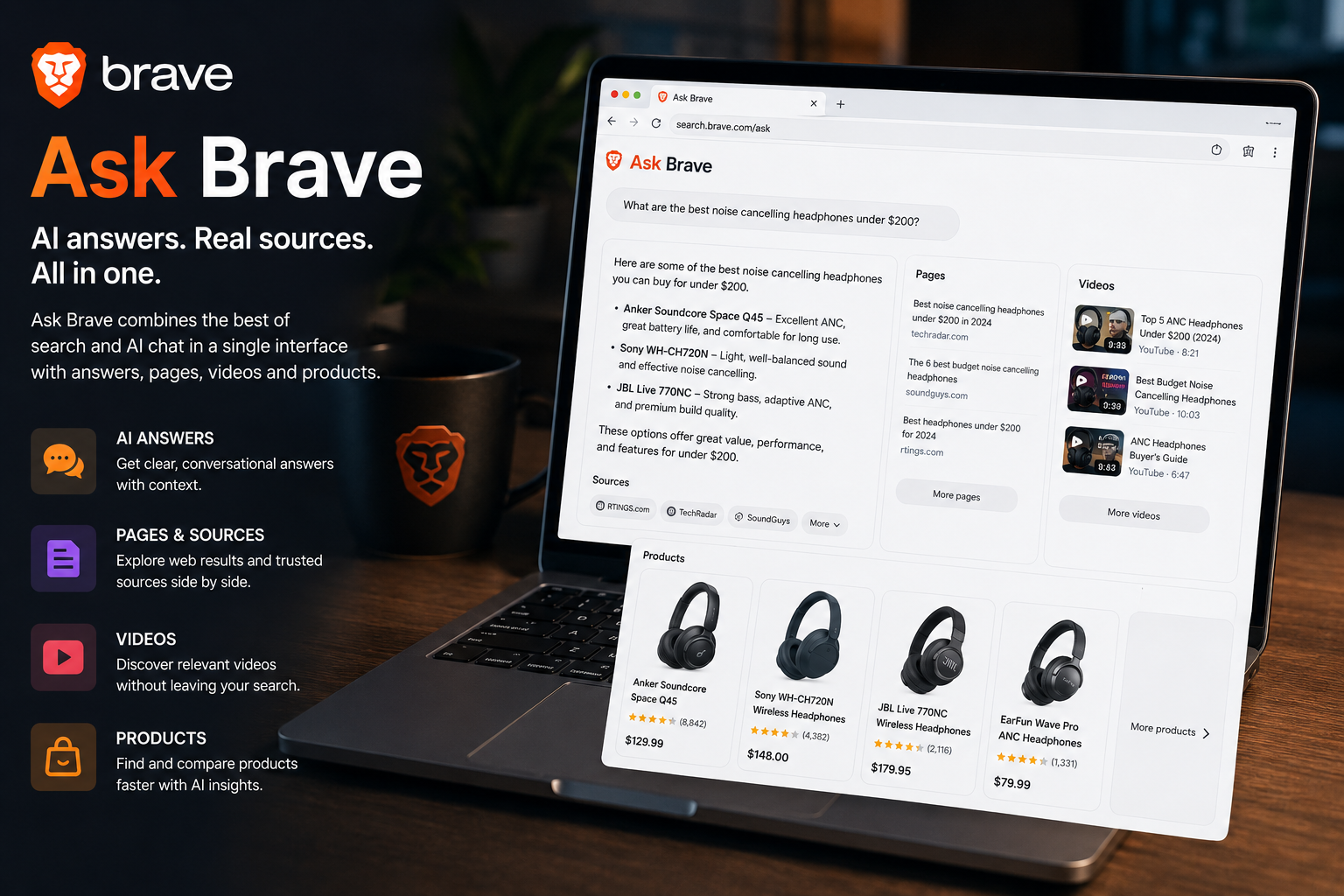
Brave should now be firmly on the search and SEO radar. While Google, Microsoft and Perplexity still dominate most AI search discussions, Brave is pushing a different but increasingly important proposition with Ask Brave: a single interface that blends the traditional search results page with AI chat, source exploration and actionable vertical results. For publishers, ecommerce teams and search marketers, this is not just another chatbot. It is a sign that the SERP itself is being redesigned around answers, follow-up prompts, cited pages, videos and products.
Brave officially introduced Ask Brave as a feature of Brave Search that consolidates search and AI chat in one interface. The company says Ask Brave is available from the Brave Search homepage and at the top of the Brave Search results page, free on any browser or platform. Instead of forcing users to move between a classic list of blue links and a separate AI assistant, Brave presents an answer and then surrounds it with additional elements such as webpages, videos and products that users can open or compare from the same experience. Brave describes the launch in its official Ask Brave announcement.
The product matters because it treats AI search as a hybrid interface rather than a replacement for search. Brave says AI Answers are designed for quick summaries, while Ask Brave is intended for longer answers, follow-up questions and more extensive results. In practice, that positions Ask Brave between a conventional SERP and a conversational assistant. A user can begin with a query, receive a grounded answer, continue the conversation in chat mode and still move sideways into pages, news articles, videos, local businesses, shopping and products. That is exactly the type of blended surface that can change how discovery, citations and commercial visibility work.
Brave’s own help documentation reinforces that this is not a cosmetic layer added on top of search. The company says Brave Search uses AI across its technology stack, including AI Answers with source references, Ask Brave with longer detailed responses and Deep Research, featured snippets, and AI-powered descriptions for search results. The same page says Ask Brave can provide contextual enrichments such as videos, news articles, products, businesses and shopping “right when and where” users need them. Those details are laid out in the Brave Search AI help page.
For SEO teams, the most important phrase in Brave’s positioning is grounding. Brave says Ask Brave answers are grounded in information found on the Web, and that its search engine limits the AI to results relevant to the question. That does not make Brave immune to errors, nor does it remove the need to test how often a site is cited or surfaced. But it does put Brave squarely in the AI citation conversation, because the product is explicitly built around a relationship between generated answers and the Web sources used to support them. In a search market where referral paths are becoming less linear, that relationship is becoming central to visibility.
Brave is also making a broader infrastructure argument. In February 2026, the company launched a revamped Brave Search API aimed at AI applications, including an LLM Context API designed to give large language models highly relevant Web context for questions and queries. Brave said that this API was already powering tens of millions of answers per day inside Brave Search and that its Search plan includes Web, LLM context, images, news, videos and more. The company’s framing is clear: the same index and grounding layer that supports consumer search can also become infrastructure for AI apps and agents. Brave explains the API update in its Search API announcement.
That infrastructure story makes Ask Brave more than a front-end feature. Brave has repeatedly emphasized that Brave Search is based on its own independent Web index, and in its API growth update it said the Search API supplies real-time Web search data to most of the top ten LLMs, while Ask Brave is powered by the same LLM Context approach. The figures are company-reported and should be read as Brave’s own market positioning, but they explain why the company is trying to compete not only as a destination search engine but also as a supplier of Web grounding for the AI ecosystem. Brave’s API growth update is available here.
Commercially, Ask Brave is especially worth watching because it does not isolate products and shopping results from the answer experience. If a user asks for recommendations, comparisons or purchase guidance, the interface can present an AI response alongside product-oriented modules and supporting pages. This creates a different discovery path from classic SEO, where ranking in the organic results list was often the primary objective. In a blended SERP-chat environment, visibility may depend on whether a page is useful as a source, whether a product is represented clearly in structured data, and whether the content can be summarized accurately by the search layer.
The publisher implications are similar. Brave’s answer interface still highlights sources, but the click may come later in the journey, after the user has already read a synthesized response or asked a follow-up question. That means content needs to serve both human readers and machine interpretation. Clear authorship, factual structure, updated information, product attributes, comparisons, evidence and original reporting all become more important when a search engine is deciding not only what to rank, but what to cite, summarize and connect to adjacent media or shopping modules.
Brave’s privacy positioning also makes it distinct from larger AI search players. The company says Ask Brave conversations are encrypted and ephemeral, expire by default after 24 hours of inactivity and are not used for training. It also says Brave Search AI features are optional and can be turned off in settings. Those privacy claims are central to Brave’s brand, but from an SEO perspective the more important point is that a privacy-first search engine is still moving aggressively toward AI answers. In other words, AI search is no longer just a Big Tech pattern. It is becoming a default design direction even for challengers whose core identity is built around independence and user control.
Brave is not yet the search volume leader that will reshape most SEO dashboards overnight. But Ask Brave deserves attention because it shows where alternative search can go: not simply a cleaner list of links, but an AI-assisted results environment that keeps pages, sources, videos and products close to the answer. For brands and publishers, the correct response is not panic, but monitoring. Track whether Brave cites your content, whether your pages are eligible for answer grounding, whether product content is machine-readable, and whether referral patterns change as users spend more time inside AI-assisted search sessions.
The strategic takeaway is straightforward. Brave has moved from being an alternative search engine to being a credible AI search interface with its own index, its own answer layer and a clear vision for combining SERP behavior with chat. Ask Brave may not be the largest AI search product in the market, but it is one of the clearest examples of search becoming conversational, sourced, vertical and transactional at the same time. That is enough to put Brave permanently on the watchlist.