
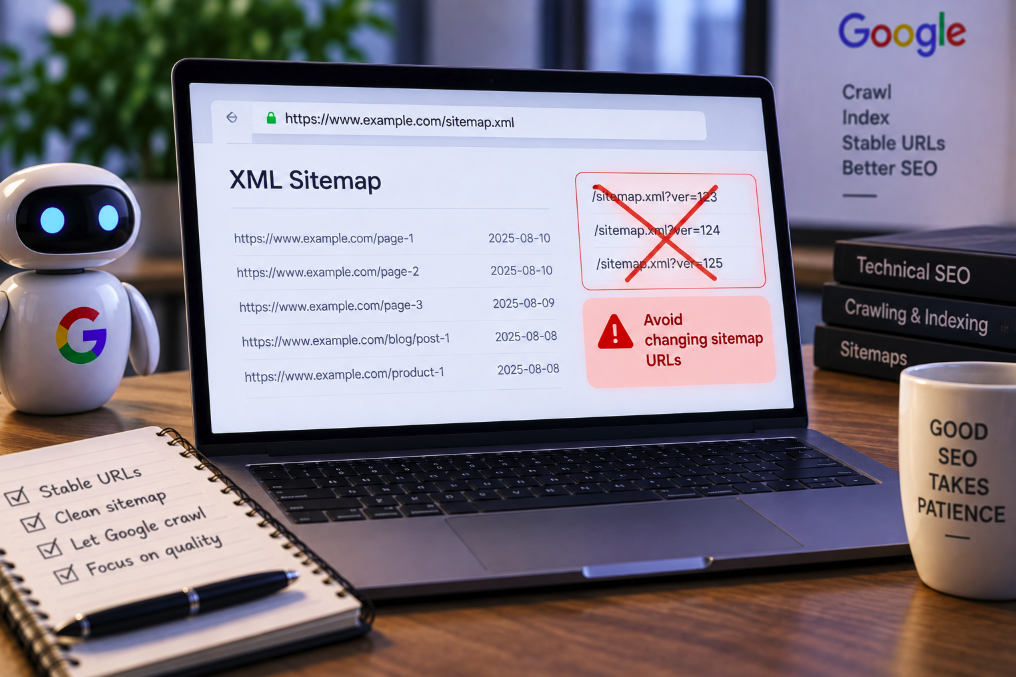
SEO teams have spent years looking for legitimate ways to make Google discover and recrawl important pages faster. That makes a technique such as appending a fresh timestamp to a sitemap URL superficially attractive: if the URL changes every day, perhaps Google will treat the sitemap as new and fetch it again. Google’s John Mueller says that is the wrong way to think about the problem. A sitemap is not a cache-busting asset, and deliberately making its URL unstable can create worse signals than simply letting Google decide when another fetch is useful.
Search Engine Journal reported on an exchange in which Mueller was asked about a large site that appended a Unix timestamp parameter to child sitemap URLs in a sitemap index. The parameter changed daily, apparently with the intention of forcing search engines to refetch those sitemap files. Mueller called the approach a bad idea, explaining that it effectively signals that the canonical URL for a piece of content is constantly changing. He emphasized that clean, stable URLs matter both to search engines and to tracking.
Cache busting solves a different problem
The technique itself is familiar in web development. Cache busting is commonly used for resources such as JavaScript and CSS when a site needs browsers or intermediary caches to retrieve a newer version instead of serving an older cached copy. A developer might append a version parameter to a resource URL after an update, producing something such as styles.css?v=42. Because the URL differs, the browser treats it as a new resource.
Applying that logic to sitemap files changes the purpose of the technique. A sitemap is a discovery and crawling signal for search engines, not a front-end resource whose stale browser cache needs to be defeated. If a sitemap index references sitemap.xml?v=1720000000 today and sitemap.xml?v=1720086400 tomorrow, the search engine sees distinct URLs even though the publisher conceptually considers them the same sitemap.
That is the instability Mueller objected to. The goal may be to encourage a daily fetch, but the mechanism creates a constantly moving address for a resource that benefits from having a persistent identity.
Google already has a signal for sitemap changes
The sitemap protocol does not require publishers to invent a new URL every time something changes. Google’s documentation for sitemap index files supports the optional <lastmod> element specifically to identify when the corresponding sitemap file was modified. That allows a sitemap index to retain stable child sitemap URLs while communicating meaningful changes.
At the individual page level, Google similarly recommends accurate <lastmod> values. Its sitemap documentation says the value should reflect the date and time of the last significant update to a page, such as a change to primary content, structured data or links. Google says it can use lastmod when the values are consistently accurate and verifiable.
The word “accurate” is important. Updating lastmod every day without a meaningful underlying change defeats the purpose of the signal. Google has previously explained that if a site repeatedly claims pages changed when they did not, the search engine may eventually stop trusting that information for crawl scheduling. The sustainable approach is therefore not to manufacture freshness but to report real freshness reliably.
A sitemap is a hint, not a crawl command
The cache-busting idea also reflects a common misconception about what sitemap submission can accomplish. Google’s crawling guidance explicitly advises site owners not to expect Googlebot to crawl every URL in a sitemap immediately. Sitemaps are useful hints that help Google discover and prioritize URLs; they are not commands that force the crawler to visit pages on a publisher-defined schedule.
Google even lists repeatedly submitting the same unchanged sitemap multiple times per day among practices to avoid. That does not mean frequently changing sites should neglect sitemaps. Large ecommerce sites, publishers and other platforms with substantial URL inventories can benefit considerably from well-maintained sitemap structures. The distinction is between supplying accurate information and trying to manufacture crawler activity through artificial URL changes.
Google’s broader documentation recommends simple, crawlable URL structures and standard internal links as part of healthy discovery. Those principles matter because crawling is an ecosystem rather than a single sitemap trigger. Internal linking, server performance, content importance, historical change patterns, crawl demand and other factors can all influence how Google allocates crawling resources.
The lesson also applies to Google’s retired sitemap ping endpoint
Google has been moving away from mechanisms that encourage publishers to think of sitemap fetching as something that must be manually forced. In 2023, the company deprecated its unauthenticated sitemap ping endpoint, saying its internal studies found those submissions were not very useful and that the vast majority had led to spam. Google instead pointed site owners toward Search Console, robots.txt discovery and accurate lastmod values.
That history makes the current advice consistent rather than surprising. Whether through repetitive pinging or rotating timestamp parameters, attempts to make an unchanged sitemap look perpetually new do not provide Google with better information about what actually changed on the site. Accurate modification signals do.
For publishers concerned about slow discovery, the first diagnostic question should therefore be why Google is not finding or prioritizing important URLs—not how to trick it into requesting the sitemap more frequently. Server logs can reveal when Googlebot fetched sitemap and page URLs, while Search Console can help identify indexing and sitemap-processing problems. On large sites, separating URL groups into logical sitemaps can also make monitoring easier.
Stable sitemap architecture makes troubleshooting easier
There is an operational benefit to stable URLs beyond Google's crawling systems: they make technical SEO easier to observe. If the same sitemap URL persists over time, teams can analyze fetch behavior, response codes, processing errors and server-log activity against a consistent resource. When the address changes every day, that history becomes fragmented across parameterized variants.
The same principle applies to sitemap indexes. A large site can use one stable index containing multiple stable child sitemap URLs, updating lastmod only when the corresponding sitemap genuinely changes. That produces a clean architecture in which both humans and crawlers can understand the relationship between files without treating each day's version as a newly invented resource.
It also reduces the possibility of accidental complexity in caching layers, monitoring tools and analytics. SEO engineering is often more reliable when infrastructure communicates state explicitly rather than encoding state into ever-changing URLs.
What to do when crawling really is too slow
If important pages are not being recrawled promptly, sitemap cache busting treats the symptom rather than the cause. Start by confirming that Google can fetch the pages efficiently, that internal links expose them clearly and that the sitemap contains the canonical URLs you actually want indexed. Check whether lastmod values correspond to meaningful updates and whether server errors or performance constraints are affecting Googlebot.
Sites publishing highly time-sensitive material have specialized options. Google recommends news sitemaps for news content, for example, while RSS or Atom feeds can also expose recent URLs. For ordinary pages, Search Console provides tools to request recrawling in specific situations, but Google still controls when the crawl occurs. There is no supported mechanism that guarantees daily crawling of every URL simply because a publisher wants it.
The underlying optimization goal should be to make change easy for Google to detect and worth revisiting. A site that regularly publishes valuable new content, maintains strong internal discovery and accurately reports meaningful modifications gives the crawler useful reasons to return. A timestamp added only to make a sitemap URL look new does not create new content or new value.
Stable URLs are still an SEO feature
Mueller’s response is a small technical clarification with a broader SEO lesson. Search optimization often becomes less reliable when a straightforward protocol is treated as something that needs a clever hack. Sitemaps already provide mechanisms for communicating location and modification. Rotating their URLs to manufacture freshness adds instability without guaranteeing that the underlying pages will be crawled any faster.
For technical SEO teams, the better pattern is deliberately boring: stable sitemap URLs, accurate lastmod data, clean sitemap indexes, crawlable internal architecture and monitoring that identifies real discovery problems. Googlebot may not visit everything on the schedule a publisher would prefer, but making the sitemap itself look like a different resource every day is not the shortcut. In crawling infrastructure, consistency remains a signal worth preserving.