
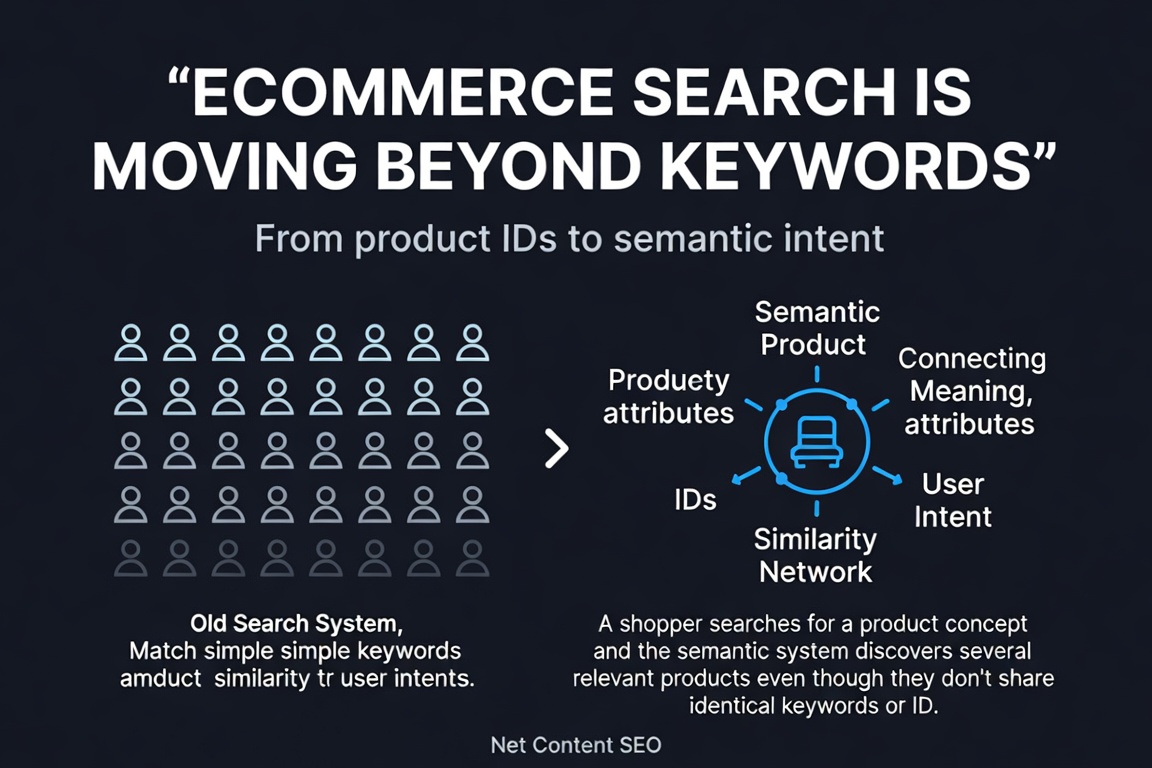
Product search has an old problem: the same or closely related product can exist under different merchant IDs, while traditional catalog categories are often too broad to capture what shoppers actually mean.
A new research paper published on August 21 proposes an interesting solution: Semantic Product IDs built from product-content embeddings. Instead of treating every merchant's identifier as an isolated object, products are organized into a learned semantic hierarchy.
The researchers tested the same hierarchy for both product ranking and query reformulation.
Their online evaluation reported stronger add-to-cart engagement in top ranking positions and broader exposure for less-popular products. On the search side, the system reduced search effort and helped users reach purchasable products earlier.
That's interesting beyond the specific implementation.
Ecommerce search is gradually moving from “Which products contain these words?” toward “Which products represent this intent?”
Keywords aren't disappearing. Product IDs aren't disappearing either.
But the layer connecting products, meaning and user intent is getting much smarter.