
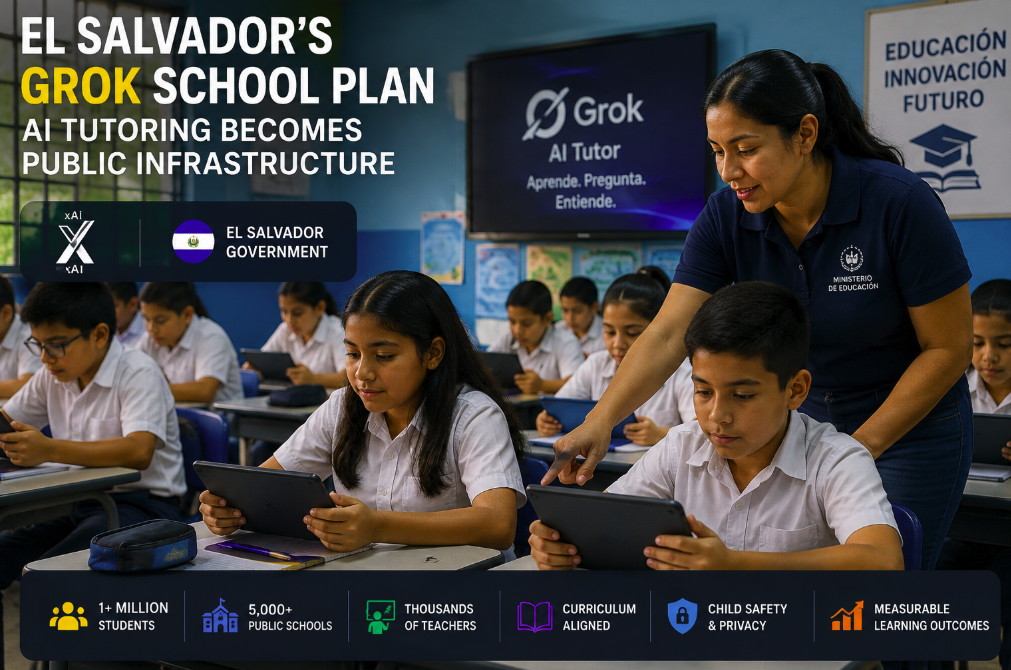
El Salvador’s plan to bring Grok into public schools is not just another story about a chatbot entering the classroom. It is a test of whether a frontier AI model can become part of a national education system, serving students, teachers and public policy at the same time. As Galloni’s Italian-language analysis notes, the central issue is no longer the announcement itself, but the much harder task of turning a political promise into curriculum, software, teacher training, child safety, infrastructure and measurable learning results.
The partnership was formally announced by xAI on December 11, 2025. The company said Grok would be deployed over two years across more than 5,000 public schools, reaching over one million students and supporting thousands of teachers. That scale is what makes the Salvadoran project unusual. Many education systems are experimenting with generative AI in pilots, after-school programs or informal classroom use, but El Salvador is attempting something closer to national AI tutoring infrastructure.
The official ambition is curriculum-aligned personalization. In theory, a student struggling with a mathematical concept could receive a different explanation, more practice or a slower progression, while a student who masters the topic quickly could move to more demanding material. A teacher, meanwhile, could use the system to identify recurring difficulties across a class. This is the strongest argument for AI tutoring: it promises a level of individualized support that is difficult to provide in crowded classrooms, especially across regions where specialist teaching resources are unevenly distributed.
Yet personalization is not the same as proven educational value. A system that adapts to a student’s pace can still provide weak explanations, encourage shortcut-seeking or reinforce errors if it is poorly designed. The decisive measure will not be the number of accounts created, prompts submitted or schools connected. It will be whether students read better, improve in mathematics, close urban-rural learning gaps and receive more effective support from teachers. On that point, the project needs transparent baseline data, long-term evaluation and independent scrutiny.
There is also a governance question that becomes unavoidable at national scale. A textbook changes slowly and visibly between editions; a cloud-based AI model can change centrally and quickly. If Grok becomes an everyday educational interface for a generation of Salvadoran students, updates to the model’s behavior, moderation rules, factual reliability or curriculum alignment become matters of public education policy. That means the country will need clear procedures for testing changes, auditing outputs, handling complaints and correcting systematic errors before they affect thousands of classrooms.
The strongest version of the project keeps teachers at the center. xAI has described educators as collaborators rather than workers to be replaced, and that distinction is essential. AI may be useful when it reduces repetitive explanation, supplies extra practice and gives teachers better diagnostic information. It becomes counterproductive if it is experienced as a top-down monitoring system, a classroom distraction or a substitute for pedagogical judgment. A national rollout will therefore depend as much on teacher training and trust as on the technical quality of the model.
Privacy is another core test because the users are children. A personalized tutor becomes more useful when it remembers what a student has mastered, where they struggle and how they respond to different forms of explanation. The same data can also create a detailed educational profile of a minor. Families and schools will need answers about data retention, access rights, model training, security and whether students can receive public education without being locked into permanent behavioral profiling. For a national AI tutor, child protection is not a feature; it is infrastructure.
El Salvador’s broader AI strategy gives the school project additional significance. UNESCO reported in June 2026 that the country has been developing an AI governance roadmap and highlighted public-sector AI initiatives, including educational tutoring, health services and digital public administration. That context matters because the Grok deployment is not an isolated classroom experiment. It is part of a wider attempt to position the country as a fast-moving AI adopter in Latin America.
That ambition also explains why the project is being watched outside El Salvador. As a related NetContentSEO analysis argued, the announcement was the easy part. The real test starts when the system must operate in actual schools, with real teachers, children, connectivity problems, curriculum requirements and public accountability. If it works, El Salvador could become a model for countries that want to expand individualized academic support without waiting decades for conventional reforms to close every resource gap.
If it fails, the lesson will be just as important. It may show that frontier AI models are impressive consumer products but still difficult to convert into trusted public institutions. The risks are not abstract: hallucinated explanations, weak age controls, vendor dependence, opaque data practices and poor outcome measurement can all scale as quickly as the promised benefits. A million active students would be a major technology deployment, but only a million students learning measurably more would be an educational breakthrough.
El Salvador is therefore testing a new definition of AI infrastructure. The debate usually focuses on chips, data centers and electricity, but a model that helps teach reading, science and mathematics becomes infrastructure in a deeper civic sense. It shapes how children encounter knowledge. That makes the standard higher than for a normal chatbot. Reliability, auditability, teacher control, privacy and measurable learning outcomes are not secondary concerns; they are the conditions that will determine whether Grok becomes a genuine educational tool or simply a spectacular national experiment.