
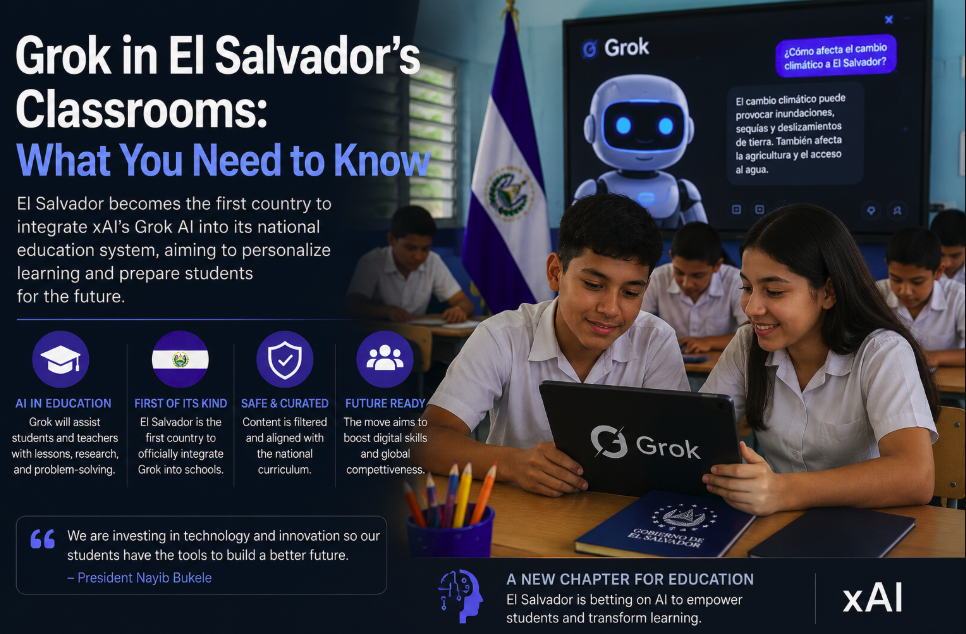
El Salvador is attempting something much bigger than putting a chatbot into classrooms. Through a partnership with Elon Musk’s xAI, the country plans to build Grok into a personalized tutoring system spanning more than 5,000 public schools and reaching over one million students. If the program reaches the scale promised, one commercial frontier AI model will become part of the learning infrastructure of an entire national public-school system.
The supplied BASENOR report highlights the extraordinary scope of the project and renewed attention around it on August 30. But the most important part of the story is no longer the headline that Grok is coming to Salvadoran classrooms. That partnership was officially announced in December 2025. The important question in August 2026 is what nationwide AI tutoring actually means once political announcements have to become curriculum, software, teacher practice, child-safety rules, infrastructure and measurable educational outcomes.
That is where El Salvador’s experiment becomes globally significant. Many schools around the world are already debating how students should use ChatGPT, Gemini, Claude or Grok. El Salvador is moving toward a fundamentally different model: instead of merely allowing students to access a general-purpose AI product, the government and an AI company intend to co-develop a system around the national curriculum and deploy it across public education.
The official plan covers more than one million students
xAI and the Salvadoran government announced the partnership on December 11, 2025. The company said Grok would be deployed across more than 5,000 public schools over a two-year period, providing personalized learning to more than one million students while involving thousands of teachers.
The Salvadoran presidency described it as the world’s first nationwide AI-powered education program. According to the government and xAI, the intended system will align with the national curriculum and adapt instruction according to each student’s pace, preferences and level of mastery. Urban and rural schools are both explicitly included.
Those numbers make the project categorically different from the AI pilots that have appeared in individual schools, universities and districts. El Salvador is not proposing to measure whether an AI tutor helps 200 students in a controlled experiment before deciding whether to expand it. The political vision is system-level deployment.
That ambition is also the source of the project’s greatest opportunity and greatest risk. At national scale, even a modest improvement in learning can affect hundreds of thousands of children. A design error, bias, unreliable explanation or weak governance mechanism can scale just as efficiently.
Grok is supposed to become an educational system, not simply the public chatbot
The distinction between Grok as a consumer assistant and the planned educational platform is important. Official descriptions say xAI and El Salvador will co-develop curriculum-aligned adaptive tutoring rather than simply hand every student unrestricted access to a generic chatbot.
That should allow the system to operate within defined educational objectives. A mathematics tutor, for example, can diagnose where a student is struggling and adjust the explanation rather than simply supplying the final answer. A reading tutor can change difficulty according to demonstrated comprehension. Teachers can potentially receive information about where groups of students are repeatedly getting stuck.
This is the central promise of AI tutoring. A teacher responsible for a large class cannot simultaneously provide a unique explanation, pace and sequence for every child. Software can, at least in principle, provide individual practice and feedback continuously.
But personalization should not be confused with proven learning effectiveness. xAI and the government have described what the platform is intended to do. That is not yet the same as independently demonstrating that Grok improves Salvadoran students’ mathematics, literacy or science outcomes better than alternative interventions.
The rollout is real, but important implementation details remain unclear
Coverage of the initiative can make it sound as though one million Salvadoran children are already sitting in classrooms using a finished Grok tutor every day. Current reporting suggests a more careful description is appropriate.
In May, Salvadoran Education Minister Karla Trigueros said work was advancing on the AI education platform with xAI. More recent Salvadoran reporting in August still described the government as working with xAI on the personalized tutoring platform and noted that full details about the broader education reform’s timetable, budget and execution had not all been disclosed.
That does not contradict the announced two-year rollout. Large national software deployments naturally move through development, integration, training and phased implementation. It does mean that promised nationwide scope should not be mistaken for completed nationwide deployment.
The distinction will become increasingly important as other governments evaluate El Salvador as a model. The useful questions are operational: How many schools are actively using the system today? For which grades and subjects? How frequently? How many teachers have been trained? What infrastructure is required? What happens when connectivity fails? What metrics determine whether the system expands or changes?
The teacher is supposed to remain inside the system
One encouraging element in the official design is that teachers are explicitly described as partners rather than obstacles to automation. xAI says the program will empower thousands of educators as collaborative participants in the new system.
That matters because the most plausible use of AI in schools is not replacing one teacher with one chatbot. It is changing the ratio between teacher attention and routine instructional work. An AI tutor can provide additional practice, explain a concept again in another way and help identify patterns of misunderstanding. The human teacher can use that information to decide where intervention matters most.
The success of that model depends on implementation. If teachers perceive the system as a centrally imposed technology that adds monitoring, administrative work or classroom disruption, adoption can become superficial. If it genuinely saves time and gives educators useful insight, it can become part of everyday teaching.
Training therefore matters as much as model capability. A frontier AI system in a classroom is only as useful as the educational workflow around it.
El Salvador is also building a wider technology strategy around schools
The xAI partnership does not exist in isolation. El Salvador has been investing heavily in school modernization and digital infrastructure. Government-linked reporting has described upgrades to public schools, expanded technology access and digital-skills initiatives. In August, Salvadoran reporting also highlighted teachers already experimenting with artificial intelligence and robotics through separate education programs.
On August 19, the Ministry of Education published a request for expressions of interest for a chat-and-voice automation platform for educational centers. That procurement should not automatically be assumed to be the Grok project, but it illustrates how conversational interfaces are becoming part of the country’s broader education technology agenda.
El Salvador has also joined international initiatives around AI infrastructure and promoted projects involving synthetic national datasets and AI-supported public services. The education partnership therefore fits a broader political strategy: use emerging technology as a mechanism for rapid institutional modernization rather than waiting for wealthier countries to establish mature deployment models first.
President Nayib Bukele has consistently framed the xAI project in precisely those leapfrogging terms.
The leapfrog strategy has a compelling logic
For a smaller developing economy, conventional educational improvement can be slow and expensive. Recruiting enough highly specialized teachers for every region, reducing class sizes and equalizing resources between urban and rural schools can take decades.
AI offers a seductive alternative. If the marginal cost of personalized digital tutoring falls sufficiently, a country could theoretically distribute high-quality explanatory support to a remote rural student almost as easily as to a student in the capital.
That does not eliminate the need for teachers, buildings, electricity, connectivity, meals, books or safe learning environments. It can, however, change the economics of individualized academic support.
This is why El Salvador may be more interesting as an AI-education testbed than a wealthy private school equipped with the latest devices. The strongest claim for AI tutoring is not that it makes an already excellent school slightly more futuristic. It is that software could reduce educational inequality where expert human attention is scarce.
But national dependence on one AI vendor creates a new kind of policy risk
There is another side to the leapfrog strategy. A national education system built around a commercial model creates dependency on the company operating that model. Changes in pricing, model behavior, corporate ownership, product strategy or technical architecture can become education-policy issues.
Schools have always depended on vendors for textbooks, software and devices, but generative AI is unusually dynamic. A textbook edition does not silently change its answers overnight. A cloud AI model can be updated centrally, changing behavior across every classroom using it.
That makes governance more than a one-time procurement exercise. El Salvador will need mechanisms to test model updates, monitor performance, investigate failures and determine which educational behaviors are acceptable. The government and xAI have said their collaboration will develop governance, auditing and safety frameworks. The quality and transparency of those frameworks may ultimately matter as much as the model itself.
Who decides what counts as the correct answer?
Curriculum alignment sounds straightforward until an AI system encounters history, civics, literature, social issues or questions where legitimate interpretations differ. Even mathematics and science tutoring can fail if the model confidently generates a plausible but incorrect explanation.
A national AI tutor therefore needs more than generic claims about truth-seeking. It needs an explicit relationship with approved curricular material and a method for handling uncertainty. Teachers need a way to challenge outputs. Students need to understand that fluent language does not guarantee correctness. Administrators need a process for correcting systematic errors.
There is also a deeper governance question: how much control does the state have over the model’s educational behavior, and how much remains with xAI? A country can approve a curriculum, but if the instructional interface is generated dynamically by a proprietary model, part of the practical curriculum is produced at inference time.
That is a new form of educational power, and governments adopting AI at this scale will need to define it explicitly.
Children make privacy and safety standards more demanding
Personalized tutoring becomes more useful when the system knows where a student struggles, what they have already mastered and how they respond to different explanations. The same data that enables personalization can create a sensitive long-term profile of a child’s learning behavior.
That raises questions about retention, access, model training, parental rights, security and the future use of educational data. A student should not have to trade permanent behavioral profiling for access to basic public education.
AI safety in this context also extends beyond blocking obviously inappropriate content. The system must avoid encouraging unhealthy dependency, presenting fabricated information as fact, undermining teachers or producing age-inappropriate responses. Different age groups require different interaction designs.
A first-grader and a high-school senior should not simply receive the same chatbot with different homework questions.
The most important metric is not usage
Technology programs often measure deployment because deployment is easy to count: devices distributed, accounts created, schools connected, prompts sent. Those numbers can demonstrate logistical success while saying very little about education.
The real test of the Grok partnership should be learning outcomes. Are students reading better? Are mathematics scores improving? Are gaps between rural and urban schools narrowing? Are struggling students catching up faster? Are teachers spending less time on repetitive administrative work and more time on high-value instruction?
Those questions require baseline data, comparison groups and transparent evaluation over time. If El Salvador and xAI want the project to become a model for other governments, independently credible outcome measurement will be essential.
A million users would make Grok a successful deployment. A million students learning measurably more would make it an educational breakthrough. Those are different achievements.
The program could produce an extraordinary dataset about AI tutoring
If implemented responsibly, the scale of the Salvadoran project could generate valuable knowledge about how students actually interact with AI tutors. Which explanation strategies work? When does personalization improve mastery? When do students become overly reliant on hints? Which subjects benefit most? How should AI escalate a problem back to a teacher?
xAI and El Salvador have said the partnership will develop methodologies and datasets that can inform future deployments. That research potential is substantial, but it also increases the importance of clear rules around children’s data and public benefit.
A national education system should not become merely a convenient experimental environment for improving a commercial model. If data generated by public-school students helps create valuable new educational technology, the governance framework should make clear what the country, schools and students receive in return.
The rest of the world should watch the implementation, not the marketing
The phrase “world’s first nationwide AI education program” is powerful, and it is how xAI and the Salvadoran government describe the initiative. But being first is not the same as establishing a model others should copy.
The next year matters more than the announcement. If teachers embrace the platform, students improve and governance proves robust, El Salvador could demonstrate that a relatively small country can use frontier AI to expand individualized educational support much faster than conventional reforms allow.
If the program struggles with connectivity, hallucinations, teacher adoption, opaque data practices or weak measurement, it will offer an equally important lesson about the limits of deploying frontier models through top-down national policy.
Either outcome would make the experiment globally relevant.
This is what AI infrastructure looks like when the users are children
The broader technology industry often talks about AI infrastructure in terms of data centers, chips and electricity. El Salvador is testing another meaning. When an AI model becomes part of how a country teaches mathematics, reading and science, the model itself starts to resemble public infrastructure.
That raises the standard it should be held to. Reliability matters. Auditability matters. Local cultural and linguistic context matters. Teacher control matters. Privacy matters. The ability to change vendors or models in the future matters. Above all, educational effectiveness matters.
El Salvador’s partnership with xAI is ambitious precisely because it refuses to keep AI at the edge of the classroom. It proposes to put personalized machine tutoring near the center of public education for an entire generation.
The announcement was the easy part. The real experiment is now whether a frontier AI model can become national education infrastructure without turning schools into a technology demonstration. If El Salvador can prove that Grok improves learning while preserving teacher authority, student safety and public accountability, other governments will pay close attention. If it cannot, the project will still teach the world something important about how difficult the transition from impressive chatbot to trusted institution really is.