
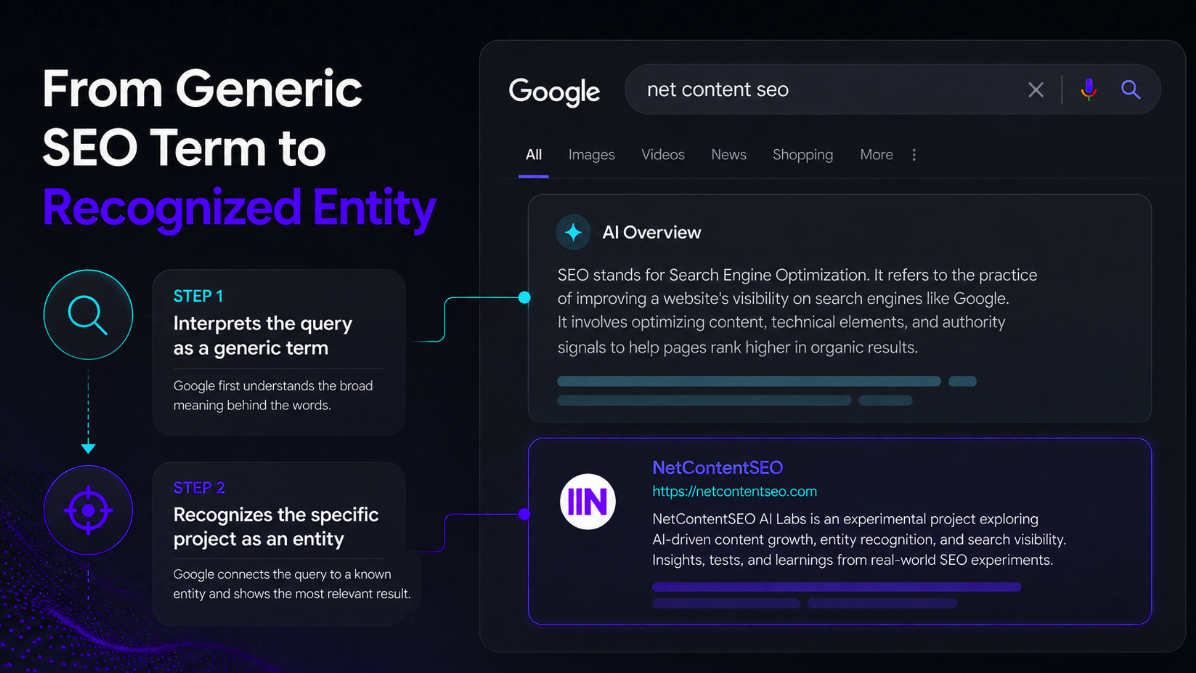
In early August, we started a small experiment around an awkwardly ambiguous name. If someone searched Google for “net content seo,” would Google understand those three words as a specific project, or would it simply decompose them into the familiar generic concept of content SEO?
The starting position was not encouraging. Google largely interpreted the query generically. The words “content” and “SEO” were much stronger than the identity behind NetContentSEO, so the result page behaved as though the user were asking about a topic rather than looking for a particular publication and research project.
Today, the result is different. It is not the clean entity-recognition outcome we ultimately want, and it is not evidence that NetContentSEO has become a source for Google's AI Overview. But the ordinary search results now contain a much clearer signal: beneath a still-generic AI Overview about “Content SEO,” NetContentSEO appears as the first organic result and is described in terms that correspond to the actual project.
That makes this a useful update to our original Google entity experiment. The earlier article documented how quickly Google's representation could change and, just as importantly, warned against turning a before-and-after screenshot into a ranking-factor claim. This follow-up needs the same restraint.
Current Google result for “net content seo.” The AI Overview still interprets the query generically as “Content SEO,” while NetContentSEO now appears immediately below as the first organic result with a description consistent with the project. An older Instagram post documenting the experiment is also visible in the result set. Screenshot captured during the current follow-up test.
The organic result is the signal we can actually observe
The most important change is not that NetContentSEO ranks for a brand query. The interesting part is that this particular query does not behave like an unambiguous brand query. “Net content seo” can easily be parsed as three descriptive words, and that was effectively what Google did at the beginning of the experiment.
Now the result page contains both interpretations at once. At the top, the AI Overview still resolves the query toward the established generic concept of content SEO. Immediately below it, however, the organic system identifies NetContentSEO as a distinct destination rather than returning only definitions, guides and unrelated material about content optimization.
That coexistence is more informative than a simple success-or-failure label. Different surfaces on the same Google result page do not necessarily reconstruct an ambiguous query in exactly the same way. In this case, the organic result appears to have crossed a recognition threshold that the AI Overview has not.
This is not an AI Overview citation
That limitation needs to be explicit. NetContentSEO is not being used as a source in the AI Overview shown in the current screenshot. The overview remains about generic “Content SEO,” and we should not describe the result as an AI citation, an AI Overview win or proof that Google now fully resolves the query to the project.
The observable improvement is narrower. A separated, lower-case query — “net content seo” — now returns the project prominently in organic search, with a description that reflects what NetContentSEO actually is. That matters because this was not the main keyword we had been treating as a conventional ranking target. It was useful precisely because its ambiguity exposed the competition between a generic semantic interpretation and a specific entity-like interpretation.
In other words, the test has almost reached the state we were looking for, but not completely. Google's organic search layer can now surface the intended project from the ambiguous phrase. Its generative layer still prefers the generic concept.
An old Instagram post adds another small piece of evidence
The current result page also surfaces an older Instagram post connected with the experiment. That is not proof that Instagram caused the organic result to change, nor does it establish that social signals directly produced recognition. It is simply another observable part of the result set: Google is connecting more than one public artifact with the NetContentSEO identity around this query.
That is useful in an entity experiment because recognition is not only about whether a homepage ranks. We are interested in whether a system can consistently associate a name with the same project, description, authorship and subject area across multiple public documents.
The Instagram result therefore belongs in the evidence log, but it should not be promoted into a causal explanation. Search results can surface social pages for many reasons, and a single SERP cannot tell us which underlying signals mattered most.
What changed around the project?
Several things became clearer during the experiment. The naming became more consistent. Page titles and H1s increasingly made the relationship between “Net,” “Content” and “SEO” explicit rather than assuming that machines would infer the identity from a compressed brand string. The site also developed clearer descriptive pages, including the About NetContentSEO page and the AI Visibility Research & Methodology page.
The publication has also accumulated a more interconnected body of material around a relatively stable set of concepts: AI visibility, retrieval, attribution, reconstruction, generative search and experiments about how systems interpret small web entities. The homepage now describes NetContentSEO consistently as an independent research and publishing project focused on how AI systems discover, interpret and reconstruct information.
All of those changes are plausible contributors to a clearer machine-readable identity. None of them can be isolated from this experiment as the cause of the new result. We do not know that changing a title or H1 caused Google to reinterpret the query. We do not know that publishing an About page, adding a Methodology page, strengthening internal connections or repeating a stable description produced the ranking. We certainly do not have evidence that any one of those elements is a special entity-recognition ranking factor.
They are better understood as changes to the information environment surrounding the project. We made the identity easier to describe consistently, and later Google began returning a result that reflects that identity more clearly. The sequence is observable. The causal mechanism is not.
Consistency may matter without being a ranking formula
This distinction is central to the experiment. There is a temptation in SEO to convert every visible change into a recipe: change the H1, publish an About page, repeat a phrase, build a certain type of internal link, then expect Google to recognize an entity. Our evidence does not support that conclusion.
A more cautious interpretation is that ambiguity becomes easier to resolve when multiple documents provide compatible information about what a name refers to. A title can identify the project. An About page can describe it. A methodology page can define its research scope. Related articles can reinforce the same relationships without repeating an identical block of text.
That kind of consistency could help a search system distinguish an intended identity from the generic meanings of its component words. It could also be coincidental with other changes in Google's index, ranking systems, query interpretation or the wider web. The current test cannot separate those possibilities.
This is why the project methodology treats individual experiments as observations rather than universal benchmarks. A result becomes interesting when it is repeatable and survives changes in time, query form and system behavior, not when it produces one satisfying screenshot.
The query itself turned out to be more interesting than expected
We were not primarily monitoring “net content seo” as a conventional target keyword. That turned out to make it useful. The query functions almost like a small ambiguity test: will Google resolve the spaces as a generic phrase, or connect them to NetContentSEO as a recognizable project?
At the beginning, the generic interpretation dominated. In the current screenshot, Google still preserves that interpretation in the AI Overview, but organic search now introduces the project immediately beneath it. The result page is effectively showing two competing reconstructions of the same three words.
This makes the experiment less about ranking position and more about query interpretation. A first organic result is valuable, but the research question is whether the system understands what the user might mean when the brand string is not supplied in its cleanest, most explicit form.
Recognition is not binary
The current SERP is also a useful example of why entity recognition should not be treated as an on-off state. A system can recognize a project in one layer while failing to use it in another. It can retrieve the correct homepage while still generating a generic answer. It can associate a social post with the identity without considering the publication authoritative enough, relevant enough or otherwise suitable to ground an AI response.
Those are different outcomes, and collapsing them into “Google understands the entity” would hide the most interesting part of the test.
Our own research methodology separates visibility from accurate reconstruction for the same reason. Being present is not the same as being correctly understood, and being understood is not the same as being selected as a source.
The current result moves NetContentSEO further along that sequence in ordinary search. It does not demonstrate the final step in AI-generated search.
The next test is the AI Overview
The next stage is therefore straightforward to define and deliberately difficult to force. We will continue repeating the query and recording what Google shows. The first question is whether the AI Overview eventually stops treating “net content seo” as purely generic and begins recognizing that the query may refer to NetContentSEO.
The second question is stricter: if the generative result does recognize the project, will Google actually use NetContentSEO as a source? Those outcomes should be recorded separately. An AI Overview could mention or describe the project without citing it, just as a system can retrieve an entity without relying on that entity's own pages for grounding.
Beyond Google, we also want to see whether AI systems increasingly cite NetContentSEO when answering questions for which its experiments or methodology are relevant. Again, the objective is not to manufacture a citation and declare the experiment complete. The useful evidence will be whether recognition and attribution appear naturally, persist over time and remain accurate across different systems.
Almost successful is a more useful result than declaring victory
The current screenshot is encouraging because the ambiguous query no longer produces only generic interpretations. NetContentSEO now appears as the first organic result, its description is coherent with the project, and an older social artifact connected with the experiment appears alongside the broader result set.
But the unresolved part is visible at the top of the same screenshot. Google's AI Overview still sees “Content SEO” before it sees NetContentSEO. That means the experiment has not reached the point where we can say the generic interpretation has been displaced across Google's search experience.
For now, the most defensible conclusion is narrower and more interesting: Google can increasingly separate the project from the generic meaning of its name in organic search, even when the query is written as three ordinary words. We do not know exactly which changes contributed, and we do not yet have the AI citation that would mark the next stage of the test.
So the experiment continues. The next meaningful screenshot will not simply show NetContentSEO ranking first. It will show whether Google's generative layer also stops treating the query as only a generic SEO concept — and, eventually, whether Google and other AI systems decide that NetContentSEO is a source worth citing rather than merely an entity they can recognize.