
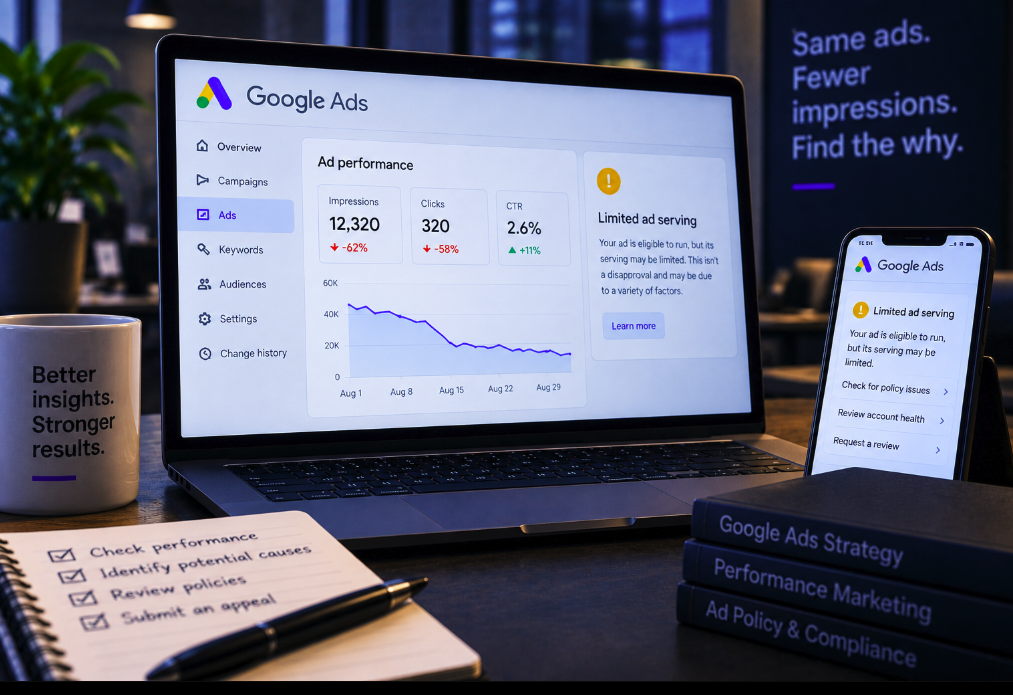
A Google Ads account can lose a large share of its reach without having a single ad disapproved. The campaigns can remain active, the ads can still be technically eligible and the account can avoid suspension — yet impressions can suddenly collapse because Google has decided the advertiser is not qualified to participate in certain auctions.
This is Limited Ad Serving, an account-level restriction that is easy to confuse with ordinary policy enforcement. John Horn explains the mechanism, warning signs and appeal process in a September 4 Search Engine Land analysis, including a client case in which monthly impressions reportedly fell by more than half overnight.
The important distinction is that Google is not necessarily saying the advertiser violated a policy. It is limiting how often the account is allowed to compete while it evaluates trust and qualification signals.
For advertisers that depend on branded searches, affiliate relationships, reselling or third-party lead generation, that difference can be financially significant. An account may look healthy at the ad-status level while the auctions it can enter have quietly narrowed.
Limited Ad Serving is not an ad disapproval
Google uses several similar labels for restrictions, and understanding the terminology is the first step in diagnosing the problem.
A disapproved ad cannot serve until the underlying policy problem is resolved and the ad is reviewed. An ad marked “Eligible (limited)” can serve but faces restrictions tied to circumstances such as geography, age or regulated products.
Limited Ad Serving is different. Google applies the restriction at the advertiser or account level. The ads themselves are not disapproved. Instead, Google limits impressions in selected serving scenarios where it believes there is a higher potential for negative advertising experiences.
Google's current Limited Ad Serving documentation says advertisers affected in a meaningful proportion of eligible impressions will receive an in-account notification. Google then continues assessing the account and can automatically update the restriction as qualification changes.
An eligible ad can still be excluded from auctions
This is why Limited Ad Serving can be confusing operationally. Advertisers are accustomed to looking for explicit errors when performance collapses: disapproved creative, exhausted budget, broken tracking, bid changes, lost eligibility or a suspension.
Under Limited Ad Serving, those obvious failures may not exist. The campaign can remain enabled and the creative can remain eligible while Google prevents the account from reaching some auctions it would otherwise have been able to enter.
Google does not disclose exactly which auctions are removed from reach. The advertiser sees the downstream effect — fewer impressions and potentially less traffic — without receiving a query-by-query map of what has been withheld.
That makes a sudden impression decline particularly important to investigate when normal campaign variables have not changed.
One account lost roughly 56% of its monthly impressions
Horn describes an authorized retailer whose account managed roughly $3 million in advertising and had written agreements permitting the use of several partner brands. According to the case study, Google applied Limited Ad Serving without warning.
Average monthly impressions fell from about 800,000 to 350,000, a decline of roughly 56%. The agency attempted to recover some of the lost traffic by bidding more aggressively, which meant accepting higher CPCs and CPAs.
The first appeal was denied quickly. Horn says the process then stretched across seven months of calls, emails and escalations before the limitation was finally removed.
Once Google lifted the restriction, impressions returned rapidly toward their previous levels. It is one advertiser's experience rather than a universal timeline, but it illustrates how consequential an account-level limitation can be even when ads remain nominally eligible.
Google is expanding the policy across its advertising ecosystem
Limited Ad Serving is not new. Google introduced the framework in 2023 for selected Search and YouTube scenarios, then expanded its scope during 2026.
Google's June 2026 policy update added more Search scenarios. An August 2026 update broadened Limited Ad Serving across Google Ads, with implementation beginning gradually and scheduled to continue through 2028.
The expanded framework means the issue is no longer something only a narrow group of Search advertisers should understand. As rollout continues, more advertisers can encounter qualification-based impression limits across Google's advertising surfaces.
Google's stated objective is to protect users from negative ad experiences while allowing advertisers that establish sufficient trust to serve without those impression limits.
Google evaluates whether an advertiser is qualified
The policy is built around trust rather than a simple pass-or-fail creative review. Google says advertisers can build qualification by complying with advertising policies, completing advertiser verification when eligible and continuing to create campaigns and creative that generate positive user engagement.
The 2026 expansion also identifies broader trust signals around account maturity, verification, policy history, user reports, ad formats, industry and other account attributes.
That means Limited Ad Serving is not reducible to one forbidden keyword or one prohibited landing-page element. Google is evaluating the advertiser in context.
The lack of a public scoring formula makes prevention less deterministic than fixing a normal ad disapproval. An advertiser can follow published best practices and still be assessed as unqualified for some serving scenarios while Google's systems gather more evidence.
Branded keywords are a recurring risk pattern
Horn says the most common pattern his agency encounters involves advertisers targeting company or product names. Affiliates, authorized resellers and third-party lead-generation businesses are particularly exposed because their ads can appear in response to searches for another company's brand.
The risk is not necessarily trademark use by itself. The underlying concern is whether users could be confused about which business they are actually engaging with.
Google's own Search best practices tell advertisers to maintain clear branding, display their own brand prominently in ads and landing pages, clearly explain relationships with other brands and avoid generic language that could obscure identity.
That makes a branded-keyword strategy fundamentally different from simply winning an auction. Google also wants confidence that the user understands who is behind the ad.
Affiliates, resellers and lead generators need especially clear identity signals
Search Engine Land says Horn's agency most often sees Limited Ad Serving affect affiliates, insurance advertisers, consumer services, third-party lead generators, travel companies and franchises. He has also seen competitor-keyword campaigns affected, particularly in sensitive verticals.
Those observations are practitioner experience rather than a definitive Google list of automatic triggers. They nevertheless align with the policy's emphasis on trust and avoiding misleading ad experiences.
An authorized reseller, for example, can have legitimate permission to use a manufacturer's logo while still creating ambiguity if its own identity is difficult to find. A lead-generation page can be legally legitimate while appearing to users like the official provider they searched for.
Advertisers in these models should make the relationship explicit rather than relying on fine print to distinguish the businesses.
Clear branding is one of Google's strongest recommendations
Google recommends prominently displaying the advertiser's own brand in both the ad and landing page. If another company's name or logo appears, the relationship should be obvious.
Generic headlines can be risky because they give the user little information about who is offering the service. Google specifically recommends clear, specific language and suggests pinning the advertiser's domain at the beginning of a responsive search ad headline in relevant cases.
Horn is skeptical about the performance value of domain pinning based on his agency's experience, saying he has seen it hurt CTR without necessarily solving a limitation. But it remains part of Google's published best-practice guidance.
This is a useful distinction between compliance strategy and conversion optimization. A change that reduces ambiguity for Google's qualification systems may not be the same change an advertiser would choose purely for CTR.
Advertiser Verification should not be treated as optional housekeeping
Completing Advertiser Verification is another clear trust signal. Google explicitly includes verification among the actions that can help an advertiser become qualified.
Horn recommends completing the process proactively rather than waiting until an account has already been limited. If an advertiser does need to appeal, verification will be part of the path Google expects it to follow.
Verification does not guarantee immunity from Limited Ad Serving. Google's qualification process uses multiple signals and the company explicitly says its examples and best practices do not guarantee qualification.
It does, however, remove one obvious source of uncertainty about who controls the account and who is paying for the advertising.
Old disapproved assets can still create policy noise
Horn also recommends keeping disapproved assets under control. Google can continue crawling paused creative, including ads that have not actively served for a long time.
Broken landing pages, old redirects or creative that no longer meets current policy can therefore accumulate in an account that the marketing team considers dormant.
Search Engine Land's recommendation is practical: review the Policy section regularly and resolve stale disapprovals rather than allowing them to build up.
Google does not publicly state that a specific number of old disapprovals automatically causes Limited Ad Serving, so this should be treated as account-hygiene advice rather than a guaranteed causal rule.
The first sign may be a notification — or the performance chart
Google says affected advertisers with a meaningful proportion of impressions subject to the policy will receive an in-account notification. Horn says Google also usually sends an email, although it does not promise one in every case.
The practical warning may arrive through performance data first. If impressions suddenly fall without corresponding changes in budget, bids, targeting, seasonality or demand, Limited Ad Serving belongs on the diagnostic checklist.
Advertisers should be particularly careful after dismissing an account notification. Horn notes that once the message has been hidden, the interface may make the ongoing status less obvious.
His recommendation in that situation is to contact Google support and ask whether the account remains limited.
Do not confuse this with “Eligible (limited)”
The similar terminology creates an avoidable troubleshooting problem. “Eligible (limited)” is an ad-level status. It generally indicates that an ad can run but faces a specific policy restriction, such as where or to whom it may be shown.
Google's policy-status documentation explains that these restrictions can relate to location, device, user age or authorization to advertise regulated products and services.
Limited Ad Serving is broader. It concerns the advertiser's qualification to receive unrestricted impressions in selected scenarios.
An advertiser diagnosing a traffic decline should therefore identify exactly which label Google is applying before following a remediation process intended for a different policy state.
The appeal starts with reducing ambiguity
If an account is limited, Horn recommends first reviewing the same issues that can reduce the risk of being flagged. Remove unnecessary branded keywords, make the advertiser's identity unmistakable and gather documentation showing authorization to use any third-party brands or logos.
Google's official policy directs affected advertisers to the dedicated Limited Ad Serving Appeals Form. This is distinct from the ordinary workflow for appealing an individual disapproved ad.
Agencies should submit the affected child account's customer ID rather than the manager-account ID, according to Horn.
The appeal should demonstrate why the advertiser is legitimate and why users are unlikely to be misled, not merely argue that the ads technically comply with creative rules.
A denied first appeal may not be the end
Horn says his agency rarely sees the first Limited Ad Serving appeal succeed. In his experience, the initial decision often arrives within one to five business days, followed by a longer support process when the appeal is rejected.
His recommended escalation package includes a clear explanation of changes made to reduce consumer confusion, visual evidence showing the ads and landing pages, and contracts or authorization documents supporting legitimate use of partner brands.
The key is specificity. A generic request to “review the account again” provides less evidence than a documented explanation of who the advertiser is, what relationship it has with the referenced brand and how the landing page communicates that relationship.
Google itself does not promise a resolution time. Its policy says accounts are reviewed automatically and limits are updated as assessment continues, but the company cannot say how long qualification will take.
Higher bids can mask the symptom while worsening the economics
When impressions collapse, an advertiser's instinct may be to bid more aggressively to recover volume. The Search Engine Land case study shows why that can be expensive.
Horn's client reportedly increased bids enough to capture some of the remaining traffic, but the result was higher CPCs and CPAs. The underlying restriction had not disappeared; the advertiser was simply competing harder inside the reduced set of auctions it could still enter.
This creates a dangerous feedback loop. A team can interpret the problem as ordinary competitive pressure, raise bids and watch efficiency deteriorate without recognizing that account eligibility has changed.
Before responding to an unexplained impression loss with more money, advertisers should verify whether the account is being limited.
There is no guaranteed prevention checklist
Google's best practices improve trust signals but do not create a safe harbor. The company explicitly says examples are illustrative and do not guarantee that an advertiser will become qualified.
Horn makes the same point from the agency side. Long-established accounts with substantial spending history can still be limited, not only new advertisers.
That uncertainty is part of what makes the policy difficult operationally. Advertisers can reduce obvious risk factors, but they cannot calculate a public qualification score or know precisely which auction triggered Google's concern.
The best defense is therefore a combination of clear identity, clean policy history, verification, careful branded-keyword use and monitoring for unexplained changes in reach.
Limited Ad Serving turns account trust into a media variable
The broader significance of the policy is that ad delivery is no longer determined only by bids, budgets, targeting, creative quality and conventional policy approval. Advertiser trust can itself influence how much inventory Google makes available.
That creates a new layer in paid-search diagnostics. When impressions fall, marketers have to ask not only whether the campaign can technically serve but whether Google currently considers the advertiser qualified to serve without restrictions.
As the expanded Limited Ad Serving policy rolls out through 2028, that question will become relevant across more Google Ads surfaces.
The practical lesson is simple but easy to miss: an ad can be approved, enabled and apparently healthy while its reach has been quietly constrained. When performance changes without an obvious campaign explanation, check the account's policy status before assuming the auction simply became more competitive.