
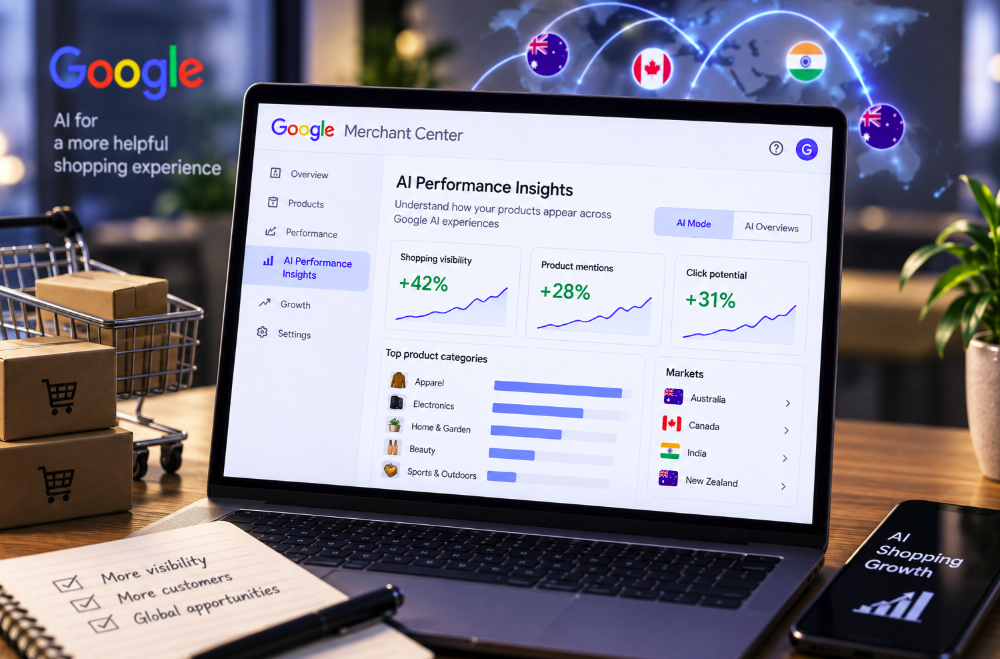
Retailers have spent much of the generative-search era trying to answer a deceptively simple question: are their products actually visible when consumers shop through AI? Google is now giving more merchants a way to measure that visibility. Merchant Center’s AI Performance Insights, initially rolled out in the United States, are now available to eligible accounts in Australia, Canada, India and New Zealand, extending Google’s emerging measurement layer for shopping journeys that begin inside AI-powered search experiences.
Search Engine Roundtable reported the expansion on September 3, noting that Google had updated its documentation after beginning the US rollout in July. Google’s current Merchant Center documentation confirms that AI Performance Insights are available for English-language queries for Merchant Center accounts in Australia, Canada, India, New Zealand and the United States.
Google is making AI shopping visibility measurable
The significance of the report goes beyond geographic expansion. AI shopping has created a measurement problem for retailers because product discovery can now happen inside a generated answer rather than through a familiar list of shopping results. A consumer might ask a detailed question about the best running shoes for a particular use case, compare materials or features conversationally and encounter products without following the keyword-driven journey marketers have traditionally analyzed.
Google says AI Performance Insights are designed to decode that transition from keyword searches to more complex conversational shopping paths. The report shows how a brand is discovered for shopping-intent conversations across AI Mode and AI Overviews, allowing merchants to evaluate visibility at different stages of the shopping journey and identify trends that could inform product-data optimization.
When Google first announced the feature in May, it also described AI-powered product discovery across the Gemini app. The current dedicated AI Performance Insights documentation focuses the report’s visibility description specifically on AI Mode and AI Overviews, while the broader launch material illustrates how Google increasingly sees conversational interfaces as shopping environments rather than purely informational tools.
Share of voice becomes an AI commerce metric
One of the report’s most useful concepts is share of voice. Google calculates a merchant’s share based on its AI impressions relative to impressions for the merchant and its defined competitors on related queries. The report also provides an average share for competing brands, giving retailers a benchmark for whether their visibility is above or below the competitive set Google associates with the account.
This is important because conventional ecommerce analytics often begin after exposure has already occurred. Retailers can measure clicks, sessions, product views and conversions, but those metrics reveal little about products that were considered by an AI system and never surfaced prominently enough to generate a visit. AI share of voice introduces a measurement layer further up the funnel: whether the brand is appearing at all during AI-mediated discovery.
Google also reports frequency, which indicates the relative popularity of search types, terms, intents or attributes, and “products showing,” which counts how many of a merchant’s products appear for selected terms, attributes and intents. Together, those metrics can help distinguish between a demand problem and a visibility problem. A product attribute may be frequently requested by shoppers while the merchant’s share of voice remains weak, signaling an opportunity to improve the underlying catalog data.
AI shopping is being mapped as a funnel
Rather than treating every conversational query equally, Google classifies shopping activity into three stages: discovery, evaluation and ready to buy. Discovery covers early exploration, evaluation includes comparisons and specification research, and ready-to-buy intent represents queries closer to a transaction. Merchants can inspect share of voice within those stages and examine the types of searches consumers are performing.
This framework matters for ecommerce teams because AI conversations can blur the boundaries between research and purchase. A single interaction can move from “what type of product do I need?” to a feature comparison and then to a buying decision without requiring separate search sessions. Measuring visibility by shopping stage gives retailers a better chance of understanding where their catalog enters—or fails to enter—that conversation.
The report also surfaces top terms, popular attributes and top search intents. Google’s examples include specifications such as size, color and material, alongside more contextual intent signals. For merchants, these are not simply reporting dimensions. They provide clues about how shoppers describe products when they are no longer constrained to short keyword strings.
Product data becomes a competitive AI asset
Google explicitly recommends using the insights to improve product data. Its guidance tells merchants to maintain high-quality, up-to-date Merchant Center information, incorporate relevant high-priority terms into product titles and descriptions, and populate missing attributes revealed by the report. That advice reinforces a broader change in shopping optimization: structured catalog completeness is becoming part of AI visibility strategy.
In traditional shopping search, missing an attribute can reduce eligibility for a filter or weaken relevance for a query. In conversational search, the consequences can become more nuanced. If a shopper asks for a lightweight waterproof jacket in a specific material and a retailer has not supplied those characteristics clearly, the AI system has less reliable evidence that the product satisfies the request. Detailed, accurate product data therefore helps both conventional retrieval and richer intent matching.
This also pushes ecommerce SEO and feed management closer together. Product titles, descriptions, attributes, category assignments and availability are no longer merely operational inputs for Shopping surfaces. They increasingly form the machine-readable vocabulary through which AI systems understand what a merchant sells and when a product should be considered for a complex request.
The report has important limitations
Merchants should avoid treating AI Performance Insights as a complete accounting of AI-driven commerce. Google states that the current report is limited to organic AI traffic, such as free listings, and does not include paid advertising traffic. Historical data is available but updates daily with a lag of several days, so the dashboard is better suited to trend analysis than real-time monitoring.
There are also nuances in the competitive metrics. Merchants cannot manually choose the competitors used in the report; Google defines the available competitor set. An account without sufficient competitor data can show a 100% share of voice, which does not necessarily mean it dominates the market. Zero values and dashes can also represent different states depending on whether impressions are insufficient or absent.
Those caveats matter because AI visibility metrics are new enough to invite overinterpretation. A rising share of voice is useful evidence that a brand is appearing more often relative to its comparison set, but it should be evaluated alongside product performance, demand trends, conversion data and broader search visibility rather than treated as a standalone business outcome.
AI search is creating a new analytics layer for commerce
The expansion to Australia, Canada, India and New Zealand is geographically modest compared with Google’s global Merchant Center footprint, and the current availability is limited to English-language queries. Strategically, however, it marks another step toward making AI-mediated product discovery a standard measurable channel rather than an experimental black box.
For retailers, the practical lesson is that optimization for AI shopping is becoming less speculative. Merchants can increasingly see which conversational themes are popular, how many products surface, where their share of voice is weak and which catalog attributes may need improvement. That creates a feedback loop between consumer language, product data and AI visibility.
Search marketing has traditionally optimized for rankings, impressions and clicks. Conversational commerce adds another question before all three: did the AI consider and surface the product in the first place? By expanding AI Performance Insights beyond the United States, Google is giving more merchants a way to start answering it—and turning AI shopping visibility into a metric ecommerce teams can no longer dismiss as impossible to measure.