
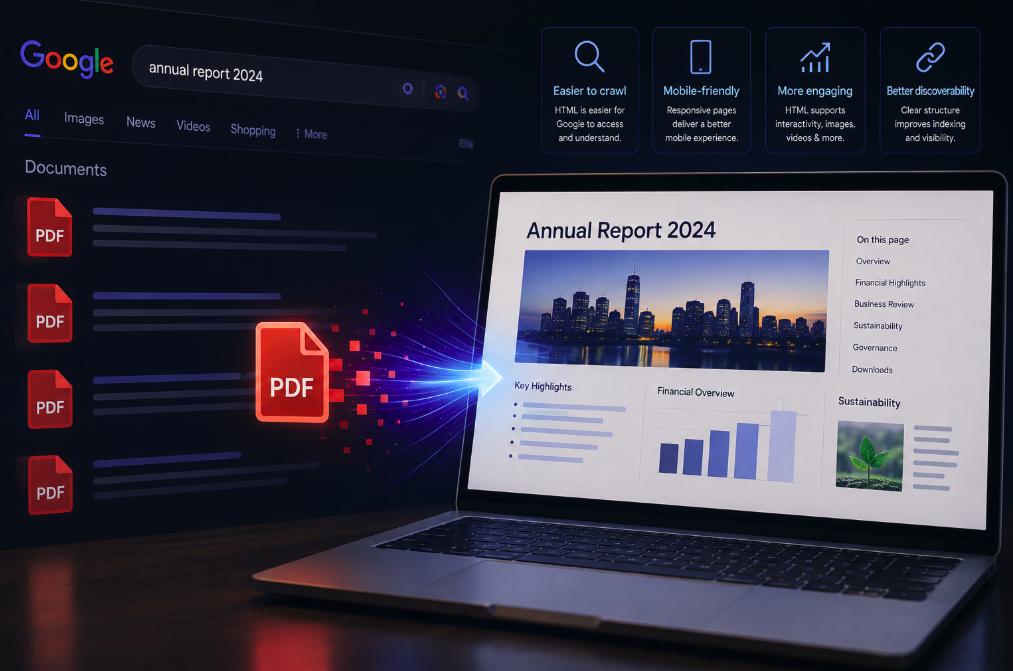
Something appears to be changing in the way PDF documents surface in Google Search. SEO observers have reported declines in the visibility of PDFs across search results, prompting a familiar question whenever a particular content format starts behaving differently: has Google changed how it values that format?
There is not enough evidence to say that Google is penalizing PDFs, and publishers should resist turning an observed trend into an unsupported ranking rule. Google’s current documentation still explicitly lists Adobe PDF as a file type that Search can index. The more useful question is whether the evolution of Search itself is making conventional web pages a better fit for an increasing number of queries, devices and search features.
The signal: fewer PDFs appearing in Search
Search Engine Roundtable reported on August 25 that several people in the SEO community had noticed Google showing fewer PDF files in its results. The observations included reports of previously visible PDFs becoming harder to find or apparently dropping from the index. Those reports are worth monitoring, but they do not by themselves establish a new Google policy or an algorithmic demotion aimed specifically at PDFs.
Google’s own technical documentation points in the opposite direction if the question is simply whether PDFs remain eligible for indexing. Its current list of indexable file types includes PDF alongside HTML, text documents, spreadsheets, presentations and other formats. Google has also said historically that textual PDF content can be indexed when it is accessible and readable by its systems. Eligibility, however, is not the same thing as guaranteed indexing or prominent ranking. Google makes clear more generally that even technically eligible content is not guaranteed to be indexed or served in search results.
That distinction gives publishers a better framework for interpreting what is happening. PDFs may still be fully supported while appearing less often because Google’s systems are choosing other documents as more useful results for particular searches. A change in relative visibility does not require a file-type penalty.
HTML fits the modern search experience unusually well
PDF was designed as a portable document format. Its great strength is preserving a document’s appearance across devices and software: reports, manuals, academic papers, regulatory filings, brochures and printable forms can retain a fixed layout. The modern web, by contrast, is built around content that adapts to context.
A well-designed HTML page can respond to different screen sizes, expose a clear document hierarchy, integrate navigation, embed media, support interactive elements and connect naturally to the rest of a website. Google’s developer SEO guidance explicitly recommends semantic HTML and stresses the importance of descriptive titles, metadata and accessible text content. Those are not statements that PDFs are disfavored, but they illustrate how closely the architecture of ordinary webpages aligns with the mechanisms used to describe, structure and navigate web content.
The difference becomes particularly important on mobile. A fixed-layout PDF can require zooming, horizontal movement or a separate document-viewing interface, while responsive HTML can rearrange itself for a phone screen. If Search is trying to choose the result most useful to a user in a particular context, usability can matter even when two resources contain substantially similar information.
Search now needs more than extractable text
Google has been able to extract and index text from PDFs for years. That capability should not be confused with the richer set of signals available on a modern webpage. HTML gives publishers direct control over elements such as page titles, headings, internal links, image markup and page-level metadata. It also allows content to participate naturally in a broader site architecture.
A PDF can contain links and metadata, and Google can understand substantial amounts of its content. But it remains a document inside the web rather than a native webpage in the same sense as HTML. This becomes strategically relevant as search results grow more dynamic and as Google attempts to understand not only the words in a resource but its structure, relationships and usefulness for different search experiences.
Modern Search is also increasingly multimodal and answer-oriented. Images, video, structured information, interactive tools and AI-generated summaries all compete for space around traditional blue links. An HTML page gives publishers more flexibility to present content in forms that can evolve with those interfaces. A static document may still be the best answer to a query seeking a specific report or downloadable file, but it may be less competitive when the user simply wants information contained inside that report.
The intent behind the query may matter more than the format
This is why the PDF question should ultimately be framed around search intent. If someone searches for an official annual report, court filing, academic paper, technical specification or government form, a PDF may be exactly what the user expects. Replacing every such document with HTML merely for SEO would sacrifice one of the format’s genuine strengths.
But consider a different query: a user wants the key findings from an annual report, instructions from a manual or an explanation of a policy buried in a 70-page document. In those cases, a dedicated HTML page can provide a clearer answer, better navigation and a more direct route to related information. Google does not need to penalize the PDF for the webpage to become the more attractive result.
This also explains why visibility changes may vary dramatically between sites. Organizations that use PDFs primarily as downloadable primary documents may see different behavior from sites that publish large volumes of ordinary informational content only as PDFs. The underlying question is not whether the file extension is .pdf, but whether the format serves the task the searcher is trying to complete.
Publishers should stop treating PDFs as webpages
For publishers and SEO teams, the emerging signal is a reason to audit format strategy rather than begin a mass PDF migration. Important documents can remain available as PDFs while their most searchable information is also presented through strong HTML landing pages. A research report, for example, can have a webpage containing its summary, methodology, major findings, charts and contextual links, with the complete PDF offered as the authoritative download.
That approach has several advantages. The HTML page can target informational search intent and integrate with the site’s internal linking structure, while the PDF preserves the fixed, portable version for readers who need the complete document. It also gives publishers a clearer place to update surrounding context without repeatedly rebuilding the original file.
Care is needed when substantially identical content exists in both formats. Google has long advised site owners to make their preferred version clear when the same material is available as HTML and PDF, including through canonicalization signals. The goal should not be to duplicate every document mechanically, but to give each format a defined purpose.
A format shift without a format penalty
The reported decline in PDF visibility may eventually prove to be a measurable search change, a temporary fluctuation or something that affects particular query classes more than others. What the available evidence does not justify is the simple headline that Google has started penalizing PDFs. Google still documents PDF as an indexable format, and there has been no confirmed announcement of a blanket demotion.
Yet the observations are strategically useful because they expose a broader shift. Search increasingly rewards content that can operate as part of a responsive, structured and interconnected web experience. HTML is exceptionally well suited to that environment. PDFs remain valuable documents, but publishers should be more selective about asking them to perform the job of webpages.
The practical lesson is therefore less dramatic than a penalty and potentially more important. Keep PDFs where the document itself is the product. When the information inside the document is what people are searching for, give that information a proper home on the web.