
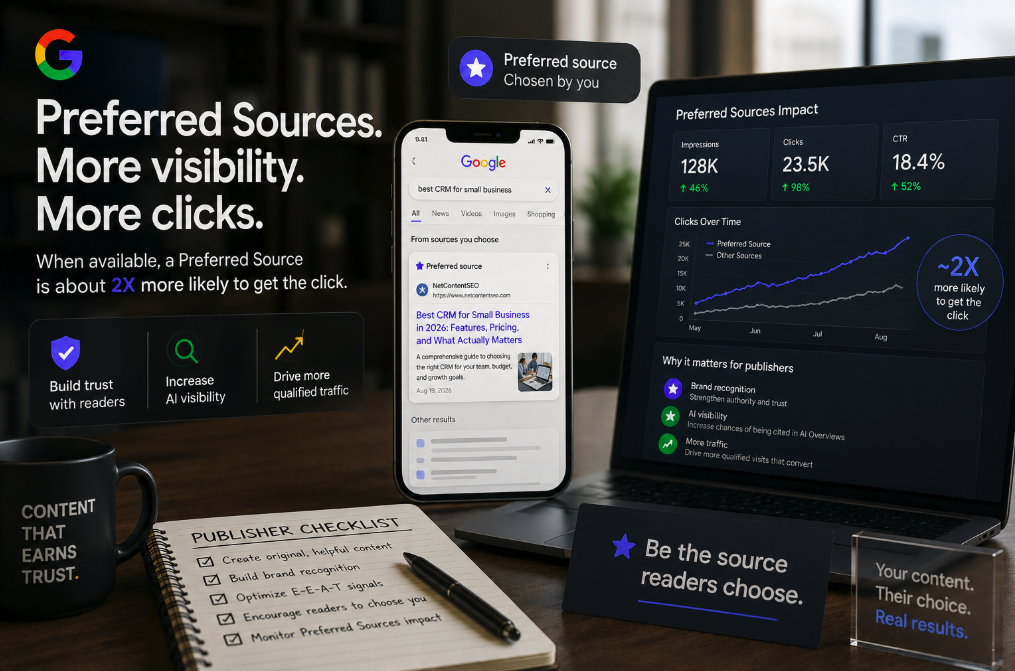
For years, publishers have treated brand recognition and Google visibility as related but fundamentally separate problems. SEO helped a page earn exposure in search; brand building helped a reader recognize the result once it appeared. Google’s Preferred Sources feature is beginning to blur that distinction by giving reader preference a direct role in how content is presented across Search.
The latest change makes that relationship much more actionable. Google now provides publishers with an interactive Preferred Sources button that can be embedded directly on their own websites. A reader can select the publication as a preferred source and then return immediately to the page they were reading. The implementation is deliberately simple, and Google says more than 600,000 unique sources have already been selected by users.
For publishers, however, the important part is not the button itself. It is the broader direction of travel. Preferred Sources now connects audience loyalty with visibility in Top Stories and with prominence inside Google’s AI experiences. Google also says readers are about twice as likely to click through to a source after marking it as preferred. That creates something unusual in modern search: a visibility mechanism publishers can actively ask their existing audience to influence.
Preferred Sources turns recognition into a search input
The basic concept is straightforward. Users can tell Google which publications they value. For relevant news queries, content from those sites can then appear more prominently in the user’s personalized Search experience. Google’s current Search Central documentation says content from a selected preferred source is more likely to appear in Top Stories and can receive a visible “preferred” badge.
The feature has also expanded beyond conventional news results. Since May, Google has brought Preferred Sources into AI Overviews and AI Mode. In those experiences, links from sources a user has selected can be highlighted with a preferred badge. That distinction matters: Google’s documentation makes an explicit “more likely to appear” promise for Top Stories, while describing the AI treatment in terms of highlighting preferred content. Publishers should therefore resist turning Preferred Sources into an unsupported claim that clicking the button directly boosts citation frequency in every AI answer.
Even with that caveat, the strategic shift is significant. A reader’s existing relationship with a publication can now follow that reader back into Google. The brand is no longer relevant only when the person navigates directly to the site, opens a newsletter or recognizes a familiar domain in a list of blue links. It becomes part of the personalization layer surrounding future discovery.
The new publisher button changes the acquisition loop
Preferred Sources previously depended largely on users finding Google’s source-preferences interface or using the star control around Top Stories. That creates friction. Even loyal readers are unlikely to interrupt what they are doing, find a Google settings page, search for a publication and add it simply because the publisher would benefit.
The August 20 update moves the action onto the publisher’s own property. Google’s recommended JavaScript implementation requires only a small script and a button element. The button is automatically localized and can use a light or dark theme. Publishers that cannot use the JavaScript implementation can instead direct readers to Google’s source-preferences tool through a dedicated deeplink.
More importantly, the interactive flow returns the reader to the publisher’s page after the selection is completed. That makes Preferred Sources resemble a lightweight subscription call to action. A publication can ask for the preference at exactly the moment when a reader has demonstrated interest in its content, without permanently sending that person away from the article.
This creates a new audience-development loop. Search brings a first-time reader to an article. The article earns enough trust for the reader to mark the site as preferred. Google can then surface or highlight that publisher more prominently for that individual in future relevant experiences. Those future appearances can create additional visits, giving the publication more opportunities to build direct habits such as newsletter subscriptions, accounts or paid memberships.
Google’s “twice as likely” number deserves attention—and caution
Google has repeatedly said that readers are roughly twice as likely to click through to a site after selecting it as a Preferred Source. The company reported the figure when the feature expanded globally and again as it brought preferred publishers into AI search experiences.
For publishers operating in a search environment where click-through rates are under pressure, a twofold difference is difficult to ignore. AI Overviews and AI Mode can answer increasingly complex questions directly on Google, reducing the need for some users to visit the underlying pages. A feature explicitly designed to make recognized publishers stand out therefore has obvious strategic appeal.
But the number should not be converted into a promise that installing the button doubles traffic. Google is describing the behavior of people who have already selected a source, when that source is available to click. Those users are, by definition, expressing a preference for that publisher. The statistic may therefore reflect both the visual treatment Google provides and the reader loyalty that caused the person to select the source in the first place.
The useful conclusion is narrower: Preferred Sources appears capable of increasing the value of an existing audience relationship inside Google. That is different from saying it manufactures audience demand from nothing.
This is not a conventional ranking factor
Preferred Sources should also not be confused with a new universal organic ranking signal. The feature is personalized. One user can select a publisher while another does not, and their experiences can consequently differ. A site does not become globally more authoritative because 10,000 readers click a Preferred Sources button.
Google’s documentation is careful about the scope. In Top Stories, preferred content is more likely to appear for the user who selected it. In AI Mode and AI Overviews, content can be highlighted with a preferred badge for that user. There is no documented mechanism in which accumulated selections raise a domain’s standard rankings for everybody.
That distinction actually makes the feature more interesting from a publisher-strategy perspective. Traditional SEO is largely about earning algorithmic visibility among people who may have no prior relationship with the brand. Preferred Sources is about preserving and amplifying a relationship after discovery has already occurred. It sits somewhere between SEO, audience retention and personalization.
Brand becomes measurable infrastructure
The emergence of Preferred Sources reinforces a broader shift in search strategy: publishers cannot treat brand as an intangible layer that sits above performance marketing. If users must actively choose a source before Google can personalize around that preference, recognizability becomes operational.
A generic site producing interchangeable articles has a difficult proposition. Even if one of its pages ranks, why would the reader explicitly ask Google to show more from that domain? Preferred Sources rewards a different kind of publishing behavior: a consistent editorial identity, distinctive expertise, repeat usefulness and enough trust that the domain itself means something to the reader.
This has consequences for content strategies built almost entirely around anonymous search acquisition. A publisher can optimize thousands of pages for keywords and still fail to create any reason for users to remember who produced them. In a search environment with AI-generated summaries and increasingly compressed discovery interfaces, that weakness becomes more serious. If Google is giving users tools to elevate sources they already value, being remembered is itself a distribution advantage.
AI visibility makes the feature more strategically important
The extension into AI Overviews and AI Mode is what moves Preferred Sources beyond a conventional Google News feature. Publishers are trying to understand how brand visibility works when search results are no longer simply ranked lists of pages. AI interfaces synthesize information, cite multiple sources and decide which links deserve limited visual space around generated answers.
Preferred Sources gives users a way to inject an explicit preference into that environment. Google says selected publishers can be highlighted in AI responses with a preferred badge. That does not guarantee citation, but it creates a recognizable layer around citations when preferred content is available.
This matters because AI search introduces a new competition for attention. In a traditional results page, ten organic links might be visible. In an AI answer, the number of source links receiving prominent treatment can be much smaller and their presentation more contextual. Anything that helps a trusted publisher stand out within that interface can affect whether recognition survives the transition from classic search to generative search.
The underlying principle is familiar from other platforms. Users follow creators on social networks, subscribe to channels on video platforms and join newsletters because algorithmic discovery is unreliable. Preferred Sources brings a version of that explicit relationship into Google Search itself.
Publishers should treat the button like an audience CTA
For eligible publishers, adding the button is technically easy. The more interesting question is where and when to ask readers to use it. Placing it everywhere without context may simply create another piece of interface furniture that users ignore.
A better approach is to think about Preferred Sources alongside newsletter and follow prompts. The strongest moment to ask is likely after the publication has delivered value: near the end of a useful article, on a returning reader’s visit, in a newsletter landing page or within an audience-membership area. The message should explain the reader benefit—seeing more from a source they trust in Google—rather than framing the action as a favor to the publisher.
Publishers should also verify eligibility before promoting it. Google says domain-level and subdomain-level sites can appear in the source-preferences tool, while individual subdirectories are not eligible as separate sources. A publication living at a dedicated subdomain may therefore be selectable independently, but a section at example.com/news cannot be treated as its own Preferred Source.
Measurement will require discipline. Search Console does not currently turn Preferred Sources into a simple standalone traffic channel that publishers can isolate cleanly. Teams should avoid attributing every increase in Discover, Top Stories or AI traffic to the button. The useful metrics may initially be more indirect: adoption of the preference CTA, repeat search traffic, branded demand and changes in click behavior among audiences exposed to the campaign.
Search visibility is becoming a relationship problem
Google’s latest publisher tooling arrives at an awkward moment for the web. Publishers are concerned that AI-generated answers will reduce outbound clicks, while Google is trying to demonstrate that its AI products can still connect users with the sites that create original information. Preferred Sources does not resolve that tension. A publisher would still generally prefer an open discovery environment that sends abundant traffic without requiring users to pre-select favored domains.
But the feature reveals how Google sees at least part of the future of search: personalization based not only on what a user is asking, but on whom the user wants to hear from. More than 600,000 unique sources have already been selected, according to Google. That is a remarkably broad distribution, suggesting the mechanism is not reserved for the largest media brands.
For independent publishers, specialist sites and niche editorial brands, that may be the most encouraging aspect. Preferred Sources creates a mechanism through which a small publication with a loyal audience can preserve some of that loyalty inside Google’s increasingly AI-mediated interfaces. It does not need to become universally dominant. It needs to become preferred by the people for whom its coverage is particularly valuable.
SEO has traditionally asked publishers to earn rankings. Social media asked them to earn followers. Newsletters asked them to earn subscribers. Google Preferred Sources introduces another version of the same strategic asset: earn enough trust that a reader actively asks an algorithm to show more of you.
That is why the new button matters more than its two lines of implementation code suggest. Search visibility is no longer only a competition to be selected by Google’s ranking systems. Increasingly, it may also be a competition to be selected by the audience itself.