
Google has spent years telling site owners that most of them do not need the Disavow Links tool. That advice has sometimes been simplified into a much stronger belief inside the SEO community: disavow is basically irrelevant because Google already ignores bad backlinks.
A new exchange with Google's John Mueller is a useful correction. Responding to an SEO who believed a ranking drop followed a disavow-file update, Mueller said the tool “does have effects” and still has a legitimate “place & time.” At the same time, he warned against assuming that disavowing a handful of links could explain a site disappearing from Search and encouraged the site owner to investigate other causes. Search Engine Roundtable highlighted the exchange on September 2.
The practical lesson is more interesting than “disavow works.” Google is effectively maintaining two positions at once: the tool is powerful enough to affect how Search treats links, but unnecessary — and potentially harmful — for most websites. That makes indiscriminate “toxic backlink cleanup” one of the stranger areas of modern SEO: site owners are often encouraged by third-party scores to neutralize links that Google may already be handling correctly.
The case started with a ranking drop after a disavow update
The discussion began on Reddit when a site owner described losing a number-three ranking roughly two weeks after submitting an updated disavow file. The owner said the site had accumulated hundreds of domains classified as toxic and that the new file also included older guest-post links purchased through Fiverr. Some of those links, the owner later worried, might still have been contributing value.
Mueller's response was notably more nuanced than either side of the usual disavow debate. He rejected the idea that the tool does nothing, saying it has effects and legitimate uses. But he also said disavowing a small number of links would not normally make a site drop out of Search and advised correcting the file to reflect what the owner actually wanted disavowed — which could mean an empty file — while investigating other explanations.
One alternative Mueller raised was timing around a broader spam update. He noted that recovery from issues connected with major algorithmic changes can take a long time, sometimes months. He also suggested checking for large technical problems rather than assuming the backlink change was causal.
That distinction is critical. The sequence “uploaded disavow file → rankings fell” is not proof that the first event caused the second. The case contains several competing variables, including a history of purchased links and a possible algorithm update.
Google's official documentation is even more cautious
Google's current Disavow Links documentation describes the feature as advanced and explicitly warns that using it incorrectly can harm a site's performance in Google Search.
More importantly, Google says most sites do not need it. Its recommended threshold is narrow: a site should generally consider disavowing when it has a considerable number of spammy, artificial or low-quality links and those links have caused, or are likely to cause, a manual action. Google says its systems can assess which links to trust in most cases without additional instructions from the site owner.
For sites already facing a manual action for unnatural inbound links, Google's Manual Actions documentation treats disavow as a cleanup mechanism after a good-faith attempt to remove manipulative links. Google specifically warns against blindly adding all backlinks to a disavow file and tells site owners not to disavow organic links.
That is very different from the workflow promoted by some backlink-audit tools: export every domain carrying a high “toxicity” score, upload the list to Google and assume the site is now safer.
The phrase “toxic backlink” creates a dangerous shortcut
Third-party SEO platforms can provide useful signals for auditing link profiles, but they do not know Google's internal treatment of a specific backlink. A tool can identify patterns that resemble spam; it cannot reliably tell a site owner that Google is currently counting a particular link negatively, ignoring it, or assigning it positive value.
Google reinforced this broader principle in its 2026 guidance on third-party SEO tools, warning users that external tools do not have access to Google's internal ranking data and that their predictions are their own. The guidance encourages site owners to distinguish between third-party analysis and actual Google data.
This matters because the Disavow Tool does not simply clean up a dashboard. It asks Google to disregard links. If a third-party system falsely labels legitimate or useful links as toxic and the owner disavows them, the site may be deliberately neutralizing signals it would have preferred to keep.
Disavow is not a negative-SEO antivirus
Another common use case is defensive: a site notices thousands of strange links from low-quality domains and assumes those links must be removed before they damage rankings. Google's guidance argues against that default reaction.
Google says it works to ensure that actions on third-party sites do not negatively affect another website and that, in most cases, it can determine which links deserve trust without help. Random spam links appearing in a backlink report are therefore not, by themselves, a reason to build a disavow file.
The stronger case for intervention is when the site's owner, previous owner or hired SEO actively participated in manipulative link building — paid links, link schemes or other artificial patterns that violate Google's spam policies. That is also why the Reddit example behind Mueller's latest comments matters: the site owner explicitly described previously purchased guest posts. This was not simply a site being attacked by random spam backlinks.
The tool having “effects” does not tell us exactly how much each link mattered
Mueller's statement is useful because it closes one misconception: Google is not saying the Disavow Tool is a decorative legacy interface. But it should not be stretched into a claim that every submitted domain directly subtracts ranking power or that removing a domain from a disavow file will restore rankings on a predictable schedule.
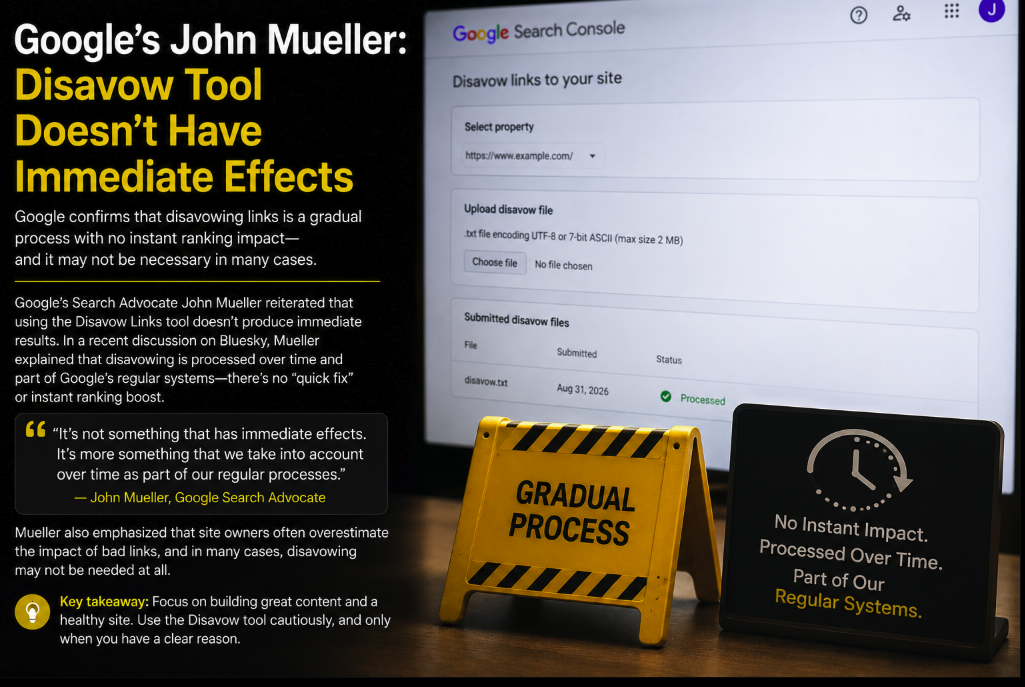
Google's documentation says uploaded disavow lists can take several weeks to be incorporated as Google recrawls the web and reprocesses pages. That creates a slow and noisy feedback loop. Search rankings can change during the same period because of content updates, competitors, technical changes, spam systems, core systems and normal reprocessing.
This makes single-site before-and-after anecdotes especially difficult to interpret. Even when rankings move shortly after a disavow change, causality may remain uncertain.
A better rule: disavow evidence, not ugliness
The most defensible way to use the tool is to begin with provenance rather than appearance. Do you know that links were bought? Did an SEO agency run an artificial link-building campaign? Is there a documented history of link schemes? Is Google showing a manual action involving unnatural inbound links? Those facts are much stronger evidence than a backlink simply coming from a site that looks low quality.
A link from an obscure domain may be worthless without being harmful. A strange anchor may be automatically ignored. A scraper can create thousands of backlinks without the target site participating at all. Treating every ugly-looking link as a liability turns normal web noise into an endless cleanup project.
Conversely, known manipulative links should not be rationalized merely because they appear to be helping rankings. Google's Search Essentials makes clear that ranking manipulation and link schemes can lead to lower rankings or removal from Search. If a site deliberately created artificial links, the correct long-term strategy is to stop the practice and address the underlying violation rather than preserve it because a third-party metric looks favorable.
A NetContentSEO experiment: can we observe disavow effects without guessing?
Mueller's statement suggests an experiment, although it needs to be designed conservatively. We should not intentionally disavow valuable links on a commercially important site simply to see what happens. But historical disavow changes across multiple consenting properties could be analyzed as a natural experiment.
For each property, we could record the exact domains added or removed, classify whether the links were known paid/manipulative links or merely third-party “toxic” classifications, and monitor page-level Search Console impressions, rankings and crawl/reprocessing timing over subsequent weeks. Properties undergoing major migrations, technical failures or algorithm-update exposure would need to be separated from cleaner cases.
The most interesting cohort would be sites that previously uploaded broad automated disavow lists and later removed domains for which there was no evidence of manipulation. If measurable visibility consistently returned after Google reprocessed those links, that would support the hypothesis that over-disavowing can suppress useful signals. If nothing changed across a sufficiently large sample, it would suggest many of those links were already irrelevant.
Either outcome would be more useful than debating whether a backlink “looks toxic.”
The Disavow Tool is powerful precisely because you usually should not use it
Google's latest clarification does not reverse its long-running advice. Most sites still do not need to disavow links. Google still says its systems can handle ordinary backlink noise, and its official documentation still reserves the tool for relatively exceptional circumstances.
What Mueller's comment changes is the framing. “Don't use disavow” should not be interpreted as “disavow does nothing.” The safer interpretation is almost the opposite: do not use it casually because it does something.
That should make SEOs more skeptical of automated backlink-cleanup rituals. A toxicity score is not a Google penalty signal, correlation after an upload is not proof of causation, and a disavow file should not become routine maintenance simply because a crawler discovered unfamiliar domains.
The tool still has effects. The difficult part is knowing when those effects are actually the ones you want.