
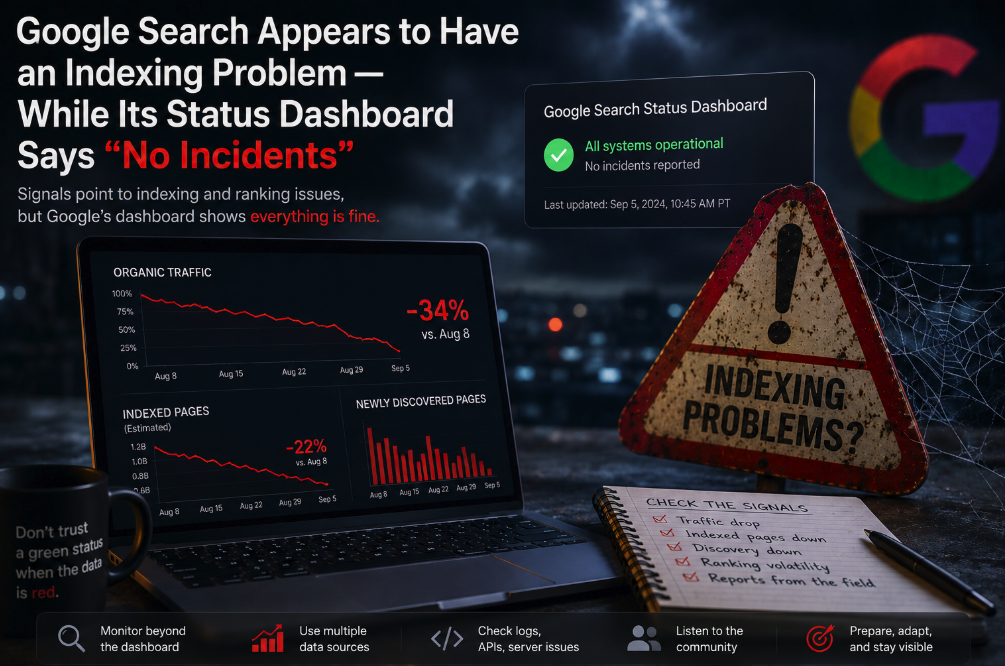
Google Search Appears to Have an Indexing Problem — While Its Status Dashboard Says “No Incidents”
Google Search appears to be experiencing an indexing or serving problem affecting newly published content on August 28, 2026, even though the company’s official monitoring page currently reports that everything is operating normally. The mismatch is a useful reminder for publishers: a green status dashboard does not always mean that fresh content is reaching search results as expected.
Search Engine Roundtable reported the issue on Friday morning after observing that recent articles from publishers that normally produce content continuously — including The Wall Street Journal, The New York Times and CNN — were showing few or no newly indexed pages in Google Search. The pattern points to either an indexing delay, a serving problem that prevents already processed pages from appearing, or some combination of the two. At the time of writing, Google has not publicly confirmed the cause.
The official dashboard still says “No incidents”
The contrast is particularly notable because Google’s official Search Status Dashboard currently displays “No incidents.” Its August 28 view shows no disruption markers for crawling, indexing, ranking or serving. Google describes the dashboard as the place where it provides status information for systems that are part of Search, while also advising users experiencing an unlisted issue to contact support.
That does not necessarily mean the dashboard is wrong. Operational incidents can begin before they are formally acknowledged, and an observed problem may be too limited, too recent or still under investigation. It also remains possible that what publishers are seeing is not a broad infrastructure outage. Until Google comments, the safest description is an apparent fresh-content indexing or serving issue rather than a confirmed Google Search outage.
Timing makes the problem harder to diagnose
The incident arrives during an already noisy period for search visibility. Google’s August 2026 spam update ran from August 18 through August 21, and the SEO community has continued reporting substantial ranking volatility after the rollout ended. Search Engine Roundtable documented that post-update turbulence on August 26, citing both third-party tracking tools and publisher reports.
That distinction matters. Ranking volatility changes where indexed pages appear; an indexing or serving failure can prevent new pages from appearing at all. Publishers diagnosing a sudden traffic decline should therefore avoid assuming every loss is an algorithmic penalty. Checking whether recent URLs are actually discoverable in Google can be more informative than staring at a ranking graph.
For publishers, the dashboard is only one signal
The practical lesson is straightforward: operational monitoring should combine Google’s status information with direct observation. Publishers can check fresh URLs in Search, monitor Search Console and server logs, compare publication times against discovery and indexation, and watch whether the same pattern appears across unrelated domains.
If the current reports reflect a broader indexing problem, Google may eventually add an incident to the dashboard or confirm that the issue has been resolved. Until then, the most interesting fact is the gap itself: publishers are observing missing fresh content while the official system says there are no incidents. In search, visibility depends not only on producing and optimizing a page, but on the infrastructure actually getting that page into the results.