
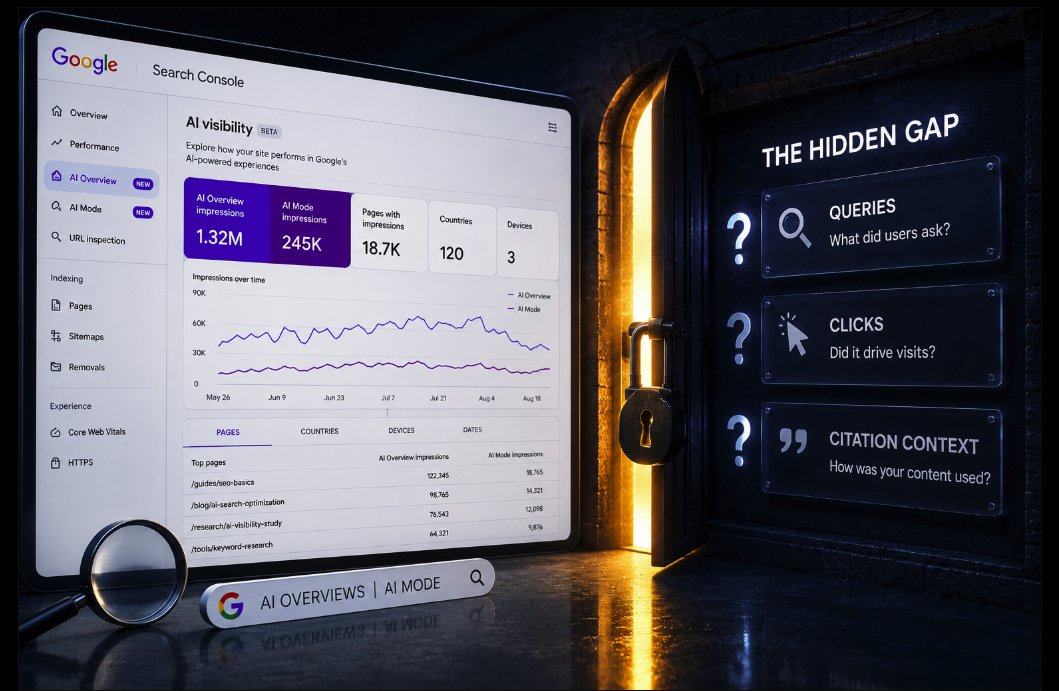
Google has taken an important step toward making AI search measurable inside Search Console. Website owners with access to the new generative AI performance report can see when their URLs appear in AI Overviews and AI Mode, identify which pages receive those impressions, break visibility down by country and device, and follow the trend over time. For the first time, Google is exposing a dedicated first-party view of a site's presence inside its generative Search experiences.
But the report stops just before the data becomes truly diagnostic. It does not expose the queries or questions that triggered the AI visibility, and it does not provide a dedicated click metric showing how many visits were generated specifically by those AI appearances. The result is a measurement layer that can tell a publisher that a page appeared in AI Search, but not what the user asked or how that appearance translated into traffic.
That distinction is especially important for GEO. AI visibility is finally becoming a native Search Console metric, but the chain marketers actually want to understand — question → selected page → AI appearance or citation → click — remains incomplete.
What Google's new AI report actually measures
Google's official Generative AI performance report for Search covers impressions from AI Overviews and AI Mode. Google says publishers can use it to see how organic impressions from generative AI features change over time, identify the pages receiving the most or fewest impressions, and understand where those impressions originate.
The available dimensions include pages, countries and devices, alongside date-based analysis. This is already a meaningful improvement over the previous situation, where publishers often had to infer AI visibility through manual prompting, referral data or third-party monitoring tools. Search Console is now exposing data generated inside Google's own AI search ecosystem.
There is also an important methodological detail: Google defines an impression in this report as an occasion when a link to the site was shown to a user in a generative AI feature. That means the report is measuring exposed links, not every invisible use of a publisher's content that might have contributed to grounding or answer generation.
The most valuable dimension is still missing: the query
In conventional Search Console analysis, query data connects visibility to intent. A publisher can see which searches produced impressions, which pages ranked for them, how frequently users clicked and how performance changed. That relationship is one of the foundations of SEO diagnosis.
The generative AI report does not currently provide that same connection. Google can show that a URL accumulated AI impressions, but the dedicated report does not reveal the prompts, questions or searches behind those appearances. For GEO analysis, that is a major blind spot because the same page could appear across very different user intents.
Suppose an article receives 10,000 AI Mode impressions. Were users asking for a definition, comparing products, researching a brand, looking for a recommendation or seeking instructions? Without the query layer, the publisher can measure exposure but cannot reconstruct the demand that produced it.
Clicks exist in Google's accounting, but not as a dedicated AI metric here
The click story requires careful wording. It would be incorrect to say that Google does not count clicks from AI Search at all. Google's official documentation on impressions, positions and clicks explicitly states that clicking an external link in AI Mode counts as a click. It likewise says that a click on an external link inside an AI Overview is counted as a click.
What is missing from the dedicated generative AI performance report is a click metric that isolates those interactions as AI-generated traffic. Google's standard Search performance reporting can account for clicks from these surfaces, but publishers cannot use the new AI report to cleanly answer a question such as: “These 25,000 AI Overview impressions generated how many visits?”
That difference matters. An impression-only AI dashboard can measure visibility growth while leaving the commercial consequence ambiguous. A page may appear frequently in AI answers and generate meaningful referral traffic, or it may provide information that satisfies users inside Google's interface with very few outbound visits. Without isolated click data, those two outcomes are difficult to distinguish.
We still cannot reconstruct citation and source selection
There is another limitation that goes beyond clicks. Search Console's impression definition tells us that a site's link was shown. It does not give publishers a granular classification of the role their content played in the generated response.
Was the URL prominently cited as evidence for a specific statement? Was it included as a supporting link? Did Google's systems use the page to ground the response in a way that was not directly exposed? The Search Console report does not provide a publisher-facing event log that distinguishes those states.
This is precisely where AI search measurement differs from classic ranking analysis. A generative answer can retrieve multiple documents, synthesize information and expose only selected links. For researchers trying to understand source selection, the visible impression is therefore only the final observable layer of a longer retrieval process.
Is the Search report global? Google's own documentation still creates ambiguity
There is an unusually interesting wrinkle in today's rollout coverage. Search Engine Roundtable reported on September 1 that Google's generative AI performance reports and controls are now available globally, following a gradual rollout that began earlier in the summer.
However, Google's official documentation for the Search generative AI performance report still states that the report is being rolled out to a subset of website owners for testing before broader expansion. The same page says that not all properties have access because rollout is happening over time.
By contrast, Google's documentation for the separate Generative AI performance report for Discover contains an explicit statement that, as of August 31, 2026, those insights have been rolled out to all websites worldwide. Curiously, that Discover page also retains language elsewhere saying that not all properties have access and rollout is continuing, illustrating how quickly product documentation can become internally inconsistent during a launch.
The safest conclusion today is therefore narrower than some headlines suggest: Google is expanding generative AI reporting substantially, and Discover has an explicit worldwide-rollout statement, but the official Search-report help page still describes access as limited. Until Google reconciles that documentation, presenting the Search AI report as unambiguously global would be stronger than the primary source supports.
Google can see the full funnel. Publishers cannot.
The bigger story is not simply that Search Console has gained another report. Google operates the interface, receives the user's query, generates or orchestrates the AI response, selects and displays links, and records subsequent clicks. From a measurement perspective, Google sits across the entire interaction.
Publishers receive only a portion of that chain. They can now see AI impressions and the URLs involved, but not the AI-specific query-to-page mapping or an isolated AI click outcome inside this report. That creates a fundamental attribution gap at exactly the moment AI search visibility is becoming strategically important.
For traditional SEO, Search Console lets us investigate relationships such as query → page → impression → click. For the new generative report, the observable sequence is closer to page → impression. The beginning of the journey and its traffic outcome remain partially hidden.
This is why independent AI visibility tracking still matters
Google's first-party data is extremely valuable because third-party systems cannot reproduce Google's internal impression counts. But the limitations also explain why independent GEO monitoring will remain necessary. Search Console and external AI visibility tools answer different questions.
Search Console can provide authoritative evidence that a site's URLs appeared in Google's generative surfaces. Independent monitoring can test prompts, capture answer composition, identify visible citations, compare competitors and observe which brands or publishers appear for specific questions. Neither dataset alone reconstructs the complete journey, but combining them gets much closer.
This is also the logic behind the kind of visibility panel we are building at NetContentSEO. Instead of treating “AI visibility” as one score, the useful model separates demand, retrieval, appearance, citation and traffic. Search Console now provides a valuable first-party signal for one of those stages. The remaining stages still require observation and experimentation.
A new NetContentSEO experiment becomes possible
The new report gives us a practical test. We can select pages receiving measurable generative AI impressions in Search Console and independently monitor a controlled set of prompts around the same topics. The objective would be to see whether changes in observed citations and source selection correspond with changes in Google's reported AI impressions.
If they correlate strongly, prompt-based monitoring may provide a useful proxy for otherwise hidden query-level behavior. If they diverge, that would be equally informative: it would show how limited any manually selected prompt set is compared with the real distribution of questions users ask Google.
A second test could compare AI impressions with overall Search clicks before and after large visibility changes. It would not provide clean causal attribution because the dedicated AI report does not isolate clicks, but repeated observations across enough pages could reveal whether rising AI exposure tends to coincide with measurable traffic changes.
AI visibility is measurable now — but attribution is not
Google deserves credit for exposing a dedicated generative AI visibility dataset. Publishers no longer have to rely entirely on screenshots, synthetic prompts and external trackers to know whether their pages are appearing inside AI Overviews and AI Mode. That is a significant change.
But visibility is only the beginning of useful analytics. The questions publishers need answered are more specific: What did the user ask? Why was this page selected? Was it cited prominently or merely linked? Did the user visit the site? Which topics and answer types actually produce valuable traffic?
Search Console cannot yet answer that full sequence. Google can now tell you that your page appeared in AI Search. It still will not tell you, inside the dedicated AI report, what the user asked — or whether that visibility produced a visit. For GEO, that missing connection is becoming the most important measurement gap of all.