
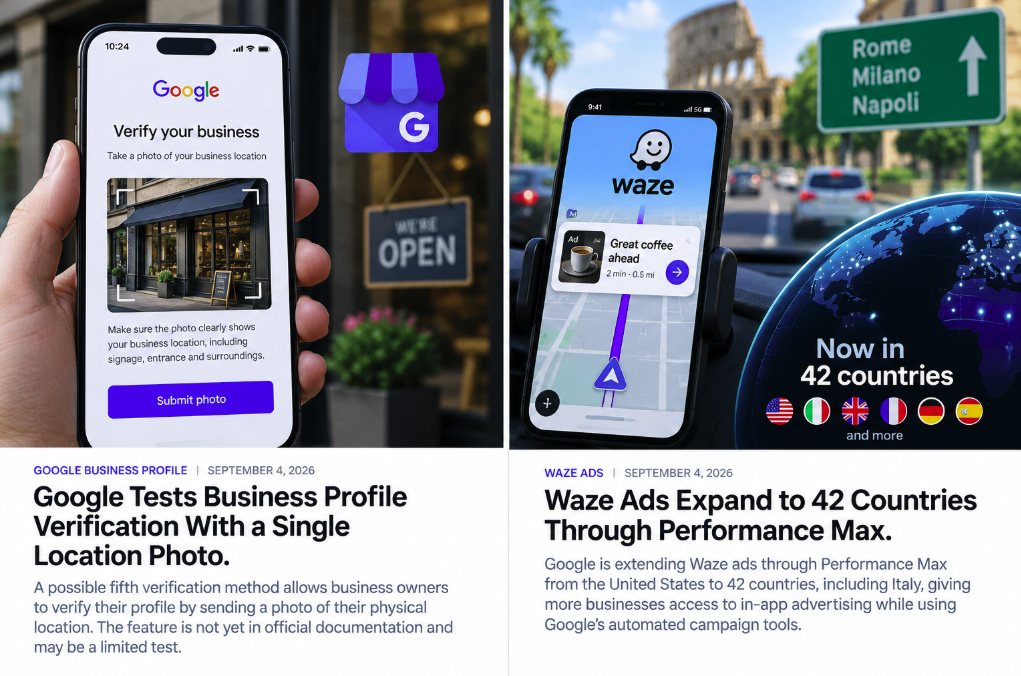
Google appears to be testing a simpler way to verify a Business Profile: submit a photo of the physical business location. The option has been spotted in the verification interface as “Submit a business photo,” potentially adding a lightweight alternative to phone, email, video and postal verification for some businesses.
The feature was reported on September 4 by Barry Schwartz at Search Engine Roundtable after local-search specialist Ben Fisher shared a screenshot of the new option. The evidence is intriguing, but the rollout should be described cautiously. Google has not added single-photo verification to its official Business Profile documentation, and there is no indication yet that every business or market can access it.
For now, the most accurate interpretation is that Google is testing or selectively exposing another verification path. It may eventually become a formal fifth method, but the interface appearing for some users is not enough to establish a global product launch.
A single photo could simplify one of local SEO's most frustrating workflows
Business Profile verification exists to establish that the person claiming a listing is authorized to represent the business and, where relevant, that the business exists at the stated location. That sounds straightforward, but the verification process can become a significant operational obstacle for owners and agencies.
Google automatically decides which verification methods are available. Its current official verification documentation says the options depend on factors including business type, public information, region and opening hours, and businesses cannot simply request a different method because they prefer it.
The documented options include phone or text, email, live video call and mail, while Google separately provides a video-recording verification flow. Some businesses may also be required to complete more than one verification step.
A single-photo option could reduce friction dramatically when Google only needs visual evidence that a location corresponds to the claimed business. Instead of coordinating a live call or recording a more extensive video, the owner could potentially photograph the storefront and submit it for review.
Google has not documented the new option
The missing documentation is the most important qualification. Google's help pages currently explain established verification methods but do not describe a workflow in which one location photo is sufficient to verify a Business Profile.
That means businesses should not assume they can independently choose photo verification or upload an ordinary Business Profile image and expect verification to occur. In fact, a Google Business Profile Community recommended answer published in August stated that normal photo uploads were not themselves a verification method at that time.
The new screenshot suggests Google may now be experimenting with a distinct verification workflow that specifically requests a business-location photo. That is different from adding photos to an existing profile, where images are intended to help customers understand the location after verification.
Until Google updates its documentation or confirms the feature, the distinction between an interface test and an officially supported verification method matters.
What would Google need to see in one photo?
That is currently unclear. Schwartz notes that the interface does not yet provide enough public information to establish exactly what the photograph must contain. The most plausible clues come from Google's existing video-verification requirements.
For video verification, Google asks businesses to demonstrate several categories of evidence. The recording can need to establish the current location through exterior signage, nearby businesses or street signs; show the business itself through products, equipment or branded materials; and demonstrate that the person recording actually manages the business through access to employee-only areas, keys or operational equipment.
A single photograph cannot easily prove all of those things at once. If Google is genuinely reducing verification to one image for selected businesses, the company may already possess enough confidence from other signals and need the photo only as an additional piece of evidence.
That would make photo verification less a replacement for every existing method and more a risk-based option shown when Google's systems believe a lightweight visual check is sufficient.
The test may reveal a more adaptive verification system
Google already says verification methods are selected automatically rather than offered uniformly. The appearance of photo verification fits that model. A low-risk storefront with clear signage, a consistent address and strong corroborating information may require less evidence than a newly created profile in a category with high abuse rates.
If that is how the test works, the interesting development is not merely the addition of another button. It is Google's ability to vary the amount and type of proof required according to the confidence it already has about the business.
That approach could make legitimate onboarding faster without weakening verification universally. Businesses that are harder to validate could still be routed toward video, phone, mail or multiple verification steps.
There is no public evidence yet explaining whether Google is using such a risk model for the new photo option, so this remains an interpretation rather than a confirmed product design.
A photograph also creates new fraud and authenticity challenges
Single-image verification would be convenient, but it is easier to manipulate a static photograph than a live video interaction. Images can be copied, edited, generated or taken by someone who does not actually control the business.
Google would therefore need safeguards if the method expands. Those could involve image metadata, capture requirements, location signals, comparisons with Street View or existing Business Profile imagery, or other internal confidence signals. Google has not disclosed how the observed feature evaluates a submitted photo.
The rise of generative image tools makes this particularly relevant. A verification system that accepts visual evidence cannot assume that a realistic storefront photograph necessarily documents a real storefront or proves management authority.
Any production rollout will have to balance convenience for legitimate businesses with the abuse prevention that Business Profile verification exists to provide.
Businesses should use only the verification options Google actually presents
For owners and local SEO practitioners, the practical advice remains simple. If “Submit a business photo” appears inside the official verification flow for a profile, it is reasonable to follow the instructions Google provides there. If it does not appear, there is no documented way to force the option.
Google explicitly says verification methods are automatically determined and cannot be changed on request. Uploading extra storefront photographs to the profile is therefore not a substitute for completing the verification method assigned by Google.
Agencies should also resist promising clients that photo verification is now generally available. The evidence currently supports only that the option is appearing for at least some users.
The next signal to watch is Google's documentation
Tests inside Google Business Profile frequently appear before a broader rollout, and some never become universal features. The clearest sign that single-photo verification has moved beyond experimentation would be an update to Google's official help documentation explaining eligibility, photo requirements and supported markets.
Until then, calling it a fifth verification method requires a qualifier. It is a possible fifth method being observed in the product, not a confirmed replacement for Google's existing verification system.
If Google does formalize it, the change could remove substantial friction for straightforward physical businesses. A single location photo is far easier to provide than a live video call or mailed code. The challenge will be making that simplicity reliable enough that faster verification does not also mean easier profile abuse.