
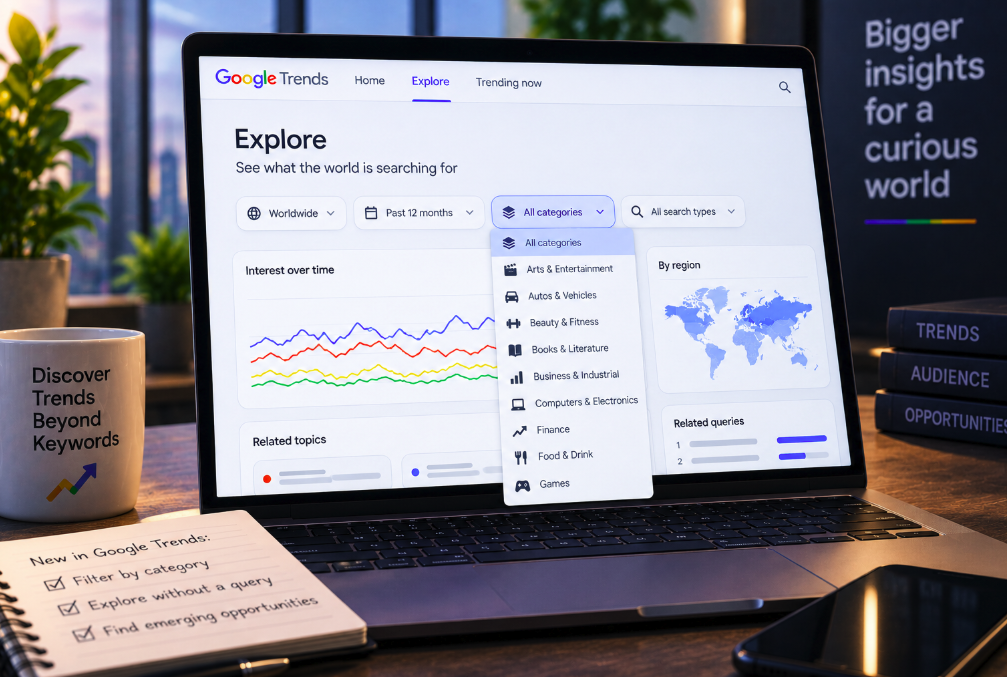
Google Trends has traditionally encouraged researchers to begin with a word: enter a topic, compare it with another term and see how search interest changes over time. A new update to the Explore page changes that starting point. Users can now select a category first — without entering any query at all — and use Google’s own taxonomy to discover what people are searching for inside a market.
The change was highlighted by Barry Schwartz in a September 2 Search Engine Roundtable report after Google announced category filters for the redesigned Explore experience. Google says the filter can be used in two ways: to narrow the meaning of an existing query or, more interestingly, on its own to reveal category-specific top searches across selected regions and timeframes.
Google Trends can now start with a market instead of a keyword
The query-free option is the important part of the update. Conventional keyword research usually begins with a seed term supplied by the researcher. That seed determines the direction of discovery: enter “running shoes,” for example, and the tool can help reveal demand related to running shoes. The analyst is still responsible for knowing that the topic is worth investigating in the first place.
Category-level exploration reverses that workflow. A researcher can begin with a broader area such as Books & Literature, Beauty & Fitness, Finance or another Google category, then examine the top-searched terms associated with it. Geography and time filters can further narrow the result. Instead of asking how a phrase is trending, the initial question becomes what is trending within this part of the search market.
That makes Google Trends more useful for discovery rather than only validation. Marketers do not need to arrive with a fully formed keyword hypothesis before the tool can show them where demand is concentrating.
The same filter can disambiguate queries with several meanings
Category filtering also solves a familiar Google Trends problem: ambiguous language. The same word can represent a programming language, a place, a product, a person or a completely unrelated concept. Aggregate trend data can therefore combine interest that has little relevance to the researcher’s actual question.
Schwartz demonstrates the point with “Java.” Someone interested in Java programming for an SEO-related analysis does not necessarily want searches about the Indonesian island or coffee. Applying an appropriate category can narrow the dataset toward the intended context and make the trend line more meaningful.
This does not mean category filters perfectly classify every search or eliminate ambiguity. Google’s taxonomy is an additional lens over the data, not a substitute for inspecting related topics and queries. But it gives researchers a direct way to reduce obvious noise before interpreting changes in interest.
Category discovery is useful when the opportunity is not yet named
The strongest use case may be situations where a business knows its market but does not know which specific topics deserve attention. An ecommerce team entering a new product category can explore the market before deciding which terms belong in a keyword list. A publisher can look for rising themes within a vertical. A content strategist can compare what users are searching for in different countries without assuming that demand will use the terminology familiar to the brand.
This is especially useful for trend research because emerging demand often appears before a company has standardized the language it uses to describe it. A new product format, cultural trend or consumer concern may be growing under terms that do not yet exist in the organization’s keyword taxonomy. Starting with a category can expose those terms rather than requiring the analyst to guess them.
The feature can also act as a useful briefing tool. Before opening a conventional keyword database, teams can use category-level Trends data to understand which themes are currently prominent, then move into deeper volume, competition and intent analysis once promising areas have been identified.
Google Trends still measures relative interest, not absolute search volume
The expanded discovery capability does not change one of the most important rules for using Google Trends correctly: its values are normalized. A score of 100 represents peak relative interest within the selected comparison, geography and time period; it does not mean there were 100 searches or disclose the absolute number of queries.
That makes the tool excellent for identifying direction, seasonality and relative changes, but insufficient as a standalone forecast of traffic opportunity. A sharply rising term can still have a small absolute audience, while a mature high-volume query can show a flatter trend because its search behavior is already established.
SEO teams should therefore use category discovery to generate and prioritize hypotheses, then validate commercially important opportunities with Search Console, Google Ads data, keyword tools, analytics and business metrics where appropriate. Trends shows how interest is moving. It does not tell a company how many clicks or conversions a ranking will produce.
Regional filters can reveal that one market’s trend is another market’s non-event
Google specifically notes that category discovery can be combined with region and timeframe selections. That matters because search trends rarely move uniformly across markets. A topic surging in one country can be stable elsewhere, and a seasonal pattern in one hemisphere can be irrelevant in another.
For international SEO, starting with the category rather than translating an English keyword can reduce a common research bias. Literal translations do not always reflect how local users describe products, problems or trends. Exploring what people actually search for inside the relevant category can surface terminology that a translation-first workflow might miss.
Regional comparison also helps content teams distinguish global stories from local opportunities. A topic that appears important in worldwide data may be driven by only a handful of markets. Conversely, a trend too small to dominate global charts can be strategically important to a company operating in one specific country or region.
The update fits Google’s broader rebuild of Trends discovery
Category filters arrive during a period of unusually active development for Google Trends. In August, Search Engine Roundtable reported that the new Explore experience expanded the number of terms users can compare and added richer map and regional exploration. The September category update pushes the interface further toward open-ended discovery.
That evolution is notable because Trends has historically been one of Google’s most valuable but relatively constrained research products. Its appeal comes from direct access to aggregated Google search-interest data, yet analysts have often needed other tools to generate the initial universe of topics worth examining. Category-first exploration closes part of that gap.
The result is a tool that can move more naturally from broad market observation to specific query analysis. A user can identify a category, see the terms attracting attention, inspect their trajectories, narrow by geography and then compare selected opportunities in more detail.
SEO research can begin one level above the keyword
The update is also a reminder that keyword research and market research are converging. Search behavior is not simply a list of phrases to place on pages. It is a live record of what people are becoming interested in, what language they use and how that demand changes across locations and time.
Starting with categories encourages analysts to look at that wider picture. Rather than immediately asking which keyword a page should target, a team can first ask which subjects are gaining or losing attention within the market, whether demand is seasonal, and which subtopics are emerging. Those findings can influence product strategy, editorial planning and paid media as well as SEO.
For content teams, this can prevent a familiar failure mode: producing another article because a keyword tool says the phrase has volume while missing a newer topic whose demand is accelerating. Historical volume remains useful, but trend direction adds a dimension that static keyword lists often hide.
Category data should generate questions, not automatic publishing decisions
There is a risk that easier discovery simply creates a faster route to trend chasing. A top-searched term in a category is not automatically relevant to every business operating in that category. Search interest may be driven by news, entertainment, a temporary controversy or an intent the company cannot usefully satisfy.
Before turning a discovered trend into content, teams still need to examine the underlying queries, the current search results and the likely user intent. They should ask whether the business has credible expertise, whether the topic connects to its audience and whether the opportunity is likely to persist long enough to justify investment.
The same caution applies to rapidly rising terms. A spike can represent an enduring shift, but it can also be a brief reaction to a single event. Timeframe comparisons and longer historical views help distinguish a developing pattern from a momentary surge.
Google Trends is becoming more useful before the keyword list exists
The category filter is a small interface change with a meaningful research consequence. Google Trends no longer requires users to know what they want to search for before Explore can become useful. Selecting a market category can now be the first step, with individual terms emerging from the data rather than being supplied in advance.
For SEO professionals, that creates a cleaner bridge between audience research and keyword research. A category can reveal the shape of demand, related searches can expose the vocabulary users actually employ, and conventional SEO tools can then evaluate which opportunities deserve pages, updates or campaigns.
Google Trends remains a relative-interest tool rather than a complete keyword platform. But with category-level discovery, it becomes better at answering the question that comes before search volume, difficulty or ranking potential: what, in this market, are people interested in searching for right now?