
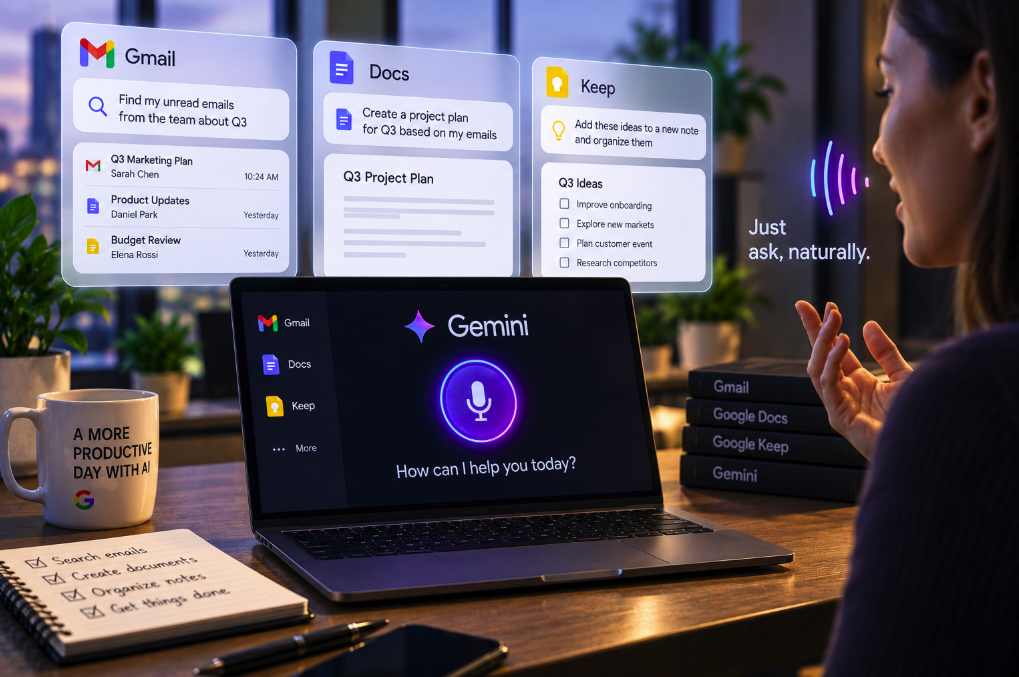
Google is turning some of the most familiar actions in Workspace into conversations. Instead of typing a Gmail search, starting a document from a blank page or manually reorganizing a stream of notes, users can now speak to Gemini and ask it to find, create and structure information across Gmail, Docs and Keep.
The new Gmail Live, Docs Live and Keep Live experiences are part of a broader shift in Google Workspace from prompt-based assistance toward real-time voice interaction. In its September 3 announcement, Google says the features use Gemini Audio models and a Gemini 3.5 Live integration to let users work conversationally. The significance is larger than adding dictation to three apps: Google is beginning to replace traditional search boxes, menus and document workflows with an AI layer that can interpret a spoken objective and act on information stored across a user’s workspace.
Gmail Live turns inbox search into question answering
Gmail Live is the clearest example of the change. Conventional email search requires users to remember some combination of sender, subject, date or keyword. With the new voice interface, Google says users can ask natural questions such as what gate their flight leaves from or what is happening at their child’s school during the week. Gmail Live searches the inbox and returns the relevant information.
That moves Gmail from document retrieval toward answer retrieval. The user does not necessarily need to locate the message containing the information, open the thread and scan it manually. The AI can interpret the question, find relevant email context and synthesize the detail being requested.
The distinction resembles what is happening in web search. Traditional search interfaces return documents that may contain an answer; generative interfaces increasingly attempt to return the answer itself. Gmail Live applies the same model to a private corpus where the search engine is not the public web but a person’s inbox.
Private search may be one of conversational AI’s strongest use cases
Email is particularly suited to conversational retrieval because inboxes accumulate enormous amounts of semi-structured information. Receipts, confirmations, itineraries, project updates, invitations and personal correspondence are searchable, but users often remember the meaning of an email more clearly than the exact words it contained.
A natural-language system can potentially bridge that gap. Someone may remember that a colleague sent revised launch timing without remembering the subject line or whether the information arrived yesterday or last week. The useful query is therefore semantic: “When did the team say the launch moved to?” rather than a carefully constructed string of keywords.
Google had already been connecting Gemini with Workspace data. In a 2025 Workspace update, the company described Gemini answering questions based on Gmail, Drive, Calendar, Keep and Tasks. Gmail Live changes the interaction model by making that retrieval conversational and voice-first inside the workflow itself.
Docs Live treats speech as the beginning of a document
Docs Live extends the same idea from retrieval to creation. Google describes the feature as a hands-free thought partner and co-writer. A user can talk through an idea in real time while Gemini organizes the material, creates structure and helps turn an unfiltered stream of thought into a first draft.
This is meaningfully different from conventional voice typing. Dictation converts speech into text. Docs Live is designed to interpret the speech as source material for a document. It can reorganize ideas rather than preserving every sentence in the order it was spoken, and Google says it can help outline the document and refine its tone.
With permission, Docs Live can also pull relevant context from Gmail, Drive, Chat and the broader web. That gives the voice interaction a retrieval layer: a user can discuss what they want to produce while Gemini finds supporting information and incorporates it into the drafting process.
Google first previewed these capabilities at I/O and in its May Workspace announcements. The September rollout turns that preview into an available product for eligible subscribers.
Keep Live makes the “brain dump” an AI workflow
Keep Live addresses a different productivity problem: capturing thoughts quickly without requiring the user to organize them first. Google Keep has long been useful precisely because creating a note requires little friction. The new feature tries to remove even more structure from the input stage.
Users can speak freely while Keep Live interprets the stream of consciousness and turns it into organized notes or lists. A rambling set of reminders about groceries, travel arrangements and errands can therefore become a structured set of actions rather than a transcript that still needs manual cleanup.
This is another important distinction between voice AI and dictation. The output is not intended to be a faithful record of every spoken word. The system is expected to infer structure from meaning. That makes the experience more useful when it works, but it also makes review important because an AI-generated organization can omit, combine or reinterpret details differently from the speaker’s intention.
Voice is becoming an interface for tools, not just an input method
Voice computing has existed for years, but most implementations have been constrained by command syntax. Users learned phrases that mapped to specific actions: set a timer, call a contact or dictate a message. Generative AI changes that model because the system can interpret a much wider range of language and maintain context across a conversation.
Gmail Live, Docs Live and Keep Live demonstrate the difference. The user is not simply speaking text that would otherwise be typed. They are expressing an objective: find the information, build the document or organize the thoughts. Gemini translates the request into operations on the underlying application.
That makes voice a potential abstraction layer over software interfaces. If the model can reliably understand intent and has permission to access the necessary tools, the user may need to know less about where information lives or which sequence of interface actions produces the desired result.
Workspace search is becoming less about knowing where things are
This shift could change the role of information architecture for individual users. Traditional productivity software rewards organization. People create folders, labels and naming conventions partly so they can retrieve information later. AI retrieval can reduce the penalty for imperfect organization by searching semantically across the information itself.
That does not eliminate the value of clean structure, particularly in shared business environments where governance and permissions matter. But it changes the retrieval burden. A user may no longer need to remember whether a detail lives in an email, a Drive file or a chat thread if the assistant can access those sources and find the relevant context.
Docs Live makes that convergence explicit because Google says the feature can draw from Gmail, Drive, Chat and the web while helping create a document. The destination remains Docs, but the information required to build the document can come from several services without the user manually moving between them.
Permissions and accuracy become more important as the interface becomes easier
The convenience of conversational access also raises familiar AI concerns in a more practical form. When a system can search private email and workplace files, users need clarity about what information it can access, when it is using that information and whether a synthesized answer accurately represents the source.
Google emphasizes permission when describing Docs Live’s ability to retrieve context from other services. That principle will become increasingly important as AI assistants move from answering questions to performing work across multiple applications. Access controls designed for individual files and services must continue to apply when the user interacts through a single conversational layer.
Accuracy matters as well. An inbox search that returns the wrong flight gate or a note organizer that drops an important task is more consequential than a minor transcription mistake. The easier the interface becomes, the easier it may also become for users to accept a synthesized answer without checking the underlying source. For important decisions, the ability to inspect where information came from remains essential.
The rollout starts with Google AI subscribers
Google says the new conversational features are rolling out during the week of September 3. Gmail Live and Keep Live are available to Google AI Plus, Pro and Ultra subscribers, while Docs Live is available to Pro and Ultra subscribers. The company says all three capabilities are coming soon to Google Workspace business customers.
The tiering reflects the broader pattern of advanced Gemini capabilities appearing first in paid AI plans before expanding more widely. It also gives Google a controlled environment in which to observe how people use continuous voice interaction for real productivity tasks rather than isolated assistant commands.
Business adoption could be particularly significant because enterprise users have larger information repositories and more repetitive retrieval tasks. At the same time, organizations will demand stronger controls around permissions, data handling, auditability and the reliability of actions taken from spoken instructions.
Google is making conversation the common interface across Workspace
The broader strategy is increasingly visible. Gemini has already been embedded across Gmail, Docs, Sheets, Slides, Drive and other Workspace products. The side-panel era taught users to type requests to an assistant next to their work. Gmail Live, Docs Live and Keep Live push the interaction one step further by allowing the conversation itself to become the workflow.
For Gmail, the change is from searching for messages to asking for information. For Docs, it is from dictating sentences to discussing what a document should become. For Keep, it is from recording a thought to asking AI to impose useful structure on it. Those are small interface changes with a larger conceptual consequence: the application is increasingly responsible for understanding intent, not merely receiving input.
If this model works reliably, the future of productivity search may involve much less searching in the conventional sense. Users will not always need to formulate keywords, remember filenames or navigate through folders. They will describe what they need in ordinary language and expect the system to locate the evidence, synthesize the answer and help create the next artifact.
That is what makes Google’s new voice features more important than another set of Gemini shortcuts. Workspace is becoming conversational at the level of retrieval and creation. The search box, blank document and unorganized note are not disappearing yet, but Google is increasingly offering the same alternative to all three: just talk to the AI.