
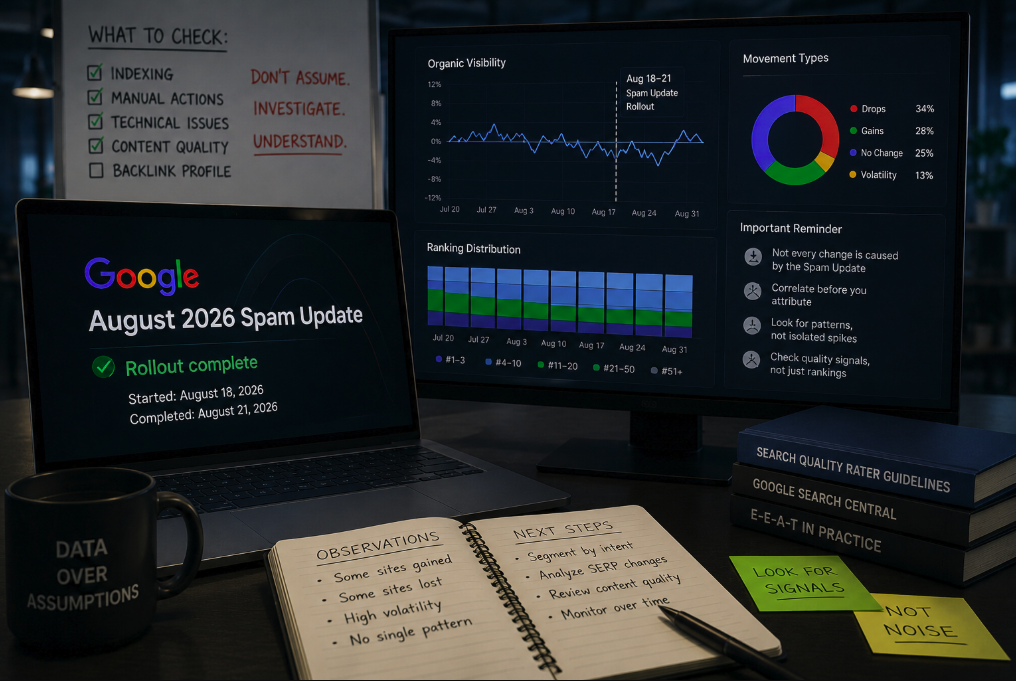
Google’s August 2026 spam update is finished. The rollout began on August 18 and was marked complete on August 21 after roughly two days and 16 hours, making it a relatively short deployment by the standards of some previous Google updates. It applied globally and across all languages. Now comes the part that is usually much harder than watching a status dashboard: determining what, if anything, the update actually changed for individual sites.
The temptation after every announced Google update is to build a clean narrative around whatever happened to traffic during the same week. A site drops 30%, the spam update must have hit it. Another site gains visibility, it must have been rewarded. A ranking tracker lights up, and the movement becomes evidence of a new algorithmic preference. The problem is that the available evidence does not justify that level of certainty.
Google did not announce a new spam policy alongside the August update, nor did it publish a detailed technical explanation of a newly targeted tactic. The company described it as a normal spam update affecting all languages and locations. Google’s standing documentation says these updates represent notable improvements to automated systems that detect search spam. That gives site owners a useful category of change, but not a list of new ranking factors that can be reverse-engineered from a few days of charts.
What Google actually confirmed
The factual baseline is unusually small. Google released the August 2026 spam update on August 18 at approximately 12:30 p.m. Eastern time and completed it early on August 21. Search Engine Journal calculated the rollout at about two days and 16 hours. It was the third announced spam update of 2026, following updates in March and June.
Google said the update was global and applied to all languages. Reporting from Search Engine Roundtable also noted that this was not specifically a link-spam update and did not target the site reputation abuse policy. Google did not disclose the percentage of queries affected or provide a list of particular spam techniques that became more heavily weighted.
That last point is important because “spam update” can easily be interpreted as a new rule. It is usually better understood as a change in enforcement or detection. Google’s automated anti-spam systems operate continuously, including its AI-based SpamBrain system. Announced spam updates occur when Google makes broader or more notable improvements to those systems.
In other words, August did not necessarily redefine what Google considers spam. It changed some part of Google’s ability to identify or respond to behavior already covered by its policies.
The rollout dates matter more than they seem
One of the first mistakes in post-update analysis is stretching the update backward to explain earlier volatility. Ranking movement was already being reported before August 18. Search Engine Roundtable documented noticeable volatility around August 12 and 13, several days before Google announced the spam update.
Google’s John Mueller explicitly pushed back on the idea that the announced update had secretly begun earlier. He said Google does not roll these updates out before announcing them and tries to make the announcement as close as possible to the actual start. That means a site whose major decline began on August 12 should not simply relabel that decline as an August spam-update hit because the dates happen to be close.
This sounds obvious, but SEO analysis frequently works backward from a known event. Once an update is announced, every nearby graph starts to look like evidence of it. The correct sequence is the opposite: establish when the movement began, compare it with the confirmed rollout window and then investigate whether the pattern is consistent with an algorithmic change.
The same caution applies after August 21. Search Engine Roundtable reported continued search-ranking volatility on August 26, several days after Google had marked the spam rollout complete. Post-rollout volatility can have many explanations, including the continuing effects of changed rankings, normal search-system adjustments, unrelated algorithmic systems, competitor changes and ordinary measurement noise. The presence of volatility does not prove that the spam update was still rolling out.
A ranking drop is not a diagnosis
Google algorithm updates are events. A traffic decline is an observation. Confusing the two creates bad SEO decisions.
If organic clicks fall during an update, the first useful question is not “What did Google punish?” but “What changed?” That requires segmenting the data. Did impressions fall, or only clicks? Did the loss affect branded or non-branded queries? Was it concentrated in one directory, content type, country, device category or search intent? Did average positions change for queries that previously drove traffic, or did the query mix itself change?
Search Console is much more useful here when treated as an investigative dataset rather than a single traffic graph. A genuine ranking reclassification often leaves patterns. Groups of related pages may move together. A particular type of query may lose visibility. Pages competing for similar intent may swap positions. A sitewide chart can hide all of those details.
There are also non-algorithmic explanations that should be eliminated before rewriting an entire content strategy. Indexing problems, canonical changes, robots directives, server failures, rendering issues, accidental noindex tags, migrations and analytics changes can all create dramatic graphs. Search demand can change as well. A traffic decline is not automatically a ranking decline, and a ranking decline is not automatically a spam classification.
Do not confuse correlation with a spam finding
The word “spam” makes update analysis unusually emotional. A site owner who loses rankings during a core update may conclude that Google has reassessed quality. A site owner who loses rankings during a spam update may feel that Google has accused the site of wrongdoing. Automated ranking systems are not that simple.
Google’s spam systems operate at enormous scale, and an announced improvement can alter how existing signals are interpreted without producing a human-readable explanation for every affected URL. There is no Search Console message saying that a particular organic decline was caused by the August spam update unless a separate manual action exists. Algorithmic spam detection and manual actions are different mechanisms.
This means that timing can support a hypothesis, but it cannot establish one. A sharp sitewide loss beginning squarely inside the August 18–21 window is more suggestive than a gradual decline that began weeks earlier. A loss concentrated in pages built with aggressive scaled-content tactics may strengthen the hypothesis further. But even then, the practical response should be based on identifiable site problems rather than an attempt to guess a hidden algorithmic switch.
What should site owners actually inspect?
The most productive post-update work begins with Google’s existing spam policies, because Google did not announce a new set of rules for August. That means reviewing the site for practices Google already describes as problematic: scaled content created primarily to manipulate rankings, cloaking, doorway abuse, scraped content, misleading functionality, hacked content and other attempts to manufacture search visibility without corresponding user value.
The review should also distinguish between an isolated weak page and a systemic production pattern. Modern websites can generate thousands or millions of URLs through templates, internal search, tags, programmatic pages, AI-assisted publishing and database combinations. A site may contain excellent editorial work while simultaneously exposing large sections whose main reason for existing is search acquisition. Spam systems do not need to judge every page identically for that architecture to become relevant.
AI-generated content deserves the same evidence-based treatment. Google’s policies do not define content as spam simply because AI helped produce it. The problem is scaled content abuse: generating large amounts of material primarily to manipulate search rankings rather than help users. A publisher responding to an August decline by deleting every AI-assisted article could therefore be fixing the wrong problem. The useful question is whether the publishing system produces distinctive, accurate and genuinely useful pages, regardless of which tools helped create them.
Recovery is not necessarily synchronized with the next update
Another reason not to make frantic changes is that recovery from spam systems can take time. Google’s guidance says sites that make changes may improve after its automated systems learn over a period of months that they comply with spam policies. Spam systems also receive periodic refreshes.
That makes the familiar SEO pattern of changing dozens of variables immediately after a ranking loss particularly dangerous. If a site rewrites templates, removes pages, changes internal links, alters metadata and restructures navigation simultaneously, any later recovery becomes almost impossible to diagnose. The team knows something changed, but not which intervention mattered.
A better response is to document the affected segments, identify the strongest plausible causes, prioritize changes that would improve the site even if no algorithm update had occurred and monitor the results over a meaningful period. If a page exists only because it can rank for a keyword permutation, that is a strategic weakness regardless of whether August 2026 specifically detected it.
Winners can be more informative than losers
SEO analysis often focuses almost entirely on sites that declined. The pages that replaced them can provide better evidence. If a site loses a group of queries, inspect what now ranks in those positions. Did Google replace thin aggregators with original sources? Did ecommerce category pages replace informational articles? Did forums or first-hand discussions gain? Did another publisher with substantially deeper coverage move upward?
The answer may reveal that the movement is not best explained as spam enforcement at all. Search results change because Google is constantly balancing relevance, quality, freshness, intent and many other systems. A competitor can gain because it became more relevant, not because the losing page was classified as spam.
This is particularly important in 2026, when search-result pages themselves continue to change. AI features, altered result layouts, video and discussion modules, shopping experiences and other SERP elements can affect click-through rates independently of traditional organic positions. A site can lose clicks without losing its nominal ranking because the search interface around that ranking changed.
The hard part starts after “rollout complete”
Google’s status dashboard gives the SEO industry something everyone wants: a clean start time and a clean end time. Real diagnosis is messier. Search is a complex environment in which many systems operate simultaneously, competitors constantly change and user demand moves independently of algorithms.
The August 2026 spam update gives us a narrow set of facts. It ran from August 18 through August 21. It was global and multilingual. Google described it as an improvement to its spam-detection systems and did not announce a new spam policy with the rollout. Earlier August volatility was not the update, according to Google, and volatility has also been observed after the rollout ended.
Everything beyond that requires evidence. Some sites will almost certainly discover patterns consistent with stronger spam detection. Others will discover technical problems, shifting search intent, stronger competitors or changes that began before the update existed. Many will never receive a definitive explanation.
That uncertainty is frustrating, but it is also the reason disciplined SEO analysis matters. The useful question is not whether a graph moved near an algorithm update. It is whether the available data can explain which pages moved, which queries changed, who replaced them and what those patterns say about the site.
The rollout is over. The update itself was the easy part. Understanding what changed—and resisting the urge to invent certainty where Google has provided very little—is the work that comes next.