
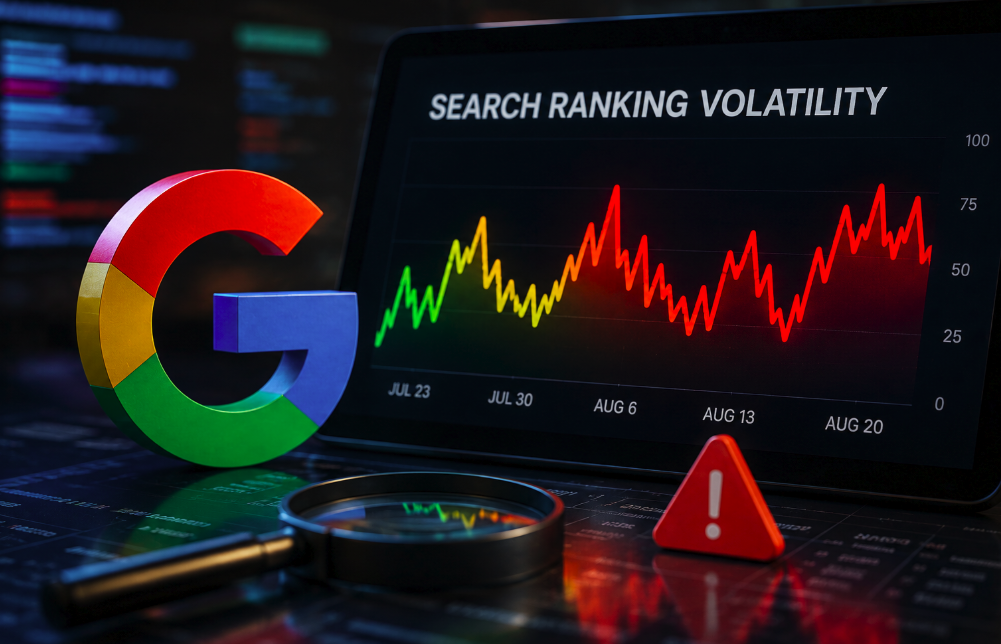
Google’s August 2026 spam update officially ended on August 21, but the search results have not exactly returned to normal. Ranking trackers and SEO community reports are still showing significant movement several days after the confirmed rollout finished, raising an obvious question: is Google pushing another ranking change, or are we simply watching the aftershocks of an unusually volatile month?
That uncertainty is the central point in new reporting from Barry Schwartz at Search Engine Roundtable. Schwartz notes that Google’s spam update began on August 18 and concluded on August 21, yet both third-party tracking tools and discussion among site owners have continued to register substantial volatility since then. The important caveat is that Google has not announced another ranking update. What the industry can observe is movement; what it cannot yet establish is the cause.
The volatility did not stop with the spam update
Search Engine Roundtable points to a broad collection of tracking platforms, including AccuRanker, Sistrix, Semrush, Similarweb, Mozcast, DataForSEO, Advanced Web Ranking and others. While these tools use different datasets and methodologies, several are detecting continued turbulence in Google’s search results after August 21.
The SEO community is reporting something similar. Schwartz cites discussions from site owners seeing major ranking reshuffles in niches that had previously been relatively stable, changes in Googlebot activity, sharp traffic movements and, in some cases, increased appearances in AI Overviews. These reports are anecdotal, but when community chatter and multiple independent tracking systems move at roughly the same time, they are difficult to ignore.
What they do not prove is that Google launched another update. Schwartz describes the current situation as feeling like an unannounced ranking change, but that remains an interpretation rather than a confirmed event.
August was already unusually turbulent
The current movement also needs to be understood in the context of a volatile summer. Search Engine Roundtable documented unconfirmed ranking fluctuations around August 13, August 5 and the first few days of August, following additional volatility in July. The confirmed August spam update therefore arrived in an environment where rankings were already moving frequently.
This makes post-update diagnosis particularly difficult. A site that lost visibility on August 19 has a reasonable basis for investigating whether the spam rollout played a role. A site whose decline began on August 13 does not. Likewise, a major change beginning on August 25 should not automatically be attributed to a rollout Google says finished four days earlier.
The dates matter because SEO analysis has a tendency to work backward from the nearest named update. Once Google confirms an algorithm event, every nearby traffic graph suddenly looks like evidence of it. That can lead publishers to make sweeping content or technical changes based on a causal relationship that has never actually been established.
Tracking tools are signals, not explanations
Volatility tools are useful because they can show when search results are changing more than usual. They cannot tell us why those changes occurred.
A high volatility score may reflect a broad algorithmic adjustment, but it can also capture movement across different Google systems, changes in search features, shifts affecting particular industries or the accumulated consequences of many smaller changes. Google constantly modifies Search without announcing every adjustment publicly.
That distinction is particularly important after a named update. Continued volatility does not necessarily mean the previous update is secretly still rolling out, nor does it prove that another major update has begun.
What publishers should do now
For publishers and SEO teams, the sensible response is observation rather than panic. Compare the timing of any traffic or ranking change with the confirmed August 18–21 rollout window. Segment Search Console data by page type, query group, country and device rather than relying on a single sitewide traffic graph. Look at which competitors replaced lost rankings and whether the change affects one content category or the entire domain.
Technical checks remain important as well. Indexing problems, canonical errors, server issues and accidental changes to robots directives can produce dramatic visibility losses that happen to coincide with algorithm volatility.
Most importantly, avoid changing dozens of variables simultaneously. If Google is still recalibrating search results, a large reactive overhaul can make later analysis almost impossible. The goal should be to identify persistent patterns before deciding that a particular content strategy, technical implementation or editorial model needs to be rebuilt.
Uncertainty is part of modern SEO
The continuing August volatility is another reminder that Google Search does not move only when Google announces an update. Confirmed rollouts give the industry useful timestamps, but they do not explain every ranking movement around them.
For now, we know that the August spam update ended on August 21. We also know that third-party trackers and SEO practitioners continued to observe substantial ranking fluctuations afterward. We do not know whether those movements represent another unannounced Google change, lingering effects across the search ecosystem or several unrelated adjustments happening close together.
That may be frustrating, but it is a better conclusion than inventing certainty. In SEO, volatility is observable. Attribution is the hard part.
Source: Barry Schwartz, Search Engine Roundtable, “Google Search Ranking Volatility Continues Post Spam Update,” published August 26, 2026.