
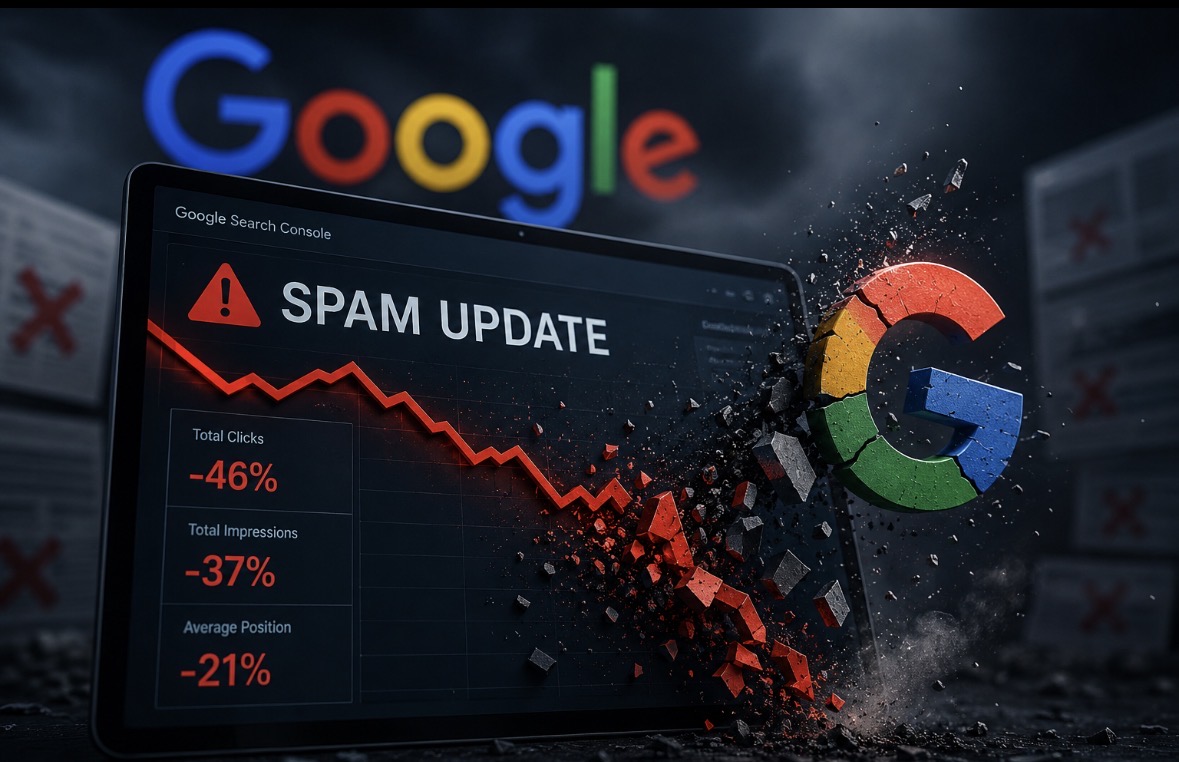
Google’s August 2026 spam update looked modest on paper. It appeared on the company’s Search Status Dashboard as a short global rollout affecting ranking, beginning on August 18 and ending on August 21 after roughly two days and sixteen hours. There was no major companion blog post, no new category of spam policy announced with the rollout, and little in Google’s own messaging to suggest a dramatic event. But the early ranking data now paints a more disruptive picture.
According to data shared by SE Ranking and reported by Search Engine Land, Google’s August spam update produced an 82% increase in top-10 URLs dropping out of the top 100 compared with a period when no confirmed Google ranking update was running. During the update window, 16.71% of URLs that had ranked in the top 10 fell beyond position 100 for the same keyword, compared with 9.2% in a comparable July baseline. That kind of movement is not ordinary turbulence for publishers, merchants, affiliates or service businesses that depend on search visibility.
The crucial detail is the scale of the drop. Normal ranking volatility can move a page from third to seventh, or from the bottom of page one to page two. A fall from the top 10 to outside the tracked top 100 is something else entirely. It can mean a page has effectively disappeared from commercial discovery for the affected query, even if it has not been removed from Google’s index. Search Engine Land noted that SE Ranking’s dataset covered 100,000 U.S. organic Google keywords across 20 industries, comparing rankings immediately before and after the spam update with a quieter July control period.
That does not prove that every affected page was spam. The data does not identify individual domains, content patterns or specific tactics that were disproportionately hit, and SE Ranking did not conduct a URL-level or domain-level diagnosis of the losers and replacements. Still, it does show that the update’s impact was broader and harsher than Google’s restrained announcement implied. Volatility appeared across every niche SE Ranking tracked, with top-10 volatility ranging from real estate at the lower end to fashion and beauty at the higher end.
The update also arrived in a year when Google has been tightening its definition of search manipulation. In May, Google clarified that its spam policies apply not only to traditional ranking manipulation but also to attempts to manipulate generative AI responses in Search, including AI Overviews and AI Mode. That policy shift, covered by The Verge, put so-called generative engine optimization tactics under the same anti-spam umbrella as more familiar attempts to game organic rankings. Google has not said that the August spam update specifically targeted AI-search manipulation, but the timing matters because site owners are now operating under a broader interpretation of what search spam can mean.
For publishers and SEO teams, the practical takeaway is to avoid treating the August rollout as a minor housekeeping update simply because it was brief. A fast rollout can still be severe, especially when automated systems reassess trust signals, scaled-content patterns, expired-domain strategies, doorway structures, thin affiliate pages or other signals that Google’s spam policies already cover. The absence of a new policy announcement does not mean the update was harmless; it may simply mean Google was enforcing existing rules more aggressively or with a refreshed model.
The timing is also complicated by Google’s separate policy tensions in Europe. Days after the August spam update completed, Reuters reported that Google changed the way its site reputation abuse policy would apply in the European Economic Area after publisher complaints and EU scrutiny under the Digital Markets Act. That issue concerns manual demotions tied to third-party content on reputable sites, rather than the August automated spam update itself. Even so, it reinforces a larger reality: Google’s anti-spam enforcement is no longer just an SEO matter. It now sits at the intersection of publisher economics, AI search, competition policy and the future shape of web discovery.
Site owners trying to understand losses from the August update should begin with a careful comparison of Search Console data before August 18 and after August 21, rather than reacting to mid-rollout noise. Pages that suffered major losses should be reviewed against Google’s documented spam policies, with particular attention to scaled content, third-party content arrangements, manipulative internal linking, thin pages built mainly for search traffic, and any attempt to influence AI-generated search answers through hidden or deceptive signals. Quick cosmetic edits are unlikely to be enough if the underlying issue is sitewide trust or a repeatable content-production pattern.
The more difficult lesson is that recovery may not be immediate. Search Engine Journal, citing Google’s documentation, noted that sites affected by spam systems may need time to regain visibility because Google’s automated systems have to observe sustained compliance before ranking signals improve. That makes panic-driven fixes risky. Removing useful pages, mass noindexing sections or rewriting everything without a diagnosis can make it harder to isolate the actual cause of a decline.
Google may have described the August 2026 spam update in routine dashboard language, but the ranking data suggests the market felt something sharper. Whether the update primarily cleaned up spam, misread some legitimate pages or accelerated Google’s broader campaign against AI-era manipulation, its effect was clear: more top-ranking URLs vanished from visible search results than a normal baseline would lead publishers to expect. For anyone relying on organic traffic, the August update deserves a full postmortem, not a footnote.