
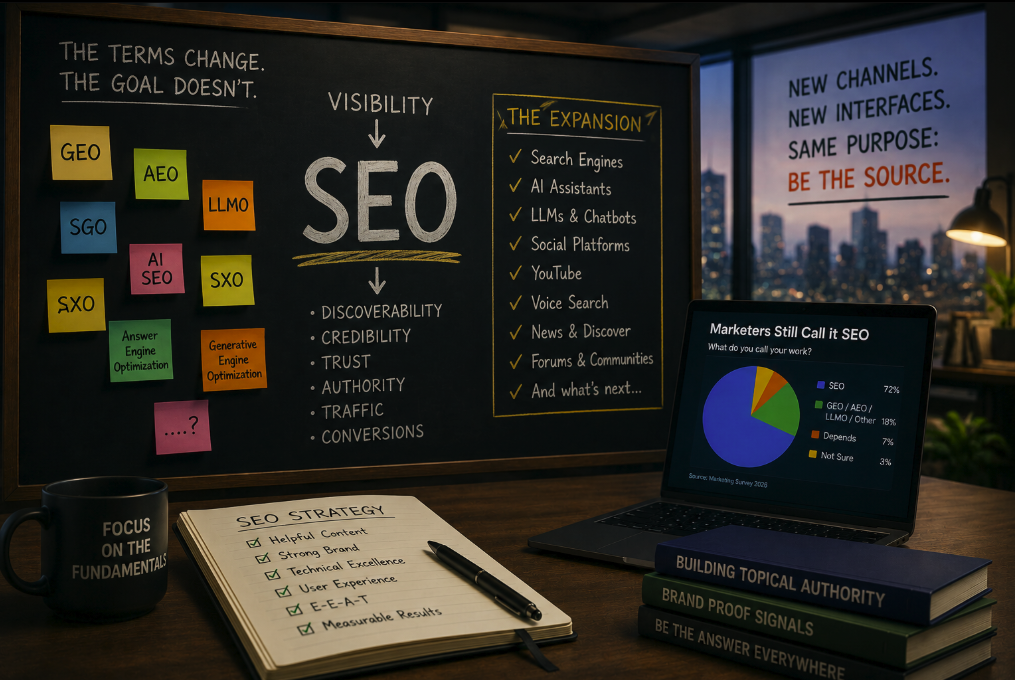
SEO has supposedly been replaced several times already. Voice search was going to redefine it. Social discovery was going to bypass it. Zero-click search was going to make rankings irrelevant. Then generative AI arrived, and the industry produced an entire alphabet of possible successors: GEO, AEO, LLMO, AIO and various combinations of “AI search optimization.”
Something interesting is happening, however. The work is changing rapidly, but the name may not be.
New research published this week by Fractl and Search Engine Land surveyed 343 U.S. marketing decision-makers about how they describe, fund and evaluate visibility in AI search. Despite two years of intense debate around Generative Engine Optimization and its competing acronyms, 81% of respondents said they still refer to their internal AI-search visibility strategy as SEO. When looking online for outside help, 46% said they would search for “AI search optimization,” while another 24% would simply search for “SEO.”
That does not mean GEO is imaginary, or that optimizing for ChatGPT is identical to ranking a page in Google. It suggests something more interesting: perhaps the market does not need a new name every time the interface through which people discover information changes. Perhaps SEO is becoming a broader discipline than its literal acronym implies.
Search stopped meaning “search engine” a while ago
The awkwardness begins with the name itself. Search Engine Optimization sounds like a very specific technical activity: optimize web pages so a search engine ranks them. That description made sense when the dominant user journey was typing keywords into Google, scanning ten blue links and clicking one.
Discovery in 2026 is considerably messier. A person might ask ChatGPT for product recommendations, use Google AI Mode to research a complex purchase, search Reddit for first-hand experiences, watch a YouTube comparison, ask Gemini to summarize options and eventually type a branded query into Google. The information journey crosses search engines, large language models, social platforms, communities and generated answers.
Marketers still need to solve essentially the same commercial problem across all of them: when someone expresses an intent relevant to the business, how does the brand become part of the answer?
Traditional SEO solved that problem by earning rankings and clicks. AI search changes the visible outcome. A brand may now want to be mentioned, cited, recommended or used as a source inside a synthesized response even when no conventional ranking is shown. Those are meaningful differences. But they may be differences inside the discipline rather than evidence that an entirely separate discipline has replaced it.
The acronym explosion says as much about marketing as technology
GEO—Generative Engine Optimization—has become the strongest challenger to SEO as the preferred term for AI visibility. AEO emphasizes answer engines. LLMO emphasizes large language models. Other labels attempt to distinguish generative search from conventional search or to create a broader umbrella around AI discovery.
There are reasonable conceptual arguments for each. The problem is that the boundaries collapse quickly in practice. Google itself now combines traditional rankings, AI Overviews, AI Mode, news surfaces, video, shopping results and personalized source preferences inside the same search ecosystem. Is optimizing a publisher so that Google can rank its article SEO, while optimizing the same article so Google can cite it in an AI Overview GEO? What happens when the AI Overview citation itself influences a later branded search?
The taxonomy becomes even less stable outside Google. A piece of original research can earn backlinks that improve conventional organic authority, get discussed on Reddit, become a source for journalists, appear in an AI assistant’s retrieval results and increase branded searches. Which optimization discipline owns the outcome?
Often, all of them do. Or, more usefully, none of the acronyms describes the complete system.
The buyers are telling the industry something
The Fractl research is useful because it examines marketing decision-makers rather than only SEO practitioners debating terminology among themselves. The results show a gap between the language used to demonstrate expertise and the language organizations use to describe the problem.
C-suite marketers in the survey used GEO and AEO substantially more often than individual contributors. GEO was used by 28% of C-suite respondents compared with 9% of individual contributors; AEO showed a similar gap, at 17% versus 3%. That suggests the new vocabulary is certainly reaching leadership teams. Yet SEO remains overwhelmingly embedded as the practical category.
Even more revealing is what marketers dislike. Thirty-six percent of respondents identified excessive buzzword usage without a clear explanation of what each term means as their biggest red flag when evaluating a vendor. In a market where agencies and software companies have strong incentives to define a new category, buyers appear to be asking for the opposite: explain what the work does.
That should not be surprising. A marketing director does not fundamentally need GEO. The director needs the company to appear when customers ask AI systems about its category. Whether the invoice calls that SEO, GEO or AI visibility is secondary to whether the strategy produces measurable results.
The work really is changing
Rejecting acronym inflation should not become an excuse for pretending nothing changed. There are genuine differences between optimizing for a ranked search result and optimizing for an AI-generated answer.
Traditional SEO has relatively familiar measurement primitives: impressions, rankings, clicks, click-through rates and conversions. AI answers are probabilistic. The same prompt can produce different sources across repeated runs. Platforms reveal little about prompt volumes, and citations can change frequently. Visibility may matter even when it generates no direct referral because a model mentioned a brand as part of a recommendation.
AI systems also draw authority from places that do not map neatly onto classic link-based SEO. Brand mentions across communities, reviews, forums, YouTube, editorial publications and other third-party sources can influence the information environment from which models retrieve or synthesize answers. A company can therefore have excellent technical SEO and still be largely absent from the conversations that shape AI recommendations.
The content objective changes too. Ranking a document is not identical to making information easy for a model to extract, understand and cite. Clear answers, strong entity relationships, original data, precise sourcing and passages that remain meaningful when separated from the surrounding article can become more valuable in generative interfaces.
Those differences deserve dedicated methods, tools and metrics. They just do not necessarily require us to declare SEO dead and replace the sign above the department.
SEO has always absorbed new layers
The strongest argument for keeping the name is historical. SEO has never remained a fixed set of techniques.
Early SEO could revolve heavily around keywords, directories and links. Over time, the discipline absorbed technical performance, structured data, mobile usability, JavaScript rendering, internationalization, entity understanding, content quality, digital PR, user intent, ecommerce architecture, local search and much more. An SEO specialist in 2026 performs work that would have been almost unrecognizable to an SEO specialist in 2006, yet the industry did not create a permanent new profession every time Google changed how results worked.
The name survived because its practical meaning expanded. SEO became shorthand for earning organic discoverability, even when the actual work extended far beyond editing a page for a keyword.
AI may simply be the largest expansion yet.
If users increasingly “search” by having conversations with models, then the object being optimized is no longer strictly a search engine results page. It is the broader information ecosystem through which machines decide what entities, sources and claims are relevant enough to surface. That requires skills traditionally associated with SEO, content strategy, public relations, brand marketing, data analysis and technical architecture to converge.
Maybe the future SEO metric is share of answer
The more important transformation may happen in measurement rather than naming. SEO historically optimized toward a scarce piece of real estate: a high organic position. AI interfaces make the scarce asset presence inside an answer.
That suggests a broader visibility model. Teams still need rankings, organic clicks and conversions, because Google remains enormous and traditional search results still matter. But they increasingly also need to understand citation frequency, brand mentions, recommendation share, sentiment, source overlap and how often competitors appear for commercially meaningful prompts.
EMARKETER has argued that AI search requires better visibility metrics rather than simply more traffic metrics. That is particularly important because AI referral traffic remains small for many publishers even when their content is frequently cited. A source can influence a purchase decision without receiving the click that traditional analytics would use to assign value.
In that world, “SEO traffic” becomes too narrow as the definition of success, even if SEO remains a perfectly useful name for the team doing the work.
Brand is becoming part of technical discoverability
One of the most consequential changes in AI search is that brand and search performance are becoming harder to separate. Traditional SEO often treated brand demand as something another marketing team created. SEO captured that demand when it reached Google.
Generative systems complicate the division. If an assistant is asked to recommend the best software for a particular job, it may draw from product pages, editorial reviews, forums, documentation, community discussions and general web consensus. Being technically crawlable is necessary, but it is not enough. The brand must exist convincingly in the information landscape.
That makes digital PR, original research, community presence and authoritative third-party mentions relevant to what an SEO team might now call visibility. It also explains why some “GEO tactics” sound suspiciously like good marketing. Building a brand that credible people discuss in credible places has always been valuable. AI systems have simply created another mechanism through which that distributed reputation can be converted into discovery.
The danger is selling novelty instead of understanding
Every technological transition creates a commercial opportunity for specialists who understand it early. It also creates an opportunity to repackage familiar practices under unfamiliar terminology and charge for the apparent complexity.
The current AI-search market contains both. There is real new work to learn: prompt-set measurement, citation tracking, model-specific retrieval behavior, AI crawler controls, answer visibility and new forms of attribution. Organizations should experiment aggressively because discovery behavior is genuinely shifting.
But the fact that a tactic receives a new acronym does not make it new. Creating genuinely useful content, establishing topical authority, earning credible mentions, making information technically accessible and understanding user intent remain foundational. If a GEO strategy ignores those fundamentals in favor of supposed tricks for making ChatGPT mention a brand, skepticism is warranted.
That skepticism appears in the survey data. Buyers say they want case studies, clear methodologies and credible expertise more than buzzword fluency. That is a healthy response to an industry still discovering what reliably works.
SEO may become the umbrella rather than the legacy channel
There is another possibility that resolves much of the terminology debate. GEO can remain useful as a name for a particular set of AI-search techniques without needing to replace SEO. AEO can describe answer-oriented optimization. LLMO can be useful when discussing model-specific visibility. They can function like technical SEO, local SEO or ecommerce SEO: meaningful subdisciplines inside a larger practice.
The larger practice would no longer mean “make Google rank this webpage.” It would mean something closer to “make this organization discoverable, understandable and credible wherever people use machines to find information.”
That is unquestionably broader than the historical definition of Search Engine Optimization. But language frequently survives its literal origins. We still “dial” phone numbers without rotary dials and “film” video without film. SEO may become another inherited term whose practical meaning outgrows the technology that gave it its name.
The Fractl survey suggests marketers may already be doing exactly that. They know AI search exists. They are allocating an average of 24% of their search or content budgets to AI-search visibility. Two-thirds report using AI tools to research marketing vendors. This is not a population unaware of the technological shift. And yet 81% still call the work SEO.
Maybe they are behind the terminology. Or maybe the industry is ahead of itself in assuming a new channel automatically requires a new profession.
GEO may become a durable term. It may eventually win the acronym competition. But the more interesting possibility is that there will be no winner because SEO will simply continue doing what it has done for more than two decades: absorb the new mechanics of discovery, expand its methods and keep the old name.
The future of SEO may not be less SEO. It may be SEO becoming much bigger than search engines.