
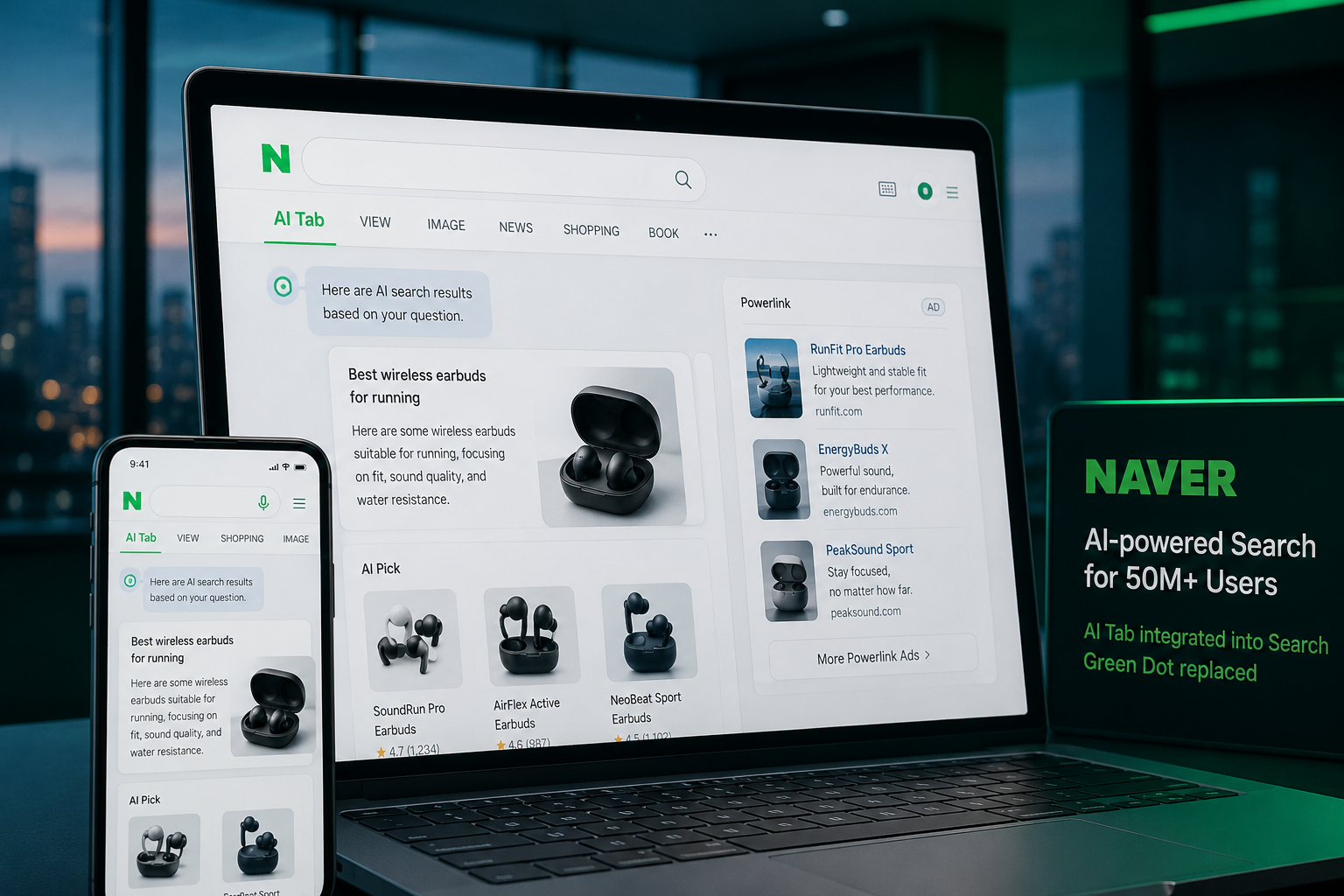
Naver has not announced a major staffing or organizational update today, but the Korean search giant did publish a notable advertising-side change on September 1: a limited redesign test for Powerlink, its core search advertising format. On its advertiser center, Naver said the Powerlink UI experiment will run from September 7 to September 14, 2026, across PC and mobile integrated search, affecting only a portion of traffic. The changes described are modest on paper, focused on the shape and placement of the ad icon, the color of promotional copy and the color of sublinks, with final appearances varying by traffic segment, according to the official Naver Ads notice.
Taken alone, this is not a dramatic product announcement. It looks like the kind of controlled interface test that large search platforms routinely run to measure user response, ad visibility and click behavior without committing to a permanent rollout. But the timing matters because Naver is not merely polishing a legacy search ad unit. It is rebuilding the surrounding search experience around artificial intelligence, and that makes even small visual changes to Powerlink more strategically important than they might first appear.
The broader context is Naver’s AI Tab, which the company formally launched to all users in June after an initial beta period. In that rollout, Naver said AI Tab replaced the long-running Green Dot entry point in the Naver app search bar and became accessible from both mobile and PC search bars. The company framed the product as an agentic, conversational search service designed not only to answer questions but also to connect users to actions such as shopping, place discovery, maps and reservations. Naver said the main page receives an average of about 50 million daily visitors across PC and mobile, putting the AI Tab in front of a mass-market Korean audience rather than a narrow experimental cohort, as detailed in the company’s official launch announcement.
That shift changes the meaning of search advertising on Naver. Powerlink has traditionally occupied the familiar performance-marketing role of appearing against keyword intent, with advertisers paying to reach users at the moment they search. Naver’s own corporate advertising page describes search ads as formats displayed when keywords are searched and suitable for a range of marketing goals, while also highlighting a wider ad ecosystem that includes shopping, place, brand and AI-powered shopping products such as ADVoost. The company’s advertising business is therefore already built around a dense mix of intent, commerce and local discovery, as shown on its advertising product page.
Conversational search introduces a different surface. Instead of typing a query, scanning a results page and choosing between organic links, shopping boxes and sponsored links, users increasingly ask broader questions and expect the platform to synthesize options. In Naver’s case, the AI Tab is explicitly designed to move from discovery to action. During the beta period, the company reported that click-through rates for product and place cards exceeded 20%, and that heavier AI Tab users generated substantially more product and place clicks than one-time users. Those figures should be treated as company-reported launch data, not as independent proof of long-term behavior, but they explain why Naver is testing how advertising, product cards and interface cues should look inside a more AI-led search journey.
The September Powerlink redesign test also follows another recent experiment that connected Powerlink more directly to AI. Naver’s advertiser center said in an August update that it was testing AI-generated summary text for some mobile integrated-search Powerlink ads. Those summaries are generated by Naver’s AI advertising agent from existing advertiser information and the user’s search intent, with an “AI” label shown to distinguish the generated text. Naver said advertisers do not need to apply or change settings for the test, and that ranking and billing remain the same as existing Powerlink operations. The company also noted exclusions for sensitive categories such as medical, finance and health-functional food advertising, according to the Powerlink AI summary test notice.
Read together, the two Powerlink tests suggest that Naver is working on both the presentation layer and the generation layer of search advertising. The UI redesign experiment adjusts how sponsored results are visually signaled inside search. The AI-summary test explores how ad copy can be dynamically interpreted and displayed against intent. Neither announcement says that Naver is overhauling auction mechanics, pricing or advertiser controls. However, both point toward a future in which the ad unit is less static and more closely integrated with Naver’s AI understanding of queries, user context and commercial pathways.
For advertisers, the immediate operational impact appears limited. The September UI test applies only to a portion of traffic, and Naver has not announced a full rollout. Campaign setup, ranking and billing are not described as changing in the September notice. Still, Korean search marketers should monitor performance fluctuations during the test window, particularly on branded and high-intent commercial queries where icon visibility, promotional text color and sublink treatment can influence scanning behavior. Even small interface changes can affect click distribution when they occur near the top of a mature search results page.
The more important lesson is strategic. Naver is treating search as a hybrid of answers, recommendations, commerce and action. That is not identical to Google’s global search evolution, because Naver operates inside a uniquely dense domestic ecosystem spanning search, shopping, maps, payments, content and local services. But the direction is familiar: AI search is becoming the front door, and advertising has to be redesigned to fit a conversational environment without losing clarity, measurement or user trust.
Naver’s September 1 Powerlink notice may therefore be a small update, but it is not an isolated one. The company is testing how sponsored search should look at the same time that AI Tab is replacing a symbolic mobile-era interface and bringing conversational search to tens of millions of users. For advertisers, the message is clear enough: the old keyword-results page is not disappearing overnight, but the space around it is being rebuilt. The brands that understand both Powerlink mechanics and AI-led user journeys will be better positioned as Naver turns search from a list of links into a more guided commercial assistant.