
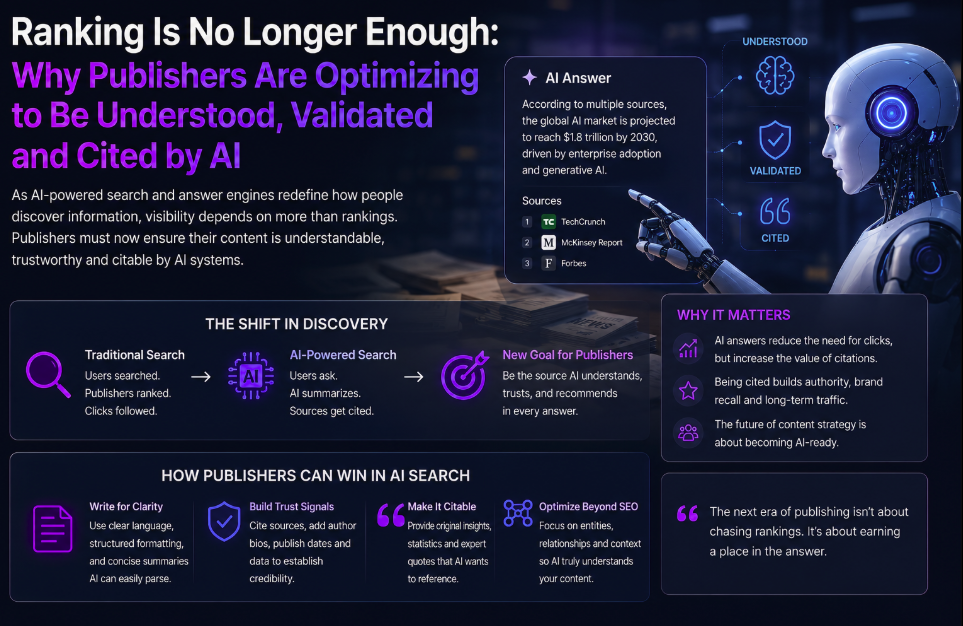
For two decades, publishers could reduce a large part of digital visibility to one practical question: where does the page rank? The answer was never the whole business, but it was a powerful organizing metric. Ranking determined exposure, exposure created clicks, and clicks created the opportunity for subscriptions, advertising, leads or sales.
AI search is breaking that sequence into smaller stages.
A publisher can now be indexed without being retrieved, retrieved without being accurately understood, understood without being selected as supporting evidence, and used as supporting evidence without receiving a visible citation. Conversely, a relatively small publisher can sometimes be discovered and reconstructed by an AI system before conventional search metrics would lead an SEO analyst to describe the site as authoritative.
This is why the emerging publisher strategy around AI search cannot be summarized as “rank higher in ChatGPT.” The optimization target is becoming more layered: make the content discoverable, make its meaning difficult to misinterpret, make important claims independently defensible, and make the source useful enough that an answer system has a reason to expose it to the user.
Ranking still matters. Google explicitly says conventional SEO remains foundational to its generative Search experiences. But ranking is increasingly the entrance requirement rather than a complete description of visibility.
The insurance data shows why presence is not the same as influence
A useful example comes from Somantra’s August 31 audit of 20 Australian insurance brands. The study tracks more than 34,000 consumer conversations across ChatGPT and Google AI Overviews and separates raw brand visibility from what Somantra calls Brand Consideration — whether the AI frames a brand as a likely recommendation rather than merely mentioning it.
Budget Direct leads combined observed visibility, while other brands reveal large gaps between being seen and being favorably positioned. Shannons ranks tenth in raw visibility but first in Somantra’s recommendation-oriented measure for its specialist vehicle segment. ING ranks eleventh for visibility but third for consideration.
The study is vendor-produced observational monitoring, and its consideration metric should not be confused with measured consumer purchases. But the conceptual distinction is important for publishers too. Being present in an AI system’s information environment is not the same as being selected to perform an important role in the final answer.
A publisher can be crawled. It can rank. It can even be retrieved. None of those states guarantees that the system will trust the page enough, understand it precisely enough or find it useful enough to display it as a source.
AI discovery turns one ranking problem into a pipeline
Traditional search also has multiple stages — crawling, indexing, ranking and presentation — but publishers have historically experienced the final ranked result as the dominant competitive surface. Generative systems introduce additional transformations after retrieval.
Google says AI Overviews and AI Mode can use query fan-out, issuing multiple related searches across subtopics and data sources before generating a response. The system can retrieve a broader collection of supporting pages than would appear in a conventional result set, then synthesize those sources into an answer.
ChatGPT Search likewise searches the web when current information is useful and can expose inline citations and a Sources panel linking users to publishers. OpenAI says ranking in ChatGPT Search is based on multiple factors intended to surface reliable and relevant information and that there is no way to guarantee top placement.
For publishers, the practical pipeline therefore looks something like this: discovery, retrieval, interpretation, corroboration, selection, synthesis and attribution. Those are analytical stages rather than an official universal architecture shared by every AI engine, but they describe the new publishing problem more accurately than a single ranking number.
Stage one: the machine has to find you
The AI era has not abolished technical SEO. It has made the cost of ignoring it easier to underestimate.
Google’s documentation for AI features says a page must be indexed and eligible to appear in normal Search with a snippet before it can appear as a supporting link in AI Overviews or AI Mode. There is no special AI schema, no mandatory AI text file and no separate technical shortcut that bypasses ordinary Search eligibility.
OpenAI’s current ChatGPT Search guidance similarly says publishers that want to be available in ChatGPT Search need to allow OAI-Searchbot and permit traffic from OpenAI’s published IP addresses.
This is the unglamorous first layer of AI visibility. If the system cannot access the page, every debate about citation optimization becomes irrelevant.
Crawlability, internal linking, stable URLs, textual accessibility, useful metadata and technically sound pages remain part of the foundation. AI visibility is not a replacement for SEO hygiene.
Stage two: being found is not the same as being understood
This is where generative systems create a problem publishers have historically measured poorly. A search engine can rank a page for a query even when the user must interpret the document themselves. An AI system often has to interpret the document before it can use it.
It needs to identify what the page is about, which claims belong to the publisher, which statements are quotations, who the author is, what entities are being discussed, which date or version applies and how the information relates to other sources.
Ambiguity therefore has a new cost.
A publisher with a vague identity, inconsistent naming, unclear authorship and loosely connected topical coverage can still have individual pages that rank. But an AI system attempting to reconstruct the publisher as an entity may produce an incomplete or incorrect representation.
We saw exactly this in our experiment asking six AI models what Net Content SEO is. ChatGPT, Gemini and Grok correctly identified the project and connected it with AI visibility, retrieval and citations. Perplexity, Gemma and Llama failed to reconstruct the same entity reliably and drifted toward generic interpretations of “content SEO.”
The website had not changed between questions. The difference was in machine recognition and reconstruction.
A small publisher can become machine-legible before it becomes conventionally authoritative
That observation led to a second experiment: can an LLM recognize a small publisher before Google fully trusts it?
The hypothesis is deliberately narrower than the usual claims around GEO. A retrieval-enabled model may be able to find enough connected information to identify a young or small publication even while that site has limited conventional authority, few backlinks and modest non-branded rankings.
This would not prove that AI systems have lower quality standards than Google. The systems are solving different tasks. Google may be deciding whether a document deserves a prominent competitive ranking. An AI assistant may only need to determine whether a newly published page contains a useful fact for one part of a larger answer.
That creates an important opportunity for publishers. Machine recognition may have a different maturity curve from search authority.
It also creates a trap. Recognition can arrive before reliable understanding. An AI system may know the publication exists while misdescribing what it does. That is why mention counting alone is an inadequate visibility metric.
Stage three: the claim has to survive validation
Once a system understands a passage, it still has to decide whether that passage is safe and useful to incorporate into an answer. For factual queries, this often means some form of grounding or corroboration.
Google’s 2026 generative AI optimization guide explicitly describes retrieval-augmented generation as one technique used to improve the accuracy and freshness of AI responses by retrieving relevant pages through its core Search systems. ChatGPT Search similarly encourages users to inspect citations and warns that search results and citations can still be incomplete, outdated or incorrect.
Publishers should not interpret this as evidence of a simple “two sources agree, therefore citation” rule. Neither Google nor OpenAI publishes such a formula. But it does mean that factual content increasingly exists inside an environment where claims can be compared with other documents before or after generation.
This changes the value of evidence.
A page that contains an original statistic with a clear methodology, date, sample and source is easier to verify than a page that says “studies show” without identifying the study. A news article that links to the underlying court filing, company announcement or dataset gives both human readers and retrieval systems a clearer evidence chain. A technical explanation that distinguishes tested facts from interpretation is less likely to be reconstructed as an unsupported certainty.
Validation is not a markup trick. It is an editorial property.
We tested what happens when credible content contains false claims
NetContentSEO’s experiment hiding false claims inside an otherwise accurate technical article illustrates why this layer matters.
The article deliberately mixed correct explanations of LLMs, retrieval, RAG and embeddings with fabricated or technically false claims. One invented a Google standard that did not exist. Another overstated what embeddings preserve.
The exercise was not designed to produce a universal benchmark for model truthfulness. It demonstrated a practical publishing problem: credibility is not uniformly inherited by every sentence on a page. A document can look authoritative overall while containing a claim that should fail verification.
For publishers, this means that the future value of a page may depend increasingly on claim-level reliability. One unsupported statement can be the exact passage a retrieval system encounters. A polished domain and strong ranking cannot make that statement true.
Stage four: useful information still has to win the citation
Even a correct, well-understood page may not be the source an AI system exposes. Several sources can support the same answer. The system has limited context, limited interface space and a reason to avoid showing ten citations for every sentence.
This introduces a selection problem.
Our article “LLM Citations May Be a Compression Problem, Not Just an Authority Problem” explores one possible explanation. Retrieval systems rarely need an entire 2,000-word article. They may work with passages, chunks or other representations. A concise paragraph containing a clear fact can therefore be more convenient for a particular answer than a long article in which the same fact is buried inside several sections.
This remains a hypothesis, not a proven universal citation factor. But it suggests a useful editorial principle: information should survive extraction.
If a paragraph is removed from the page, can a system still tell what entity it refers to? Is the date explicit? Is the statistic attached to its source? Is the conclusion distinguishable from the evidence? Does the passage depend on an ambiguous “it,” “they” or “this study” whose referent lives six paragraphs earlier?
Writing for humans does not require robotic repetition. It does require enough local clarity that important information remains meaningful when retrieved out of its original visual context.
This is why “write for AI” is often the wrong instruction
The phrase encourages publishers to imagine a machine-specific prose style: shorter sentences, excessive headings, repetitive entities, FAQ blocks and formulaic summaries designed to please an invisible model.
Google’s current guidance pushes in the opposite direction. In May, Google published a dedicated resource for generative AI optimization that emphasizes unique, valuable, non-commodity content and says normal SEO best practices remain foundational. Its documentation explicitly says publishers do not need special AI markup or machine-readable files to appear in AI Overviews or AI Mode.
The stronger strategy is therefore not to make prose sound like it was written for a parser. It is to improve the information architecture underneath good editorial writing.
Name things precisely. Attribute claims. Link to primary evidence. State what was observed and what is inferred. Give original research enough methodological detail to be checked. Maintain clear author and publication identities. Update stale information visibly. Avoid publishing twenty interchangeable rewrites of facts already available everywhere else.
These practices help humans too. That is usually a good sign.
Original information becomes more valuable when AI can synthesize commodity information
Generative systems are extremely good at recombining widely available information. That weakens the strategic value of publishing another generic article that says essentially the same thing as hundreds of existing pages.
Google now explicitly recommends non-commodity content for generative Search. For publishers, that can mean original reporting, proprietary datasets, experiments, interviews, primary documents, specialist analysis, first-hand observations or unusually clear synthesis that adds something genuinely new.
The reason is not mystical. If 100 pages all restate the same press release, an AI system has little reason to expose every one of them. If one publisher conducted the experiment, interviewed the source or produced the dataset, that page occupies a more defensible position in the evidence graph.
This is one of the areas where the economics of AI search may ultimately reward traditional journalism rather than destroy it. Original information is expensive to produce, but it is also harder to replace with synthesis because it is the material being synthesized.
Publishers are moving from keyword ownership toward evidence ownership
In classic SEO, a publisher could think in terms of owning a query: build the strongest page for “best travel insurance,” rank first and capture the traffic.
AI systems complicate that objective because one answer can decompose the user’s request into multiple subquestions. Google describes this as query fan-out. The system might investigate coverage, exclusions, age restrictions, destination risk and price before constructing one response.
No single page needs to “rank number one” for the entire conversational request. Different sources can supply different pieces.
That creates another optimization target: own the evidence for a subproblem.
A specialist publisher may never outrank a giant domain for the broadest head term, but it can become the clearest source for a narrow statistic, definition, comparison, test result or expert observation that the generative system repeatedly needs.
This is a different competitive geometry from ten blue links.
Citation can become a distribution channel even when the answer reduces clicks
Publishers understandably worry that AI-generated answers can satisfy users without requiring a visit to the source. That risk is real, particularly for simple informational queries whose value can be compressed into a short answer.
But citation creates a form of distribution that did not exist in exactly the same way in conventional search. The publisher’s source can become part of an answer assembled from multiple documents, including for complex questions the publisher never explicitly targeted as a keyword.
OpenAI built visible citations and a Sources panel into ChatGPT Search. Google’s AI Overviews and AI Mode display supporting links and can use query fan-out to surface sources that users might not have encountered through a conventional search. Google has also expanded its Preferred Sources feature into AI Mode and AI Overviews, allowing users who select a publication to see it highlighted with a preferred badge where the feature is available.
None of this guarantees traffic. It does mean that source identity remains strategically important inside answer engines.
The publisher is not disappearing from discovery. Its role is changing from destination-only to evidence provider as well.
The new visibility stack needs new measurement
Google took an important step in June by launching dedicated Generative AI Performance reports in Search Console for a subset of sites. Publishers can now see impressions from AI Overviews and AI Mode separately, while Google notes that those impressions remain included in the broader Search performance totals.
This begins to expose the generative layer, but publishers still need a broader measurement model across AI systems.
Useful questions include whether the brand or publication is recognized correctly, which pages are retrieved, whether important facts are attributed accurately, which competitors or alternative sources appear beside them, whether the source receives a visible citation and how stable those outcomes are across prompts, models and time.
Raw mention counts should be treated as the beginning of analysis, not the conclusion. The Somantra insurance study demonstrates the same problem from the brand side: visibility and favorable positioning can diverge.
Publishers need to know not only whether the AI has seen them, but what the AI thinks they are useful for.
Authorship may become part of machine understanding, but the evidence is still early
Publishers are also paying more attention to author identity. That is sensible, but it is an area where claims can easily outrun evidence.
There is currently no public proof that adding a recognizable author automatically creates an AI citation advantage. We have treated this as an open research question rather than a ranking factor. Still, clear authorship helps establish provenance. It connects claims to people, expertise, previous work and external references.
For a machine attempting to reconstruct an information ecosystem, those relationships can be useful even if no model contains a literal “author authority score.”
The practical recommendation is therefore conservative: use real authors, make expertise understandable where relevant and maintain consistent identity because those practices improve transparency and trust for readers. Do not manufacture author personas because someone promised an AEO boost.
The web around the article matters too
A publisher cannot fully control how an AI system understands it from its own pages alone. Models and retrieval systems can encounter external descriptions, citations, social discussions, databases, syndicated copies and other sources.
This creates an entity-consistency problem. If a publication describes itself one way, external sources describe it another way and individual author profiles use inconsistent terminology, a retrieval system has more reconciliation work to do.
Traditional digital PR focused heavily on links because links influenced search authority and sent referral traffic. In AI discovery, accurate third-party references may have another value: they help corroborate what an entity is and what it is known for.
Again, this should not become an excuse for synthetic mention campaigns. Fabricated consensus is fragile. The durable version is straightforward: do work that earns independent references and make those references easy to connect back to the correct entity.
Ranking remains foundational precisely because AI systems still retrieve the web
There is a tendency in every platform transition to declare the previous discipline dead. AI search does not justify that conclusion.
Google’s July 2026 generative AI optimization guide says its AI features remain rooted in core Search ranking and quality systems. Retrieval-augmented generation uses those systems to find relevant, fresh pages from the Search index. A technically inaccessible, low-quality or unhelpful page does not gain an advantage merely because someone labels its strategy GEO.
OpenAI likewise says there is no guaranteed way to obtain top placement in ChatGPT Search. Relevance and reliability remain part of the problem.
The shift is additive. Publishers still need to rank and be discoverable. They now also need to consider what happens after retrieval.
The durable strategy is to publish information machines can verify without making humans suffer
The strongest AI-search strategy looks surprisingly similar to strong editorial practice.
Publish something worth retrieving. Make the central claim clear. Explain where the evidence comes from. Link to the original material when possible. Distinguish reporting from interpretation. Preserve dates and context. Use stable identities for publications and authors. Structure long articles so individual sections remain intelligible. Correct errors visibly. Build topical depth without producing redundant pages merely to cover keyword variants.
Then measure how different systems reconstruct the result.
This is more demanding than adding a schema block, because it cannot be delegated entirely to a technical checklist. It requires editorial, SEO, product, data and reputation disciplines to converge around the same objective: create information that remains trustworthy as it moves through machines.
The publisher’s new job is to survive transformation
Search engines historically transformed the web into ranked lists. AI systems transform the web more aggressively. They retrieve fragments, compare them, compress them and generate a new response in which the original document may appear only as a citation.
The publisher therefore has to survive several transformations.
The crawler must find the page. The retrieval system must recognize its relevance. The model must interpret the passage correctly. The claim must remain defensible when compared with other evidence. The source must be useful enough to survive compression. And the interface must decide that exposing the citation helps the user.
No publisher can control every stage, and no current optimization method guarantees the outcome. That uncertainty is exactly why simplistic “AI ranking factor” lists are so unhelpful.
The strategic direction, however, is becoming clearer. Ranking is still necessary, but it is no longer sufficient as the sole mental model for digital visibility. Publishers are increasingly competing to be understood correctly, validated reliably and selected as evidence inside answers that may never resemble a traditional search-results page.
The next era of publishing is not about abandoning SEO. It is about extending SEO’s original purpose — making valuable information discoverable — into a world where discovery increasingly happens through machines that read before the user does.